There is an unspoken irony to art fairs. They promise discovery, yet often deny us the very conditions required for discovering anything at all. Surrounded by thousands of works competing for attention beneath unforgiving artificial lights, accompanied by the constant murmur of collectors, curators, dealers and cameras, paintings frequently become victims of the spectacle that was designed to celebrate them. One moves too quickly. One looks too briefly. Beauty is consumed with the impatience of a social media feed, and masterpieces risk becoming merely another stop before the next booth.
It was during one of those crowded afternoons at an art fair in Istanbul that I unexpectedly encountered Massimo Giannoni.
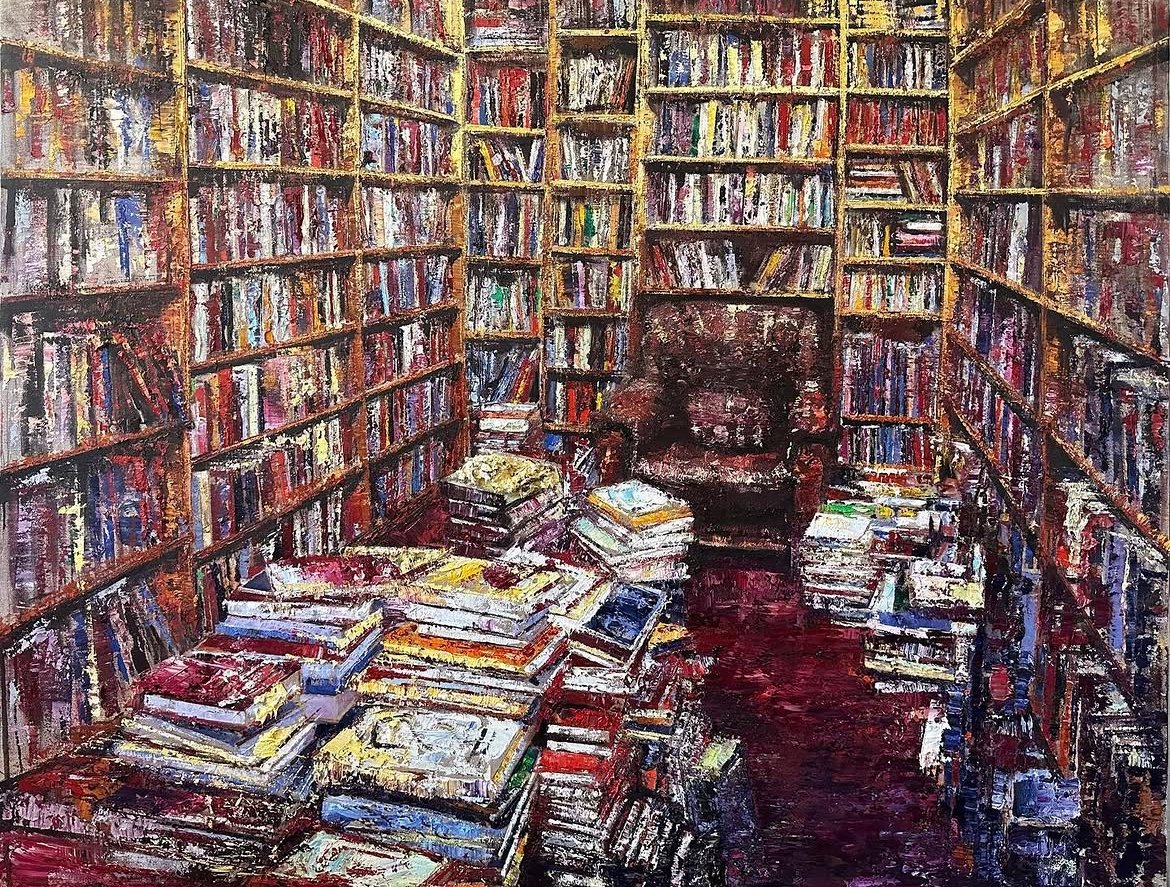
I remember with complete clarity, the peculiar sensation that accompanied our first meeting. His paintings did not ask to be seen. They did not seduce through monumentality or theatrical color. They were remarkably quiet. In the middle of all that visual noise, however, they possessed an almost magnetic silence, standing on the wall like an opening into another dimension, a portal through which the frantic rhythm of the fair seemed suddenly suspended. I found myself standing before one of his monumental libraries for far longer than I had intended.
At first glance I believed I was looking at shelves of books, but the longer I remained there, the less certain I became. The volumes dissolved beneath fluid brushstrokes, existing somewhere between representation and memory. They were recognizable, yet impossible to identify; tangible, yet strangely elusive. I caught myself wanting to reach towards the canvas, to pull one of those anonymous books from its shelf, to discover whether its pages contained philosophy, poetry, forgotten correspondence or centuries of accumulated silence. That impulse fascinated me.
Very few paintings tempt us to touch them not because of their material surface, but because of the fictional world they construct. Giannoni’s libraries do precisely that. They awaken an almost physical curiosity, inviting the viewer not merely to observe but to inhabit them. His canvases are not windows in the Renaissance sense, opening towards another reality; rather, they function as thresholds through which memory itself appears to become spatial.
It is not an easy confession for any artist. However, I felt a sudden envy for Massimo as an artist. We spend years cultivating our visual vocabulary, learning to trust the themes that repeatedly call us back to the studio. Doubt rarely arrives as dramatically as outsiders imagine; more often it emerges quietly, disguised as admiration. Yet there are exceptional moments when another artist’s vision is so profoundly convincing that it momentarily destabilises our own certainties. Such encounters are not crises of confidence but reminders that genuine originality still exists, and when we encounter it, we recognize it instinctively.
That was my experience with Massimo Giannoni. It was not his technical mastery alone that captivated me, remarkable though it undoubtedly is. Nor was it merely the seductive atmosphere of his interiors or the virtuosity with which oil paint becomes simultaneously material and memory. What I envied was something infinitely rarer: I envied the discovery, not the execution of an idea, the idea itself.
There are artists whose works we admire because of their extraordinary skill. There are others whom we respect because of their historical importance. And then, on exceedingly rare occasions, we encounter someone whose artistic choice appears so inevitable, so intellectually elegant and emotionally resonant, that we find ourselves wishing we had arrived there first.
Perhaps that is what artistic envy truly means. Not the desire to paint someone else’s paintings. But the impossible wish to have discovered their universe before they did.
Massimo Giannoni became, quite unexpectedly, the first painter to make me feel exactly that. And somehow, it feels entirely appropriate that he should be Italian.
After all, there are countries where art is taught, and there are countries where art seems almost to circulate through the bloodstream, passed from one generation to the next like an inherited language. Italy belongs unmistakably to the latter. From the Renaissance workshops of Florence to the quiet contemporary studios that continue to reinterpret centuries of visual tradition, its artistic history has never been merely preserved; it has remained astonishingly alive. Massimo Giannoni stands within that lineage, yet never beneath its shadow. His libraries are unmistakably contemporary, not because they reject history, but because they transform it into something emotionally immediate. Looking at them, I realized I was not simply standing before paintings of books. I was standing before paintings about civilisation itself.
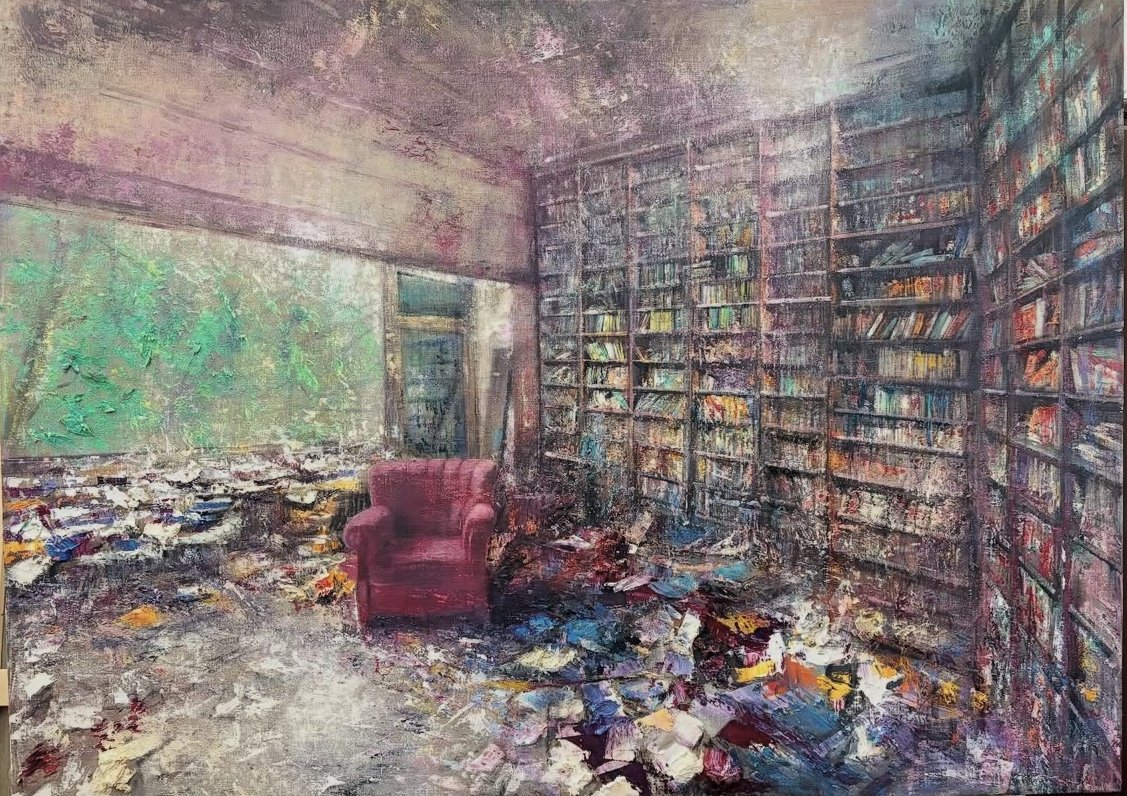
Massimo Giannoni was born in Empoli, near Florence, in 1954, a geographical detail that is far more significant than a simple biographical fact. Florence is not merely a city that produced great artists; it is a city where painting became a language through which an entire civilization learned to understand itself. To grow up in Tuscany is to inherit a visual vocabulary formed by centuries of dialogue between architecture, sculpture, perspective and light. Even those contemporary painters who consciously distance themselves from Renaissance traditions inevitably carry traces of that inheritance, not as imitation but as cultural memory.
Giannoni belongs to that lineage without ever appearing burdened by it.
His paintings neither romanticize the past nor reject it. Instead, they acknowledge history as something alive, something capable of continuous transformation. One senses that the great libraries he paints are not archaeological monuments but living organisms whose purpose remains profoundly contemporary. They are spaces where ideas continue to migrate across generations, where every newly opened book enters into conversation with those that have remained on the shelves for centuries.
His artistic career reflects precisely this dialogue between tradition and innovation. After studying at the Academy of Fine Arts in Florence, Giannoni developed a visual language that gradually moved away from conventional architectural representation towards increasingly atmospheric interiors. His works have since entered major private and public collections across Europe, North America and Asia, while exhibitions in Italy and abroad have established him as one of the most recognizable contemporary interpreters of architectural memory. Yet despite this international recognition, he remains, above all, a painter deeply committed to the discipline of painting itself. That commitment matters.
Standing before Giannoni’s canvases, I was reminded of something that is becoming increasingly rare: Oil paint still possesses the extraordinary ability to slow down thought.
There is a physical resistance inherent in painting that refuses acceleration. Every layer requires time. Every revision leaves traces. Every decision becomes sediment rather than instant correction. Unlike the infinitely reversible nature of digital images, oil painting preserves hesitation. It records uncertainty as faithfully as certainty, allowing the history of its own making to remain visible beneath the final surface. Perhaps this is why Giannoni’s libraries feel so convincing.
They are not simply images of places where knowledge is stored; they are themselves products of slow knowledge. Their making embodies the very intellectual virtues they depict: patience, repetition, concentration and sustained attention. These qualities have become unexpectedly radical.
We live in a culture increasingly governed by immediacy. Information arrives before questions have fully formed. Opinions circulate before reflection has begun. Images disappear almost as quickly as they are produced. Under such conditions, Giannoni’s paintings acquire an almost philosophical dimension. They refuse speed. They demand duration. They insist that certain experiences cannot be compressed without losing their meaning.
As I continued reflecting upon his work after leaving the fair, another thought gradually emerged.
Perhaps Giannoni is not painting libraries at all. Perhaps he is painting civilization’s confidence in its own continuity. Libraries have always represented far more than collections of books. Throughout history they have functioned as declarations of belief: belief that knowledge deserves preservation, that future generations will continue asking questions, and that ideas possess a value extending beyond the lifespan of those who first conceived them. From the Library of Alexandria to the monastic scriptoria of medieval Europe, from Ottoman manuscript collections to the great reading rooms of modern universities, every civilisation has measured its cultural ambition not only by what it created but by what it chose to remember. Giannoni paints that act of remembering.
As painters, we often search for images capable of carrying multiple meanings simultaneously. We hope that a single visual motif might eventually expand beyond itself, becoming metaphor rather than object. My own skies gradually transformed into reflections on peace, migration and the fragile possibility of coexistence. Giannoni’s libraries undergo a similar transformation. What begins as architecture slowly reveals itself as philosophy. What appears to be furniture becomes memory. What resembles documentation ultimately becomes meditation.
And that is precisely where admiration quietly gave way to envy.
Not because I wished to exchange my artistic language for his, nor because I imagined his paintings to be more beautiful than mine.
Artists do not envy beauty. Beauty is subjective, historically unstable and endlessly abundant. What artists envy is discovery, discovery of an idea.
Every original body of work begins with an act of recognition so deceptively simple that, once realized, it appears almost inevitable. We look at it and immediately wonder why no one had seen it before. The greatest artistic ideas possess that paradoxical quality: they surprise us only until the moment we encounter them, after which they feel as though they had always existed, patiently waiting for someone to uncover them.
Giannoni’s libraries belong unmistakably to that category.
For the first time in my professional life, I found myself confronting another artist’s work with an emotion I had rarely allowed myself to acknowledge. It was not competitive. It contained neither resentment nor frustration. Instead, it resembled gratitude accompanied by a faint, almost playful melancholy.
The thought was disarmingly simple. ‘I wish I had thought of that.’
Perhaps artistic jealousy has been misunderstood for centuries.
Outside the creative world it is often interpreted as insecurity or rivalry. Within the studio, however, it can assume an entirely different form. It becomes an act of recognition, a silent admission that another artist has given visual form to an idea of extraordinary clarity. The envy is directed neither towards fame nor success, but towards the privilege of having arrived first.
There are many painters whose technical brilliance I admire. There are others whose courage has expanded my understanding of what contemporary art can become. Massimo Giannoni occupies a different place altogether. He reminded me that the rarest achievement in art is not virtuosity. It is finding a universe that no one else had quite seen in the same way before.
For sure, many other artists have painted libraries, but in the art world, there is only one artist that idea belong to and he is gifted to handle that idea in the best artistic way possible. This is why that artist and his paintings shine bright among all the equivalents of its.
As a painter, I found myself lingering over Giannoni’s treatment of light. Unlike the dramatic theatrical illumination of Caravaggio or the crystalline luminosity of the Venetian masters, Giannoni’s light appears to originate from memory itself. It does not enter through identifiable windows; it seems to emerge slowly from within the architecture, as though centuries of reading had permanently altered the atmosphere of the rooms. It is a patient light, one that has forgotten urgency. Instead of revealing objects, it allows them to breathe. Perhaps that explains why his libraries never feel nostalgic. Nostalgia looks backwards. Giannoni’s paintings do something considerably more sophisticated. They suspend time altogether.
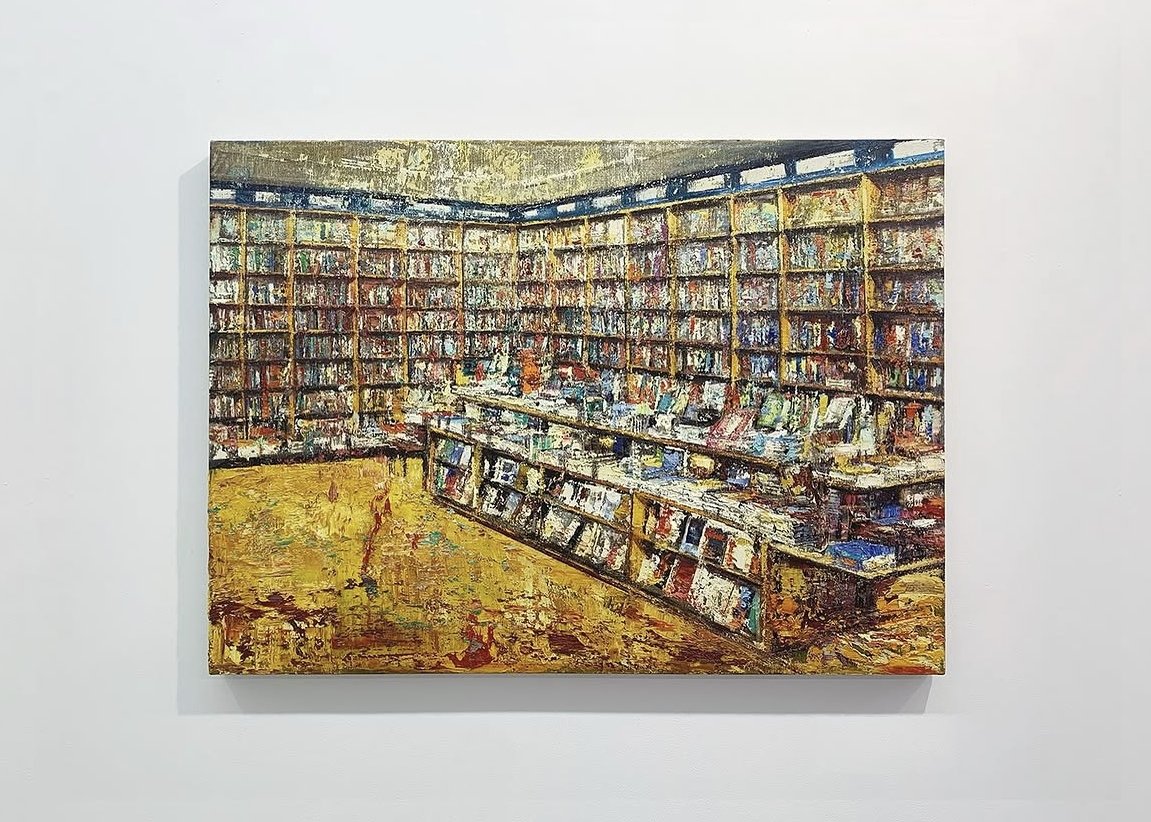
They remind us that genuine knowledge exists outside chronological urgency. A manuscript written five hundred years ago remains capable of transforming a contemporary reader. Plato converses effortlessly with Umberto Eco. Dante occupies the same shelf as Borges. Civilizations separated by centuries coexist within a single architectural organism. In this sense, the library becomes not a historical monument but the most democratic space ever imagined, where time itself loses authority.
This temporal suspension inevitably recalls Jorge Luis Borges and his Library of Babel, that infinite universe composed entirely of books in which every possible text already exists, waiting only to be discovered. Yet Giannoni’s vision differs in one fundamental respect. Borges explored the terrifying infinity of information. Giannoni paints the serenity of knowledge. His libraries do not overwhelm; they console. They remind us that wisdom is accumulated patiently, through generations of quiet labor, rather than through the frantic acceleration with which contemporary culture consumes information.
We inhabit an age in which knowledge has become increasingly detached from place. Libraries now fit inside our pockets. Entire museums can be visited through a screen, archives searched within seconds and philosophical traditions summarized by algorithms before one has even encountered the original texts. Accessibility has expanded beyond anything previous generations could have imagined, yet our relationship with knowledge has simultaneously become strangely weightless.
Giannoni quietly resists that condition. His paintings restore gravity to knowledge.
Standing before one of his monumental canvases, one becomes acutely aware that ideas possess architecture, that culture requires physical spaces in which silence may survive and that civilization is not sustained by the speed with which information travels but by the patience with which it is preserved.
It was somewhere within these reflections that my initial admiration gradually transformed into something else. I realized that I was no longer analyzing his paintings solely as an art historian or even as a fellow painter. I was beginning to question my own practice.
What does it mean to choose a subject that one can continue exploring for decades without exhausting it?
How does an artist discover an image capable of containing an entire philosophy?
Why do certain motifs remain inexhaustible while others lose their vitality after only a few variations?
Every serious painter eventually confronts these questions.
Most of us spend years searching for our visual language. We experiment, abandon, return, refine and begin again, hoping that somewhere beneath all those attempts lies an image that will continue speaking to us throughout a lifetime. Very few artists are fortunate enough to find such a subject.
Looking at Giannoni’s libraries, I could not escape the feeling that he had. Perhaps that is where this reflection must come to rest. Not with a definitive conclusion, but with a quiet acknowledgment.
Some encounters in art do not demand resolution; they simply remain with us, altering the way we look, think and remember. Giannoni’s paintings belong to that category. They do not insist on interpretation, nor do they seek to persuade. Instead, they linger like the silence of a library after the last reader has left inviting us to return, again and again, to the slow unfolding of meaning.
After all my deep insight and close look at this contemporary living artist, I thought my envy would diminish, however I realize it is still there besides an increasing admiration and desire to own one of his libraries on my own library’s wall.