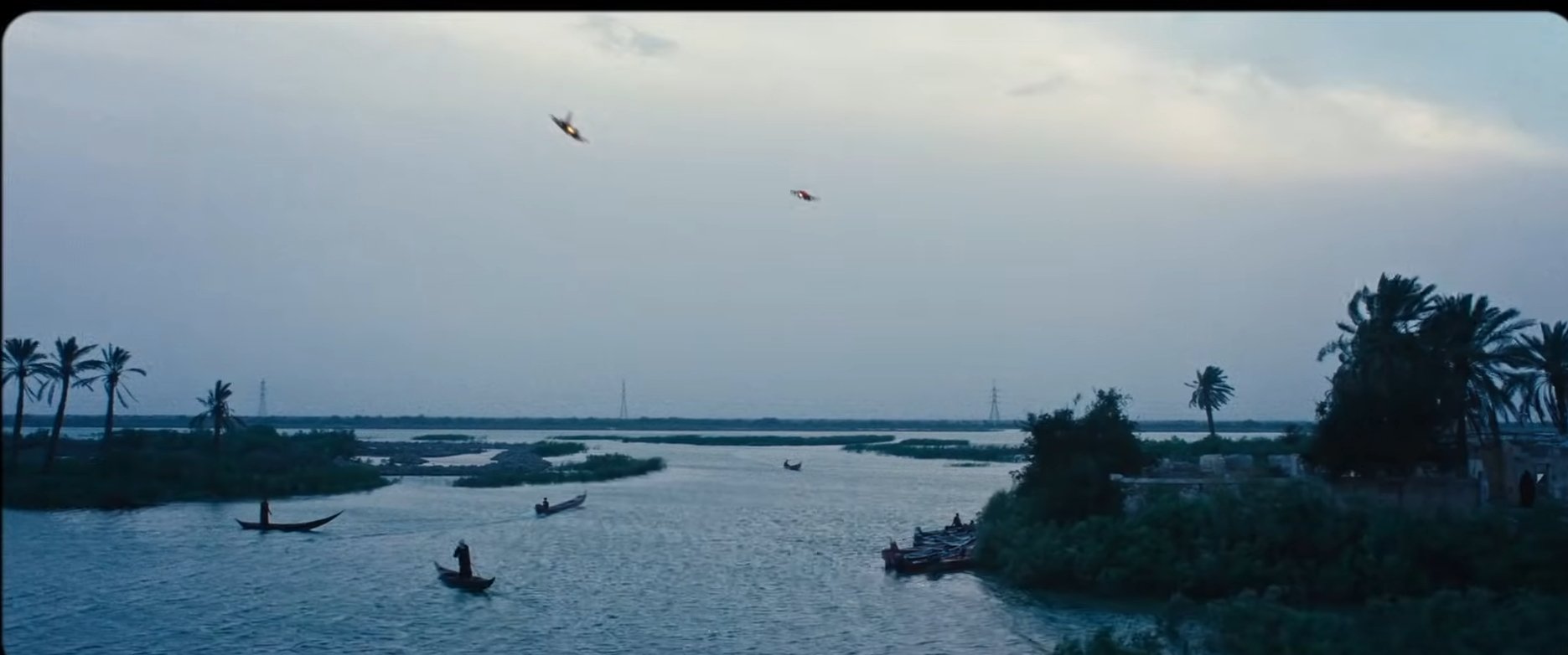
Hasan Hadi’s "The President’s Cake" opens with the most beautiful scenery of a village on the water at dusk. A grandmother and granddaughter are in a paddle boat, the water is blue-black, the sky blue-red and the image has a grainy quality that reminds me of analogue photographs of my childhood. The grandmother is telling the story of "Gilgamesh" to the granddaughter, reminding the viewer that these are waters where the first stories were told and Iraqis will continue to pass on this tradition of storytelling. The film has already won the Best Film Award at the Bosphorus Film Festival and is on its way to acquire a few more prizes.
Despite the fact that it is a film set in wartime the beauty of the natural landscape is mesmerizing and it dawns on me that I am watching a film about the Iraq War, made by Iraqis, about Iraqis, for the first time. I want to erase all the images of Iraq I’ve seen through the barrel of American guns in the last couple of decades. I want to erase all the words I’ve read about Iraq by "international" experts – not least Rory Stewart who made a career out of "governing the marsh Arabs."
When I ask the director Hasan Hadi in the press conference at Doha Film Festival what his connection to the marshlands is, he says that the marshes are ingrained in the identity of the Iraqis and that when he first visited as a child, he had thought it was paradise. He added that Saddam hated the marshes and poured salt into the waters and finally drained them out to cut off the livelihood of the villagers.
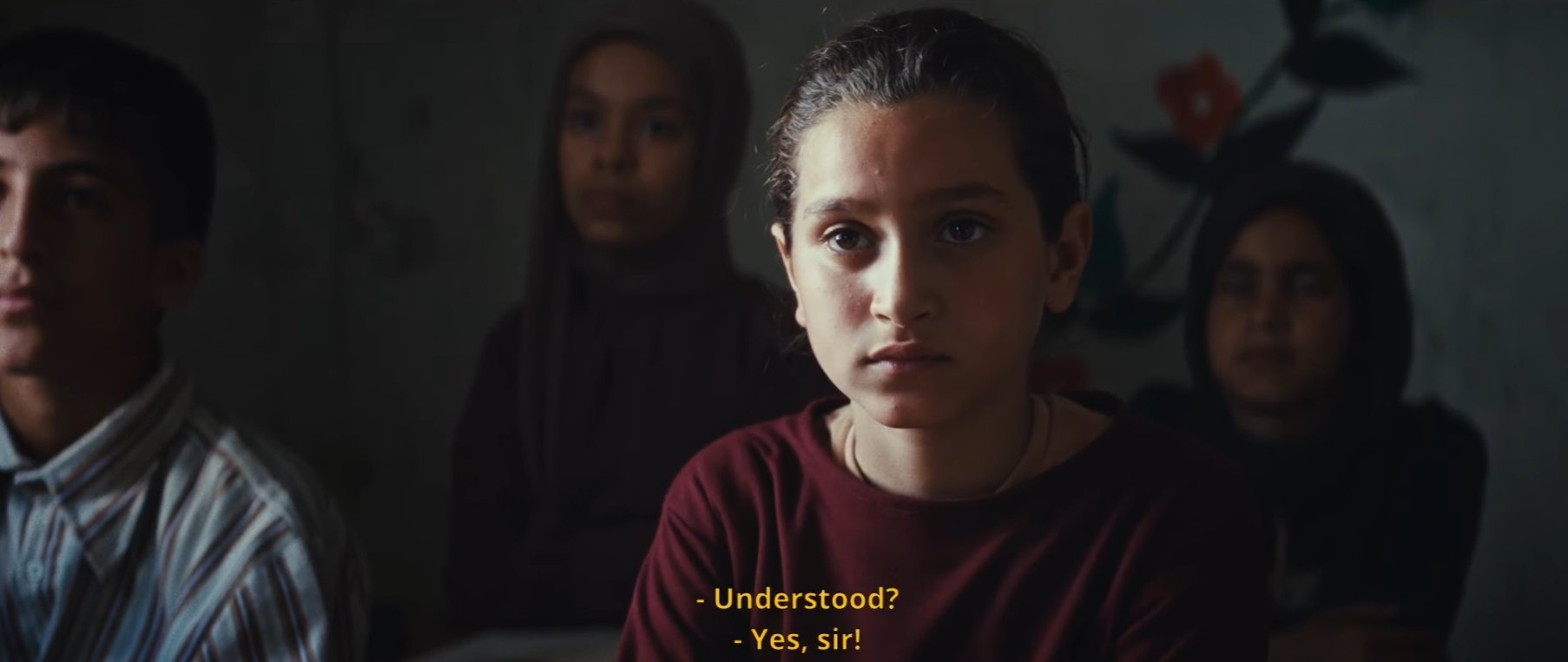
The film follows the fortunes of Lamia and her grandmother, who are part of this marsh community, trying to eke out a living in Saddam’s sanction-ridden Iraq. Saddam’s birthday is approaching and every classroom in the country has to make a cake and bring drinks to celebrate. The job of providing these items for the party is dished out among the students through lottery. Lamia’s fears are realized when her teacher, who has just stolen her apple while she was out playing, calls out her name. The moment when the teacher steals Lamia’s apple is the start of a series of small (and bigger) crimes the audience will witness as our heroine goes on a mission of trying to procure the ingredients for her cake.
When Lamia tells her grandmother that she is the unlucky student who will have to make the cake, the grandmother starts packing a few things to sell at the market in town. When they manage to hitchhike and get to the market, the grandmother with the bric-a-brac and Lamia holding their rooster under her arm, the grandmother starts bartering for a school uniform. The audience, having seen how frugally they live, instantly understands there is something fishy going on. And when granny takes Lamia to a restaurant rather than to the shops to collect the items for the cake, we learn that the grandmother has what she believes to be "sensible" plans for Lamia.
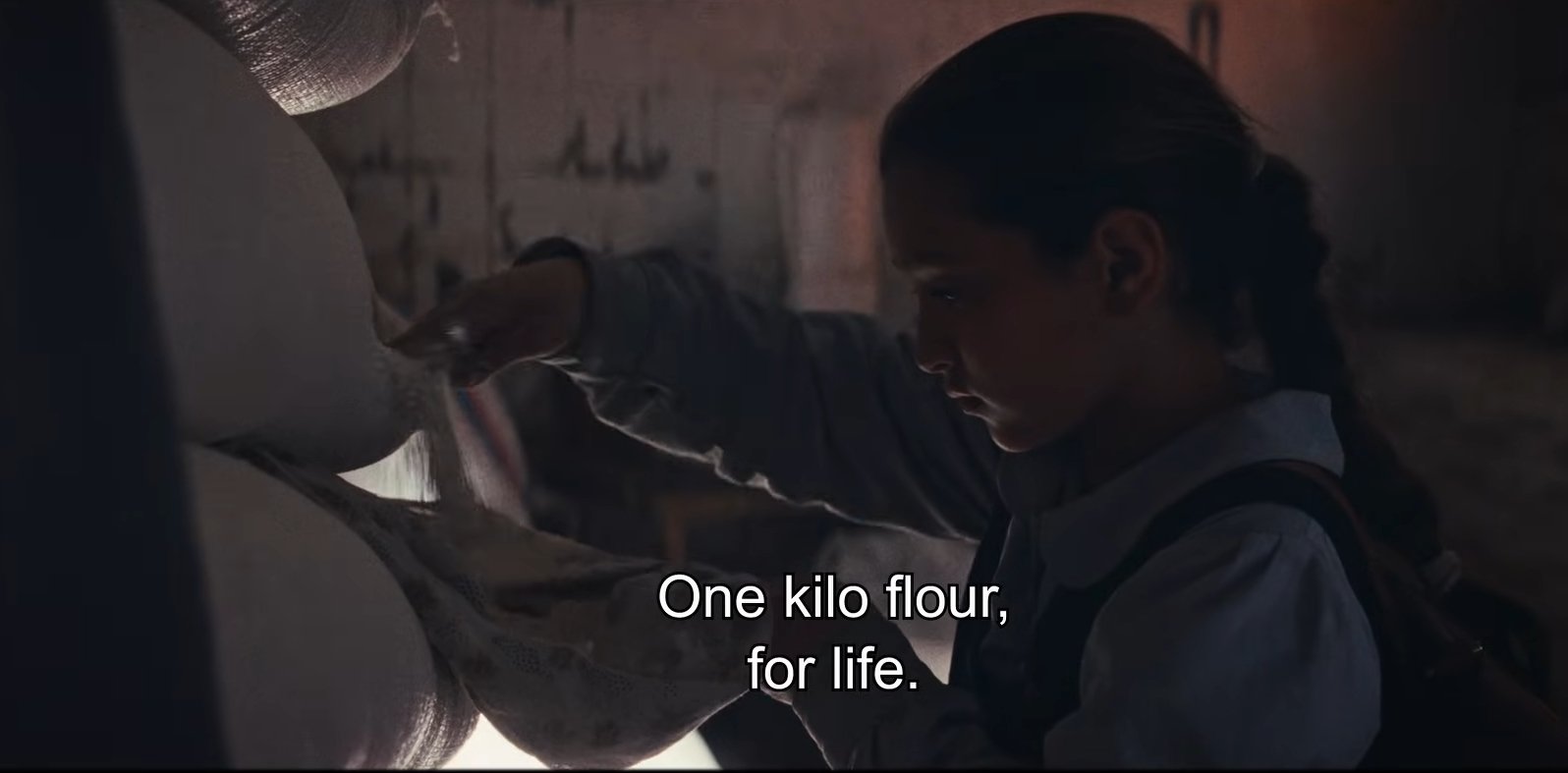
But Lamia, played wonderfully by Baneen Ahmad Nayyef, does not like these plans and is convinced she can escape them if she can manage to get together the ingredients for the cake. She abandons her much perturbed grandmother to go look for sugar, flour and egg, and in the process, joins forces with her classmate, with her rooster keeping them company. The following is a veritable odyssey in the old market. The two children encounter acts of deception against them or others in all the shops they visit, revealing how corruption at the top trickles down to lower levels of society. However, this atmosphere of corruption is countered by the bond between Lamia and Saeed, who are determined to get the ingredients. Though corruption may be the modus operandum now, Hadi soothes us with beautiful photography of these caravanserais and old antique shops. The beauty of what the Iraqi people have created through the centuries persists and Hadi makes us believe that these beautiful spaces will be in their rightful glory when better people govern the country.
One force for good in the film is the gentleman who helps grandma as she is looking for Lamia. He, in fact, is the man who stopped for them when they were hitchhiking to town. He appears again, like Hidhr, when grandma goes to the police station to tell them to look for her granddaughter. His is a much-needed figure for the audience to not lose hope in the goodness of people.
Nayyef carries the weight of the film on her shoulders, naughty, sad, devastated as the scene may require. It is pure joy to see her in the press briefing, a happy Iraqi girl, whose favourite thing about making the film was to hang out with the actor who played her friend and the rooster. She seems not to have been interested in the history they were reenacting, which also warms my heart for a generation of Iraqi children who grow up unburdened by this dark history. For they must have double the happiness and joy, robbed from Iraqi children by Saddam and the U.S. for a decade.
Hadi said that it was important for him to tell the story of these children who were expendable for the West and reminded us of the following conversation that Madeleine Albright had with a journalist:
“We have heard that half a million children have died. I mean, that is more children than died in Hiroshima, is the price worth it?”
“I think that is a very hard choice, but the price, we think, the price is worth it.”
Hadi’s film reminds us that each of those children who were "worth the kill" had beautiful lives even under dire circumstances. Children like Lamia, who seem to remain collateral for the West’s political goals, are our sisters and daughters, indeed, our younger selves in the nonwhite nations of the world. As such, "The President’s Cake" is an unmissable film that commemorates the beautiful children of Iraq, and tells the story of a beautiful land through the eyes of its own people.