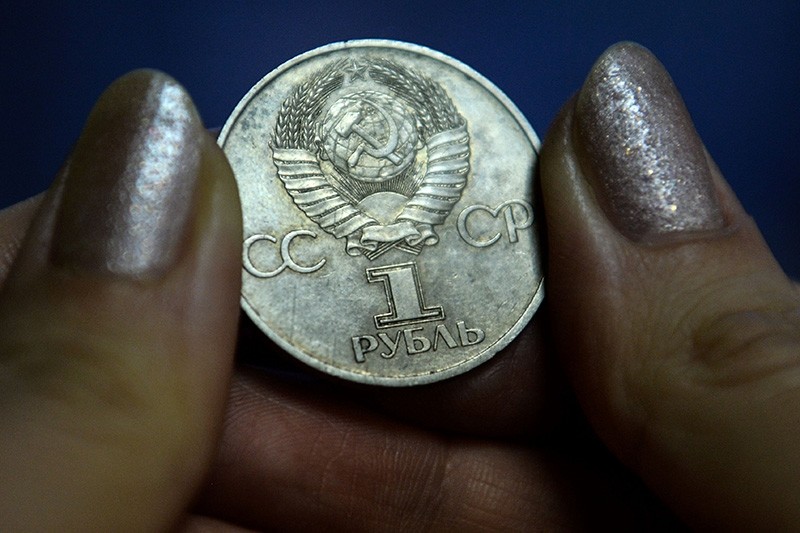
A quarter of a century after the fall of the Soviet Union, Russia is finally set to pay off all the foreign debt it inherited from the vanished Communist empire.
Keen to establish a reputation of a reliable borrower -- despite Western financial sanctions over the Ukraine conflict -- Moscow announced last week it would pay off $125.2 million in Soviet-era debt to Bosnia-Herzegovina within 45 days.
Bosnia's finance ministry said the deal signed Tuesday in Moscow will make Bosnia the only ex-Yugoslav republic to collect the debt in cash. The full amount is expected to be transferred by the end of May, but the timing depends on how speedily the Bosnian parliament ratifies the deal.
In 2003, Russia took over the responsibility for the Soviet Union's debt to the former Yugoslavia estimated at $1.3 billion. Moscow has cleared the portions of debt claimed by other Yugoslav successor states, repaying them in goods and services.
The payment "completes the settlement of the external public debt of the former USSR, which is a historic event," said Russia's deputy finance minister Sergei Storchak.
In February, Moscow paid $60.6 million to Macedonia.
After the Soviet Union's collapse in 1991, Russia assumed responsibility for its foreign debt of some $70 billion.
Paying for perestroika
This was mostly contracted during the difficult perestroika era from 1985 to 1991, a time of failed attempts to reform the USSR's dysfunctional political and economic system.
This commitment proved a painful burden in the 1990s as Russia faced catastrophic economic problems that culminated in a humiliating default on its foreign debt in 1998.
But in 2006 -- thanks to a steady influx of petrodollars since the early 2000s -- Russia was able to pay off its debts to 17 major creditor-countries in the so-called Paris Club.
A payment of more than $20 billion -- or 95 percent of the value of all Soviet-era loans -- was made eight years after the 1998 default.
Russia has also allowed itself the luxury of cancelling some country's debts, with Cuba the latest in 2014.
The remaining debt chiefly consisted of "commercial" debts that resulted from the imports of goods to the Soviet Union from ally countries.
Such debts were formed "in a strange way," Anatoly Aksakov, head of the parliament's economic market committee, told RIA Novosti state news agency.
He questioned how such countries turned out to be creditors of the Soviet Union even though it was "a very rich country".
A faultless borrower
In the case of the former Yugoslavia -- which the USSR provided with military equipment in exchange for consumer goods -- Russia faced the tricky task of dividing up the debt among the countries that emerged from its breakup.
"It is politically important: Russia has paid off the USSR's debt to a country that no longer exists," said Yuri Yudenkov, a professor at the Russian University of Economics and Public Administration.
"This is very important in terms of reputation: the ability to repay on time, the responsibility," he told AFP.
Yudenkov contrasted this with Kiev which has refused to repay a $3-billion loan Moscow gave the pro-Russian government of former president Viktor Yanukovych before he was ousted from power in 2014.
The relatively modest payments to Macedonia and Bosnia have helped Russia to cultivate the image of a faultless borrower as Western economic sanctions dissuade foreign investors.
Many analysts had warned that the sanctions imposed over Russia's actions in Ukraine could deplete the country's finances.
But the Kremlin has so far managed to maintain financial stability despite also being hit hard by the slump in oil prices.
Thanks to drastic cuts in public spending, Russia's budget deficit remained under control at just 3.6 percent of GDP last year -- and salaries, pensions, and social benefits continue to be paid out in the public sector.
The public debt stands at less than 15 percent of GDP -- much lower than in most Western countries.
After a few months of turbulence following the imposition of sanctions, Russia has successfully returned to the international financial market.
While rating agencies initially downgraded the country's outlook, they now show an increasing optimism about Russia's economic prospects.