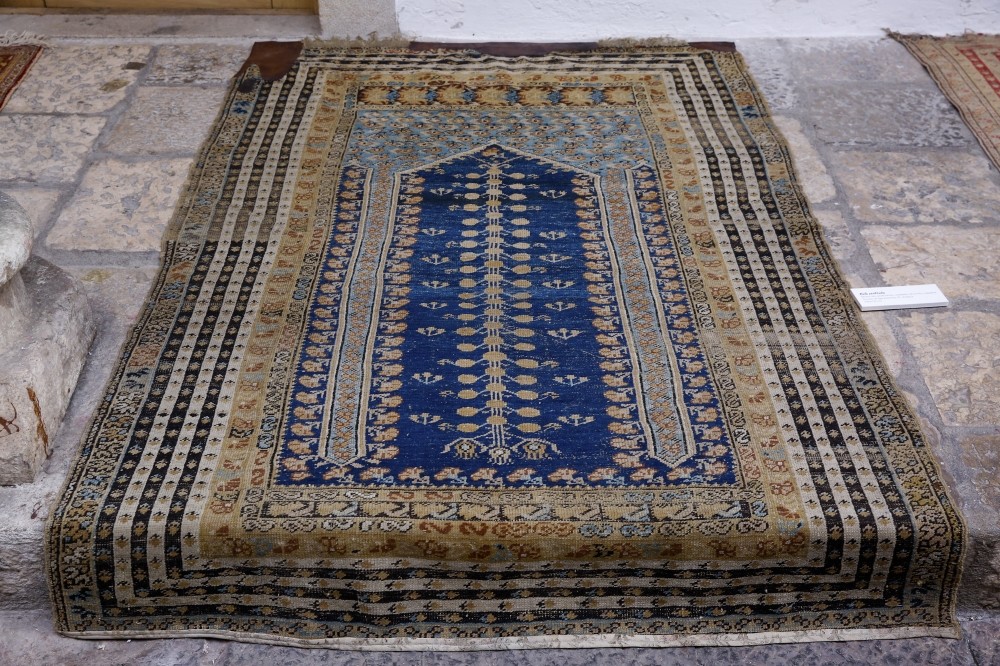
Prayer rugs in Sarajevo mosques, most of which date back to Ottoman era in the 18th and 19th centuries, have been collected for an exhibition, which drew great attention with their colorful patterns and craftsmanship
Centuries-old colorful, ornamented prayer rugs and carpets that were used in mosques in Sarajevo in the 18th and 19th centuries have been brought together in a unique collection. A selection of these antique prayer rugs and carpets, which decorate 40 Sarajevo mosques, was recently on display for the people of Sarajevo at the Gazi Husrev-beg Mosque. The prayer rugs, which shed light on the history of the region, attracted a great deal of attention due to their colors, motifs and craftsmanship.
This collection of prayer rugs was put together by monthly magazine Islamic Arts Editor-in-Chief Kenan Surkovic and Haris Dervisevic from the University of Sarajevo's Department of Art History. The duo, who are very impressed by the stories behind these prayer rugs, collected rugs and carpets from 40 mosques.
The oldest prayer rug in the collection dates back to the 18th century. Although this blue rug was destroyed in a fire that broke out in Sarajevo, it was mended with leather later on.
Speaking to Anadolu Agency (AA), Dervisevic said that even he could not believe how many unique prayer rugs and carpets could be found in these mosques before devoting himself to the collection. Stating that they were very reluctant to open an exhibition in the first place as they had heard rumors about how Sarajevo mosques lost their ancient rugs and carpets, Dervisevic said: "We visited 40 mosques around Sarajevo. The sights we came across in the mosques were breathtaking. We managed to put together a collection of 40 different prayer rugs and carpets in the end."
Dervisevic claimed that it took a long time to determine which rug belonged to which period. He said that the study of the rug and carpet history of Sarajevo is very new, and it is hard to find many experts interested in the subject.
As Dervisevic and Surkovic were unable to study the rugs and carpets due to the lack of experts in Bosnia and Herzegovina, they consulted Albert Boralevi, one of the most important rug and carpet experts in the world, and emailed the Italian expert pictures of the rugs that they had discovered. Boralevi examined the photographs and pointed out the historic importance of these and encouraged them to continue their investigation. They consulted museum catalogues from around the world to pinpoint the origins of the rugs. Instead of conducting chemical analyses, they identified the rugs via their motifs and colors.
Dervisevic said they discovered that all the prayer rugs and carpets in Sarajevo mosques were brought from western Anatolia and said: "We believe that there was a great demand for prayer rugs in Sarajevo during Ottoman rule in Bosnia. People, whether officials of the mosques or whether they shopped from the same stores or just the ordinary people of Sarajevo, purchased these rugs during their visit to Istanbul, the capital city of the Ottoman Empire. All these prayer rugs and carpets are very valuable and artistic."
Dervisevic indicated that all the prayer rugs and carpets in the collection were woven using the same technique with silk and wool and that red, green, yellow and blue are the most recurrent colors.
The oldest prayer rug in the collection dates back to the 18th century. Although this rug was destroyed in a fire that broke out in Sarajevo, it was mended with leather later on. The most interesting thing about this blue rug is that a similar prayer rug is displayed in the Victoria Albert Museum in London. "These are very important, valuable artworks. We are protecting them. Each one is unique and meaningful," added Dervisevic. He pointed out that there is an old tradition concerning prayer rugs in Bosnia and Herzegovina and said: "When a family member passes away, the prayer rug that he or she prayed on is donated to the mosque. However, this tradition started to fade away after prayer rugs began to be woven by machines. Family prayer rugs were usually donated to mosques near the neighborhood where they lived. As the years passed, young people conducted their Eid prayers on rugs that their grandfathers and fathers once used."
Dervisevic said that the prayer rugs featured in the collection are much bigger than prayer rugs that Muslims use today since these rugs were suitable for more than two or three people to pray and that they plan to establish a museum focusing on Islamic art. He added: "Prayer rugs and carpets in mosques are objects that seem of lesser value. They are the easiest objects to be replaced once they are worn out. However, these prayer rugs are some of the most important pieces of Islamic art."
The exhibition, part of a celebration of Prophet Muhammad's birthday, ends today. Following the exhibition, all the rugs and carpets borrowed from the mosques of Sarajevo will be returned.
Keep up to date with what’s happening in Turkey,
it’s region and the world.
You can unsubscribe at any time. By signing up you are agreeing to our Terms of Use and Privacy Policy.
This site is protected by reCAPTCHA and the Google Privacy Policy and Terms of Service apply.