
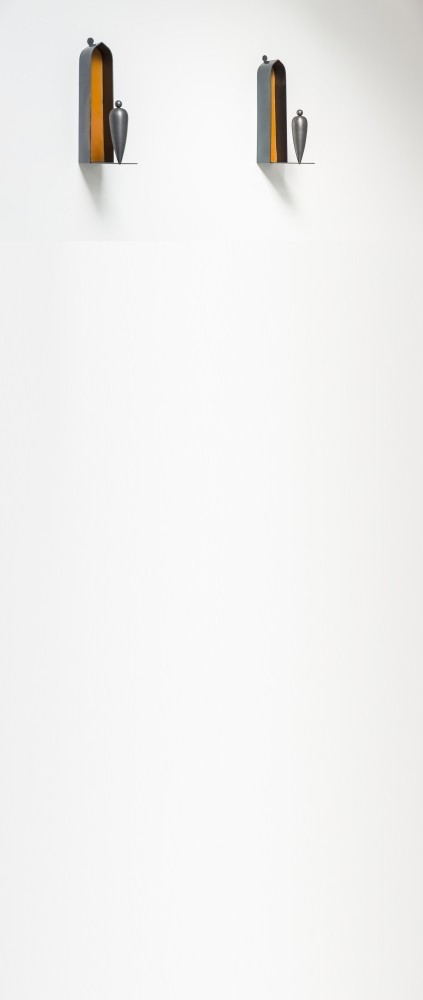
Osman Dinç is one of Turkey's leading sculptors and his new show at Pi Artworks reminds us why. "Beeswax is the Elbow Grease of Bees" is a captivating exhibition and Dinç's meticulously produced sculptures, and the attention and care that went into their making is inspiring. Dinç filled pods with beeswax in an attempt to make his viewers ask questions about the utility, labor and function of art.
"The reason I named this show 'Beeswax is the Elbow Grease of Bees' is to show how I see labor as a sacred thing," he says in a video exhibited in the show. "Once labor was like religion and it had its own theology; but in this age of the economy of commerce, labor has been left in the background."
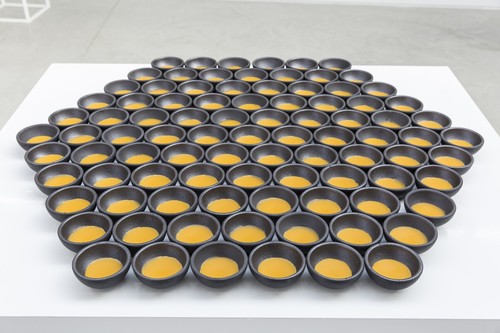
"Beeswax is the Elbow Grease of Bees," 2017
Steel, aluminum, beeswax
115x130 cm.
Dinç wants to revitalize and celebrate traditional forms of labor. If he had lived in the last two decades of the 19th century, he could be a member of the Arts and Crafts movement with his interest in reviving traditional handicrafts and beautifying ordinary objects from domestic life.
"The installation 'Elbow Grease of Bee,' composed of 100 aluminum pods filled with beeswax, challenges the audience with a strong fictional narration," the exhibition text reads. "Other works part of the show, related to the sources of nature, such as sculptures' arrangements made of steel boats, water-trapped steel cuddles and water clocks, change form and turn into ideas. These views, supported by the language of the materials used, are the basis of the story, telling the way the world works. The artist invites the viewers' self-awakening with everyday objects of our collective memory."
If, as the curators contend, all the pieces in this exhibition have their own story and conduct a "flawless and unexpected dialogue between them," can there be something Proustian in the way Dinç approaches objects and memory?
"Maybe by coincidence there is a Proustian parallel there," Dinç said. "For me, creating art is producing free compositions of accumulated memories and forgotten moments. And the artist automatically connects others while developing her own questions. Because memories are both private and public."
For a long time, Dinç had a habit of working with different materials.
"In the beginning, the reason for that was mostly financial," he said in an interview last week. "But in time, I realized that using different materials in fact brings new potential to my work. They make it richer. The stories and history of the materials themselves add new layers to my works. My new exhibition continues that dialogue."
"Naturally I am interested in bees," he said. "In the past, my father worked as a beekeeper."
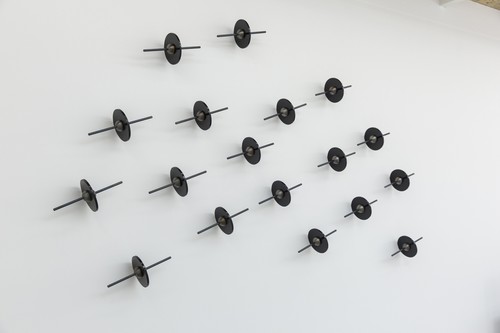
"Araç," 2013
Aluminum, steel.
"In my first works, I used soft stones and carved them so that bees could drink water from them. I placed those next to beehives. Here, the expression 'Beeswax is the Elbow Grease of Bees' refers to labor. Bees make wax from their own sweat and they even build their homes with that. This reminds me of a person who builds their own house with their sweat," he added.
Dinç does not only admire bees but he also feels like a bee.
"As an artist producing his own work, I feel very close to bees," he said. "I used the same theme in the 1980s and produced many works that interrogated the subject of labor and productivity. And by the way, wax is among the most crucial materials of the art of sculpture. It is used in bronze sculptures. For 4,000 years, paintings that are a mixture of wax and pigment had been produced, just like in the ancient Egyptian civilization."
Born in 1948, the Ankara Art Foundation named Dinç the Sculptor of the Year in 2002, and he won the UNESCO Sculptor of the Year in 1993.
"Dinç grew up in rural Turkey at a time when he recalls there being a greater symbiosis between man and nature," according to the gallery catalogue. "His childhood was mostly spent outdoors. This period had a significant effect on his work, as can be seen in the recurring primary forms he creates. Even when they are at their most abstract form, Dinç's sculptures represent his family's tools in his youth to tend the fields of their farm."
His works are in the collections of Centre d'art Contemporain in Amilly and at the Municipality of Paris. Recently Dinç had exhibitions at Bozlu Art Project in Istanbul, CerModern in Ankara, Maison d'art Contemporain Chailloux in Fresnes and Pi Artworks London.
"Osman Dinç creates sculptures from steel and glass that sit at the crossroads between Minimalism and Arte Povera," the curators at Pi Artworks write. "His output alternates between arresting, freestanding, edifices for public spaces, to small sculptures that subtly animate walls. Dinç works predominantly with steel, which he transforms from rigid sheets of primary material into polished, often rhythmic forms with soft, playful, undulating curves. This is primarily guided by his principle interest in creating work with the least possible intervention to his raw material as possible. Dinç minimizes waste and refrains from obscuring the raw material's inherent sense of weight and density. Upon completion, the work is usually treated with nothing more than protective layers of epoxy resin, thus retaining its natural earthy colors."
Dinç also curated the show.
"Friends from the gallery helped me with it," he said. "It is like a dowry show and all the space is used. A long time ago, where I lived, young girls would exhibit all the objects and embroideries they had so far produced. I remembered that tradition while curating this show. As an artist who constantly produces new works, my pieces often resemble pieces of a puzzle. Their relationship is at times conceptual, and sometimes formal. When quite different artistic series are hung on the wall, viewers produce their own relationships with them and this way the artwork is complete through the thinking process of the viewer."


