The light that stretches across a boulevard does more than leave behind a historical view. It quietly announces the fate of modern humanity: What accelerates is erased, what remains still becomes visible.
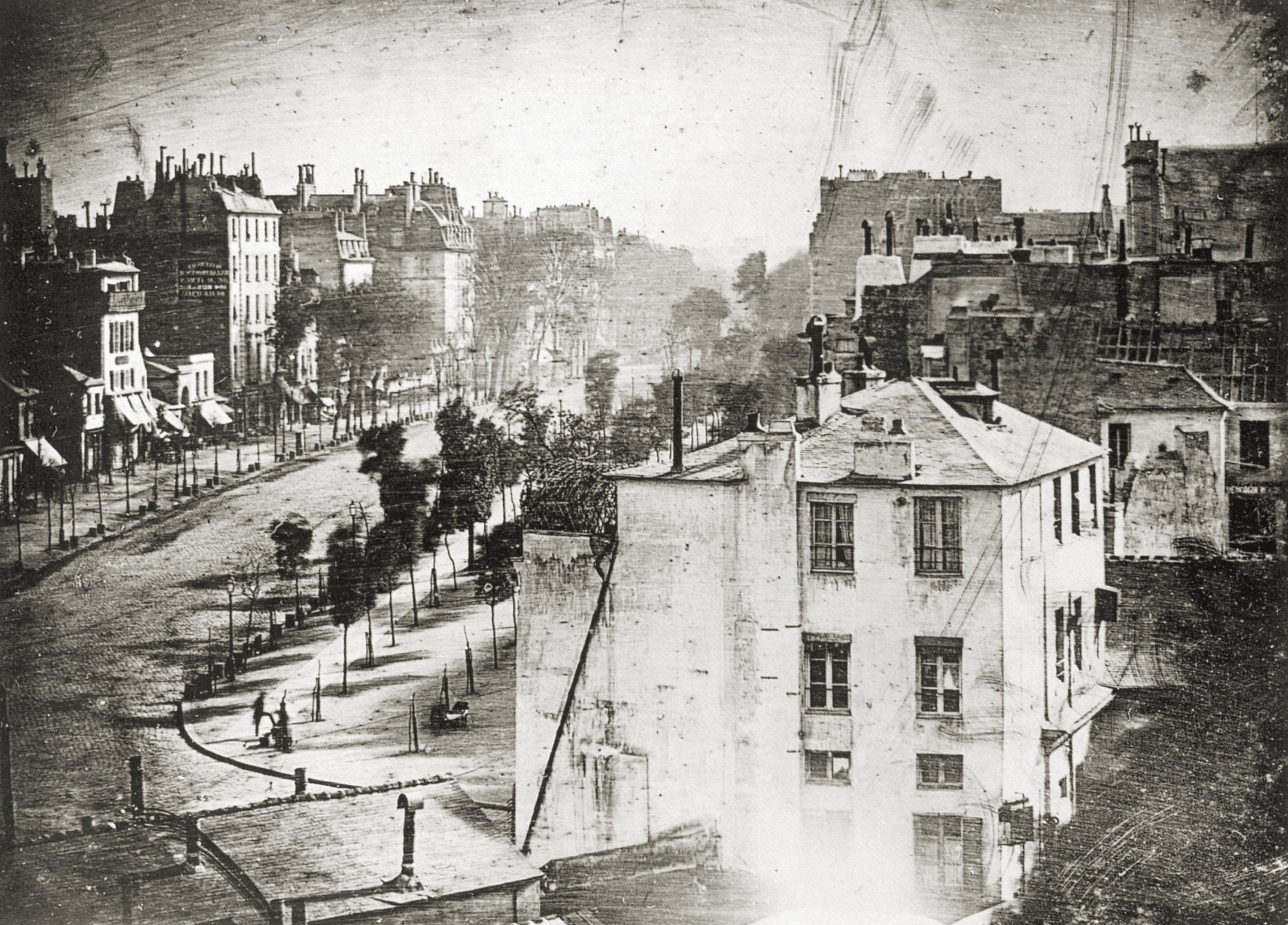
The daguerreotype that Louis-Jacques-Mande Daguerre captured from a vantage point overlooking the Boulevard du Temple is not merely an early example in the history of photography. It is one of the first thresholds at which photography began to recognize itself. It is not yet “art,” nor is it fully a “document.” Rather, it is a fragile yet ambitious negotiation between chemistry and light. A metal plate is rendered sensitive by iodine vapor; light falls upon its surface and leaves a trace for long minutes. This technical necessity determines photography’s destiny. It erases what moves and sanctifies what remains still. Thus, the city stays, and the human disappears.
At the time, the Boulevard du Temple was one of Paris’s liveliest and most crowded streets. Theaters, shops, horse-drawn carriages, pedestrians, the pulse of life beat there. Yet when we look at the photograph, we see that nearly all of this life has vanished. The modern city cannot yet keep pace with photography’s slowness. Long exposure punishes movement; only what is sufficiently slow becomes visible.
For this reason, the two silhouettes that appear in the lower corner of the image – a man having his shoes shined and the shoeshiner bent before him – are not incidental but almost philosophical selections. A human being enters history only by stopping.
This image raises the question of the “first human” in photographic history. These figures are not portraits; their identities are unknown, their faces indistinct. Yet it is precisely this anonymity that makes them universal. Here, the human is not a subject but a technical byproduct. Photography does not aim for the human; it captures them by mistake. And this mistake becomes one of the most powerful metaphors of the modern age: as technology advances, the human becomes invisible.
The height of the frame is no coincidence. Daguerre’s gaze does not come from the street but from above. This is not the perspective of the individual but of order itself. The avenue is wide; the trees are aligned; the buildings are disciplined. Although Haussmann’s massive urban renovations have not yet begun, their mental infrastructure is already in place. The city begins to shift from a lived space to one that is seen, planned and controlled. Photography stands as the silent witness to this transformation.
The burst of whiteness at the center of the image, the light that obliterates detail and strains the eye, is not merely a technical overexposure. It also functions as a metaphor for modernity itself: a light that sets out claiming to reveal everything ultimately destroys detail. At the center of the photograph, meaning burns away; around it, time darkens. This is why the image is neither fully clear nor fully obscured. It carries an uncertainty, much like the era being born.
The scratches, stains and abrasions on the surface tell the story of the photograph’s second life. These marks do not belong to the moment of exposure but to what the image has endured. The daguerreotype is singular, irreproducible and fragile. Over time, it darkens, scratches and suffers damage. In this way, the photograph records not only a moment but also its own aging. The Boulevard du Temple thus becomes a double-layered memory: it shows both 19th-century Paris and how a photographic object withstands time.
For this reason, what we see in this image is not so much a “first” as a threshold, between image and document, art and science, human and city. Photography here does not yet pass judgment; it merely records. But this record is not innocent. The decision of what is preserved and what is erased is made by the technique itself. And technique is not neutral.
The photograph of the Boulevard du Temple whispers this truth to us: the modern world first promises visibility, then makes visibility selective. If you accelerate, you disappear; if you stop, you become visible. The human condition captured in this first photograph remains valid amid today’s crowds. Cities may have grown, cameras may have accelerated, exposures may have shortened, but the fundamental question has not changed: Who is seen and who is erased?
Perhaps this is why the photograph still speaks. Because that boulevard still stretches onward, not only in Paris, but within the modern mind itself.