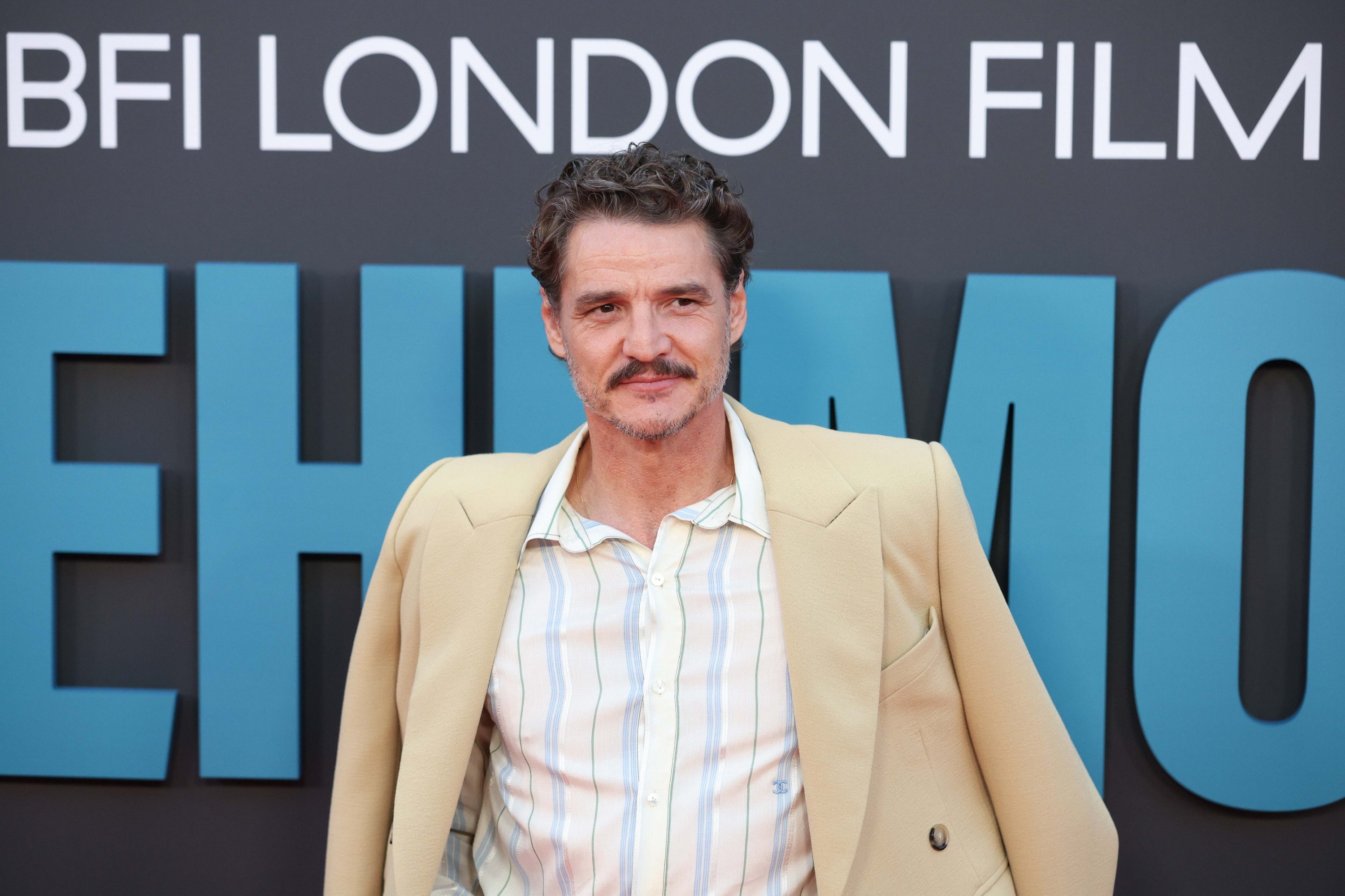
One of my favorite films at the London Film Festival this year was Tony Gilroy’s "Behemoth!" which follows the love life and career of a cellist played by Pedro Pascal. The film opens with a chase scene where Pascal’s character Alex is running away from an ex-lover (played by Olivia Wilde) with music and pacing that can rival any Jason Bourne film. Yes, Gilroy has written the script for several of the Bourne franchise films, and you can see it in his plotting and tempo in this film. "Behemoth!" is a portrait of an artist, with all his inspiration and weaknesses, told like a spy thriller. The film seems to be conceived like a symphony, with notes and motifs reappearing as the pacing requires. While in this first scene Wilde’s character is dressed and moves like a supervillain, her reappearance later in the film works for a very dark comedic effect.
I do not claim to know Pascal’s filmography that well, but in "Behemoth" Gilroy manages to get emotional notes from him that I have not seen him display before. The film is a very intimate account of a classical musician’s life, as he moves from (international) city to city, expecting calls from Hollywood producers for him to come play the music for the latest blockbuster. The recording of these scores is the most revelatory scene of the film, in which Gilroy invites us to see behind the scenes of big productions. They attest to the power of music in film, as he interlaces scenes of the orchestra playing the film score with Alex’s own adventures, making the audience read Alex’s actions in the genre the music suggests. The best example of this is when Alex is running away from some guards after having stolen a toothbrush from a mansion. The scene is interlaced with scenes of the orchestra playing the music for an action film – making Alex’s escape from the guards look like he has stolen the toothbrush in order to develop a bioweapon against a villain or hero. The matter at hand is actually much more romantic – he has stolen it to determine whether a girl is his daughter or not.
Gilroy has definitely carried his Bourne experience to "Behemoth!" as he places a sneaky flashback before the halfway point of the film. Since, as a traveling musician, Alex’s life is composed of different cities and different orchestras, place and time shifts are already within the linear plot of his life. Throughout the film, Pascal looks as he always does, attractive and athletic, and so you try hard to follow how his mother, who was in a nursing home a minute ago, is now going through her husband’s clothes, picking up a tie for her son. In this flashback scene, Alex then saunters off to the funeral, where we see the child version of a young musician that we saw Alex listen to on his headphones earlier. And then if you look closely, you can see that Alex has no gray hair, and maybe a bit more muscle on him. It is because there is only one of these flashbacks, and it is woven so seamlessly into the film that it takes you a while to understand that it was a flashback.
A short relationship Alex has with fellow musician Eva becomes the central moment of Alex’s "biopic," a manifestation of how he finds it hard to set down roots and always takes the route of least resistance. The way he meets Eva is quite sweet; as musicians in the same orchestra in Dallas, they are surrounded by gloriously made-up and nipped-and-tucked rich women who assume they are lovers. At first the film seems to make fun of these elderly women, but the way they flirt with Alex and know when it is their cue to leave is so sympathetic, it is quite a discovery to see that the Bourne scriptwriter has such a big heart. We do not quite know how much time Alex and Eva spend together, but Gilroy shows us a crucial moment in their relationship when Eva speaks to another man in her life and tells Alex that this other man is asking her to marry him. The audience understands that this is the moment that Alex needs to act, and he does not, with rather sad consequences.
The coda of Alex’s biography comes at the end with the scoring of a film called "Behemoth!". The scene with the bad boy, German-accented conductor trying to get "life" out of the players is delicious to watch. The musicians do not like being bullied by this "more intensity!" guy, nor does the director, it seems, for after fisticuffs he is replaced by the very young musician Alex has been following for most of the film. Alex’s life is scored, as it were, by the music he plays for other people’s stories. If we must try to make sense of the title, we can say that while he is part of the labor that produces the emotional intensity required by blockbusters, Alex is unable to inhabit his own life and emotions with the same intensity. Gilroy does try to give him a moment of connection in the end with the young musician, and it is up to the viewer to judge, with all the travel and the music, whether Alex’s life is one that is well-lived.