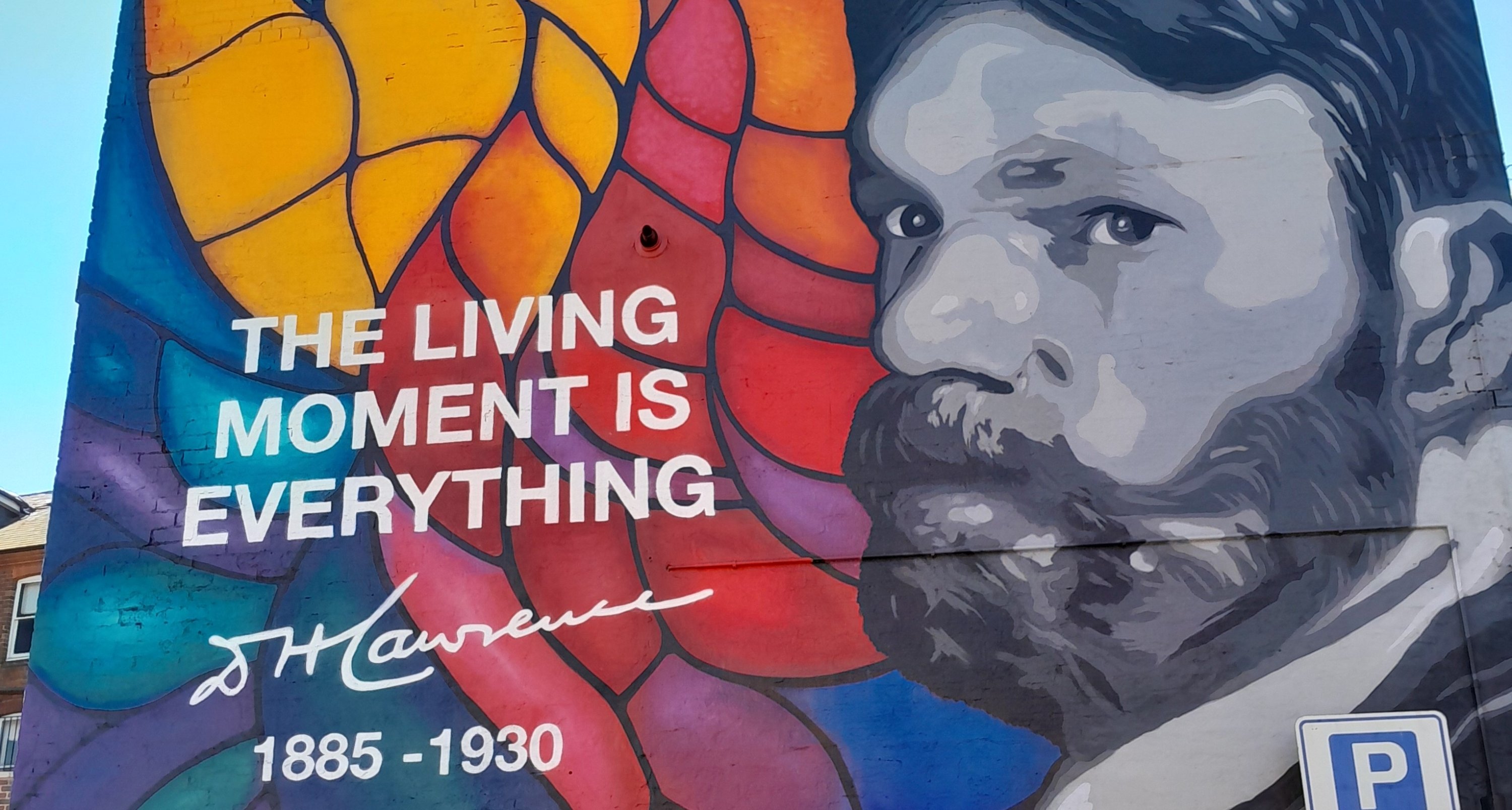
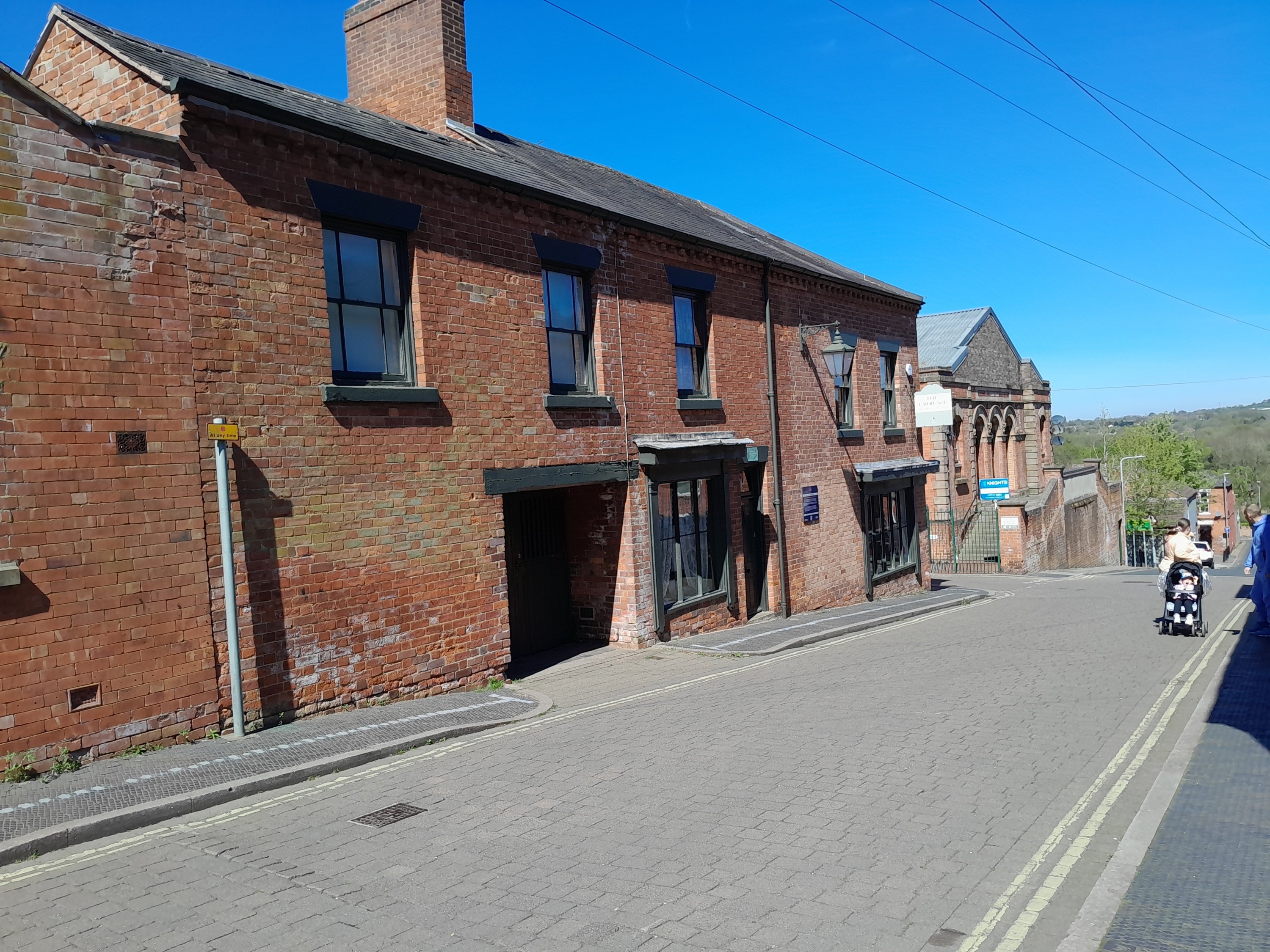
On the wall of one of the dull red-brick houses on a seemingly insignificant side street in the town of Eastwood, not far from Nottingham, there is a brightly colored mural. Recently painted by Nathan Bainbridge, the mural is of the English writer D.H. Lawrence. It faces towards the house where the writer was born and where, along with the property next door, there is now a museum, the D.H. Lawrence Birthplace Museum.
That this otherwise unremarkable dwelling would, as its name suggests, mark the place in which commenced the life of one of the leading literary figures of England, a country certainly not lacking in literary giants, belies the fate expected of one born into the working-class world of the Victorian Era. As his biographer John Worthen puts it:
The house where Lawrence was born in 1885 is in a row of miner’s houses: redbrick, grimy, two-up two-down, just 13 feet wide, with a shop window. It probably looks more attractive today, as a museum, than it has at any time in the last 130 years ... The place reminds us not just of Lawrence’s difference from most other English writers, but pinpoints the oddity of someone born at 8a Victoria Street, Eastwood, in the English Midlands, ever becoming a writer.
Worthen is right in that what Lawrence himself calls “the black, fuming, laborious Midlands” and which he regarded as “horrible” has lost its grime, even if it suffers from post-industrial ills today.
The entrance and the exit room of the museum are the same, and are in the adjoining cottage to that in which the Lawrences actually lived. This room is spacious and serves mainly as a gift shop selling books and items connected with Lawrence. Upon entering, the visitor is brought up the stairs, the riser of each stair displaying the name of a book by the prolific author.
The visitor is then brought into a light, airy room where they are invited to sit and watch a short documentary film on the story of Lawrence in Eastwood and the surrounding area. Lining the walls of this room at present are a number of pictures by the local Brinsley Art Group. These include a black-and-white pencil sketch of an impish-looking Lawrence with almost hypnotic eyes by Pat Whitehead as well as pictures of phoenixes, Lawrence’s chosen symbol for himself, one a stately green bird rising from the flames by Jo Elliott.
Leaving this room on the right, the visitor passes into the original house in which Lawrence came into the world. Indeed, by taking another right, the visitor finds themselves in the actual room in which he was born. This is the front bedroom of the Lawrence house that overlooks Victoria Street. The room is small, but has been recreated with authentic Victorian decoration including the typical heavy dark wooden furniture of that era. The bed with its white counterpane seems to take up most of the room, and even though this is not the actual one on which Lawrence was delivered, it surely resembles it. The visitor is left with a very odd sensation; for they are standing in the exact space in which this genius of English letters took his first ever breath. Moreover, elsewhere in the museum, amongst other Lawrence-related items, are the scissors that actually cut his umbilical cord on display.
This room was the shared sleeping space of Lawrence’s parents. Though the photographs of the couple displayed in the room show the sheer physicality of Lawrence’s father Arthur, the room itself has a decidedly feminine feel to it; there are depictions of pink roses almost everywhere, from the swirling floral wallpaper to a delicate jug and bowl. Moreover, reflecting the piety of what Worthen calls the “intensely moral” Lydia, the mother of Lawrence, there are framed non-descript nature pictures with inspirational sayings such as “The Lord is our King. He will save us.” All in all, the room, as the whole house, reflects the domineering and ardent spirit of Lydia, a woman who, as another of Lawrence's biographers, Francis Wilson puts it, “kept an immaculate house” and who had ultimate “control” over it. In the museum there are a few items labelled “original Lawrence family item,” and here in the front bedroom there is one as well. It is an adjustable bedside table that belonged to Lydia.
Although Lawrence himself was initially an unwanted extra child, his feeble condition must have engaged his mother’s affections for him early, for whilst Lawrence was born in this house, it was soon feared that he would die in it as well. He suffered a near-fatal bronchial attack when he was just two weeks old. Lydia later told him that she had not expected him to survive over three months.
Right opposite the front bedroom and with it forming all the living space of this floor is the back bedroom. This was for the children. Here there is a narrow bed with a doll, a doll’s bed and a hot stone water bottle for keeping the bed warm laid out on it. The wallpaper is similarly floral to the front bedroom, though not quite so overwhelming, and this room too has an exhortation to pious living. The relatively small wardrobe is revealed to be not that for this room, but that for the whole family, reflecting how little clothing they would have had.
Then the visitor climbs a narrow staircase up to the attic, which would have been used by the Lawrence boys. This room, as its name suggests, is literally framed above by an inverted V-shaped ceiling. This relatively sparse room, with a low-lying window being the only source of light, seems somewhat cramped, though its uneasy access would surely allow boys some feeling of escape from the rest of the family.
The visitor then makes their way down to the ground floor, which would have been where the family really lived. There is the relatively spacious kitchen, revealed to be “the center of family life” The visitor can then pass out into the courtyard where there are separate toilets, presumably modern ones and not authentically Victorian, though I never went in to check, and hanging on a wall is an iron tub of the kind in which miners like Arthur would use to attempt to get off some of the grime after a hard day of work.
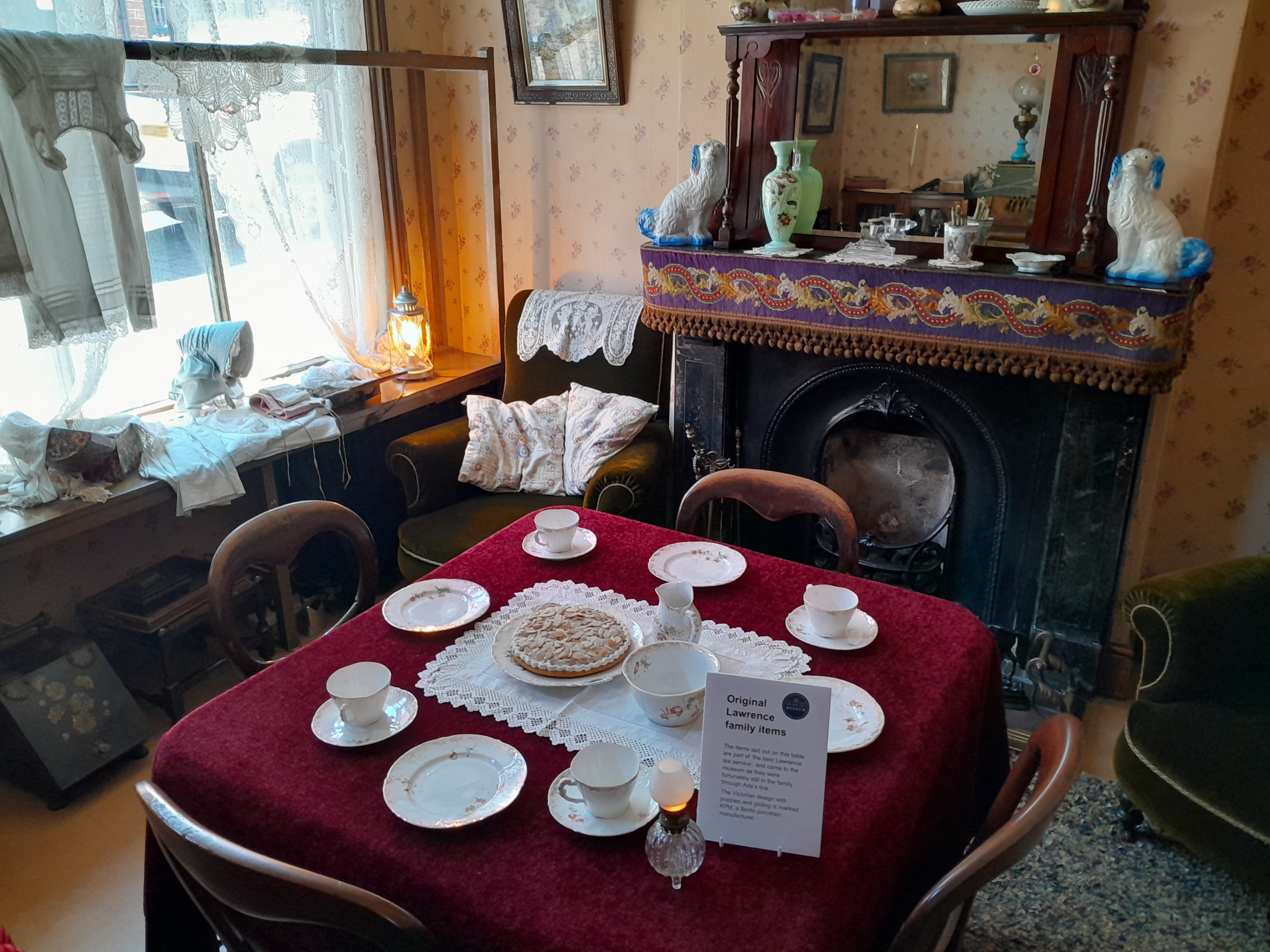
In the middle of the parlor, at the front side of the house at street level, is a table set for tea. The large window facing onto the street has cloth items all around it. This is to reflect the fact that, as another Lawrence’s biographer, Harry T. Moore, puts it, Lydia “set up a little shop” there and “used the large square window of that room for display and inside she sold linen and lace, the caps and aprons of the Victorian housewife.” Worthen accepts that there would have been a need to supplement Arthur’s wages, but feels that Lydia would also have snobbishly set up shop as “a way of demonstrating that they were not just a miner’s family and that she was no longer a sweated laborer but a retailer.” Indeed, the shop was not a financial success, Worthen noting that “it is hard to think of Lydia as an engaging saleswoman,” and then, with Lawrence as her fourth child to care for, it was abandoned.
Although a visitor today could find the smallness of the house somewhat cosy, when imagining it full of the Lawrence family with its five children and especially if visitors called, it would have been extremely cramped and crowded.
There is an extra room to the museum which was not part of the original house and which is on the story above the entrance. I reclimbed the stairs to see it, and within it are items of interest to the Lawrence enthusiast, including the aforementioned scissors and the image of yet another phoenix. This is an ironic phoenix as it was made to mark the place where the fire of Lawrence went out, not to be reignited, for this decorates the gravestone that marked his original burial site in the south of France before his body was moved to its final resting place in Taos, New Mexico.
All in all, the museum is worth the 7.50 pound (about $10) entrance fee, though it is also worth noting that currently it is only open from Thursday to Saturday between 10 a.m. and 4 p.m.
That being said, I came away from the museum with an odd sensation. I had come all the way to Nottingham primarily to visit this museum, and I had expected to somehow “feel” Lawrence there. However, that had not happened at all. The most obvious explanation for this is that Lawrence himself, though born in the house, did not really know it at all. When Lawrence, having defied the expectation of his death in infancy, was just two, the family moved to a different house in Eastwood. They would later move to two other houses; indeed, they can be regarded as having made a mini migration around this small mining town.
Yet, it was not that either. It was something suggested to me by the video that I had watched at the beginning of my tour of the museum. This detailed Lawrence’s life in the area, which certainly also makes its way into his fiction, but pretty much cuts off with his leaving the area in 1908. It notes that after having made his final break with Eastwood, he rarely returned.
However, it is particularly the Lawrence from that period onwards by whom I am fascinated. And this Lawrence though formed in Eastwood, to me at least, breaks from it to belong to the wider world both literally in his extensive wanderings and more significantly in his mind that accepts no limits in its relentless probing. Confirmation for my feelings was perhaps ironically found in a book that I bought from the shop in the museum. It is Frances Wilson’s Burning Man. This book is unlike conventional biographies of Lawrence, which start with Eastwood and end with his death from tuberculosis in France in 1930, as it focuses on 1915-1925, the part of his life of greatest intrigue.
The other confirmation comes from the mural I mentioned earlier. Looking at it more carefully, after having left the museum, I properly took in its three important elements. One, which dominates the right side, is a black-and-white rendition of the adult Lawrence’s face, slightly askew but holding the observer with his eyes. The choice of monochrome is surely suggested by the photographs of Lawrence in his lifetime, but also to further emphasize the main image of the mural, which is a huge rainbow-colored phoenix.
Lawrence, described by Wilson as a man “who thought in symbols,” regarded this mythical bird as representing himself, his spirit. The phoenix is a bird of rebirth, one that burns down to ash and then vibrantly returns to life. It is thus the symbol of new beginnings, of self-reinvention. And then there is a Lawrence quotation boldly expressed on the mural, the affirmation that “the living moment is everything.” The mural thus suggests that Lawrence consciously continues to create himself and is thus not beholden to his past, but rather seeks to grasp life in the present. It is not exactly a repudiation of the Eastwood which certainly formed him, but rather symbolizes that he is not bound by it and that it is through an always active force of life-embracing will that Lawrence really is Lawrence. And this Lawrence manifested himself as he wandered across the world, from Italy to Sri Lanka to the New Mexico where he is buried.
The metaphorical birth of that world-wandering, life-embracing Lawrence also took place in Nottinghamshire, though in Nottingham rather than Eastwood. In the years following his departure from the family home, the life of Lawrence dramatically changes. This is, surprisingly, perhaps not so much due to his writing, which at that time focuses on his past, though this does enable him to sustain his new life.
The main event is the changeover of the main woman in his life. For what really tied Lawrence to Eastwood was not a deep emotional connection to the place, but to his mother. Of course, the physical umbilical cord was cut with the scissors in the museum moments after Lawrence’s birth. The metaphorical one between him and Lydia remained tight, however, until her death in 1910.
Yet, Lawrence was a man for whom women played a central role in his life, and this role was soon to be picked up by another, someone quite unlike his constrictively respectable mother. This woman was the free-spirited Frieda Weekly, née von Richthoven. She was destined to be the love of Lawrence’s life and their encounter changed both of their lives completely.
For he met Frieda in the house of her professor husband in a northern suburb of Nottingham, whom Lawrence had gone to visit for advice about his future but who had fatefully been out that day. Lawrence’s brief encounter with the older Frieda was enough to convince this passionate young man that this was the woman he wanted, and within a short subsequent period, his sheer force of personality prevailed upon her to run away with him and leave her old life, including her children, behind.
This, of course, made Frieda something of a phoenix, but it did the same for Lawrence too. For his relationship with Frieda introduced him to the world outside of England, to which he arguably truly belonged and which provided him with greater material for his incredibly perceptive eye. Indeed, it is difficult to imagine Lawrence the world-wanderer without the woman he dubs the queen bee. Moreover, their relationship would lead to an actual rupture with his homeland. Two years after they first met, World War I broke out, and Frieda, now Lawrence’s wife and a German, and Lawrence, too ill to be drafted, were harassed by their increasingly xenophobic English neighbors, eventually forcing them to leave the country.
Thus, I think his fateful meeting with Frieda can be regarded as the moment when the Lawrence who would become famous as a world-wandering writer was born. Although the house where they met is certainly not a museum, and I may even have misidentified the exact property – though not the area in which it stands – I came in search of the Lawrence I admire and found a sense of connection with him at this site. All I could do was peer over a fence at what was probably the house and then walk away, but I felt that I had stood at the spot where the old Lawrence was reduced to ashes and a new phoenix was born: the Lawrence who has fascinated me for so long.