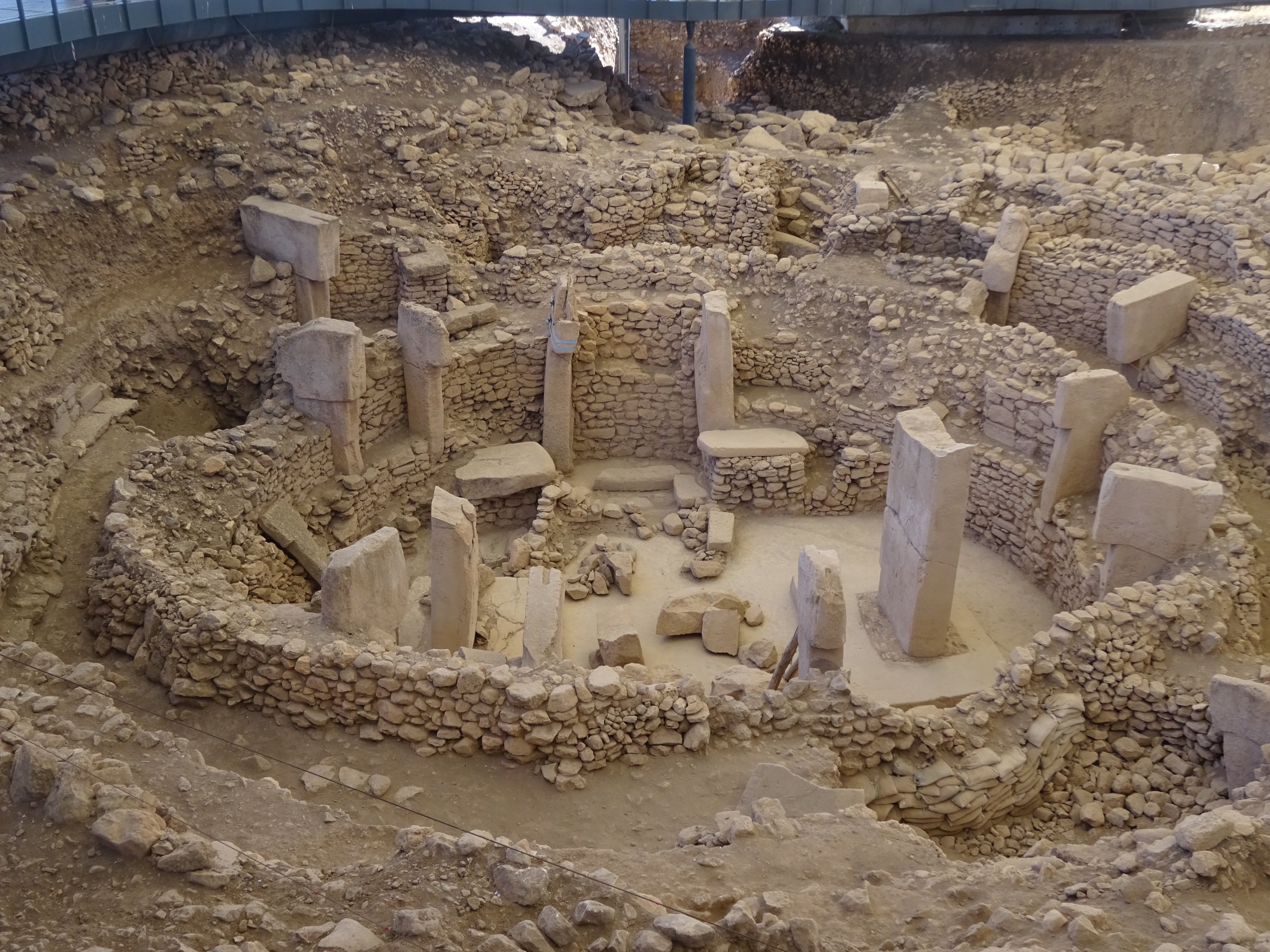
At the outset of this piece, I wish to say that despite what its title might suggest, this is definitely not a piece of mysticism inspired by what has been unearthed at the ancient archaeological site of Göbeklitepe in the southeast of Türkiye. As such, it is quite unlike the almost unwatchable nonsense of "Atiye," or "The Gift," starring Beren Saat.
What I want to suggest in this piece is that, because Göbeklitepe, dated to 9600 and 8200 B.C., predates recorded records by so many millennia, it is unlikely that its secrets will ever be fully divulged. Yet, I feel that if a visitor to the site attempts to temporarily set their mind out of its modern setting, then they may have a better insight into what they are looking at than if they do not.
Of course, it is possible to simply look at a religious site, not understand anything and still be profoundly moved by it. There is nothing wrong with this. Let’s take as an example a non-Muslim visitor to Istanbul who visits the Sultanahmet, or the Blue Mosque. Due to the sheer grandiose beauty of this mosque, it is likely that even if this visitor knows nothing about Islam or Islamic architecture, they will probably still experience a deep feeling of awe. Those who have read up on the latter, though, may add to this experience by recognizing and being able to name, for instance, the mihrab and the minbar. Yet, such reading gives only a literal, superficial understanding, explaining the what but not the much more significant why. That belongs to the mindset of the Muslim believer, who holds that this world is only a transitory step to an incomparably better and eternal place, provided that the believer follows the divine ordinances, the key one being regular worship, preferably in a communal form. If the visitor is able to understand this mindset, then they can make the best sense of the mosque in that it was constructed and has been maintained at great expense and labour in order to facilitate this worship. Then, through this act of imagination, a greater understanding of the religious building in question is gained.
A similar approach can be taken to any religious site around the world in use today. And even for some that are out of use, such as the old temples from the classical world, the lack of living believers is compensated for by surviving texts from the time, which once again allow the modern visitor the chance to imaginatively understand why these buildings were made and for what use. Yet, when it comes to the religious sites of people so far back in time that we have no record of who they built them or what they believed, there is a seemingly insurmountable problem.
Yet, there is perhaps a way to somewhat surmount it. For though any attempt to enter the mindset at Göbeklitepe must involve speculation, there is silly, baseless speculation – such as, for example, the site having been made by aliens – but there is also a way to speculate upon it with a high likelihood of that speculation containing at least some degree of the truth. While our imaginations, used properly, cannot fully penetrate through the mists of unrecorded time and change that have elapsed since Göbeklitepe, when used properly, they can help us attain some degree of closeness to the way the people who built and used the site must have thought.
In order to gain some access to the probable mindset of the builders and users of Göbeklitepe, it is necessary to strip away many of our preconceptions. We have been unconsciously conditioned with a great many of these by our modern urban technical society. Even around a hundred years ago, when these changes were less pronounced, Gertrude Bell wrote, “We are not accustomed to finding ourselves face to face with nature.” Bell is not, of course, assuming that her contemporaries have never taken a walk in the countryside, but is referring to nature raw, immediate and inescapable. And however true that was for Bell and her contemporaries a century ago, today it is an even greater truth.
Yet, if imaginatively we can identify how our modern urban technical society has conditioned us and then imagine what life was like without this conditioning, I think we can make some approach toward the mindset of those who lived in the inescapable directness and rawness of nature, and then have a better understanding of the site of Göbeklitepe.
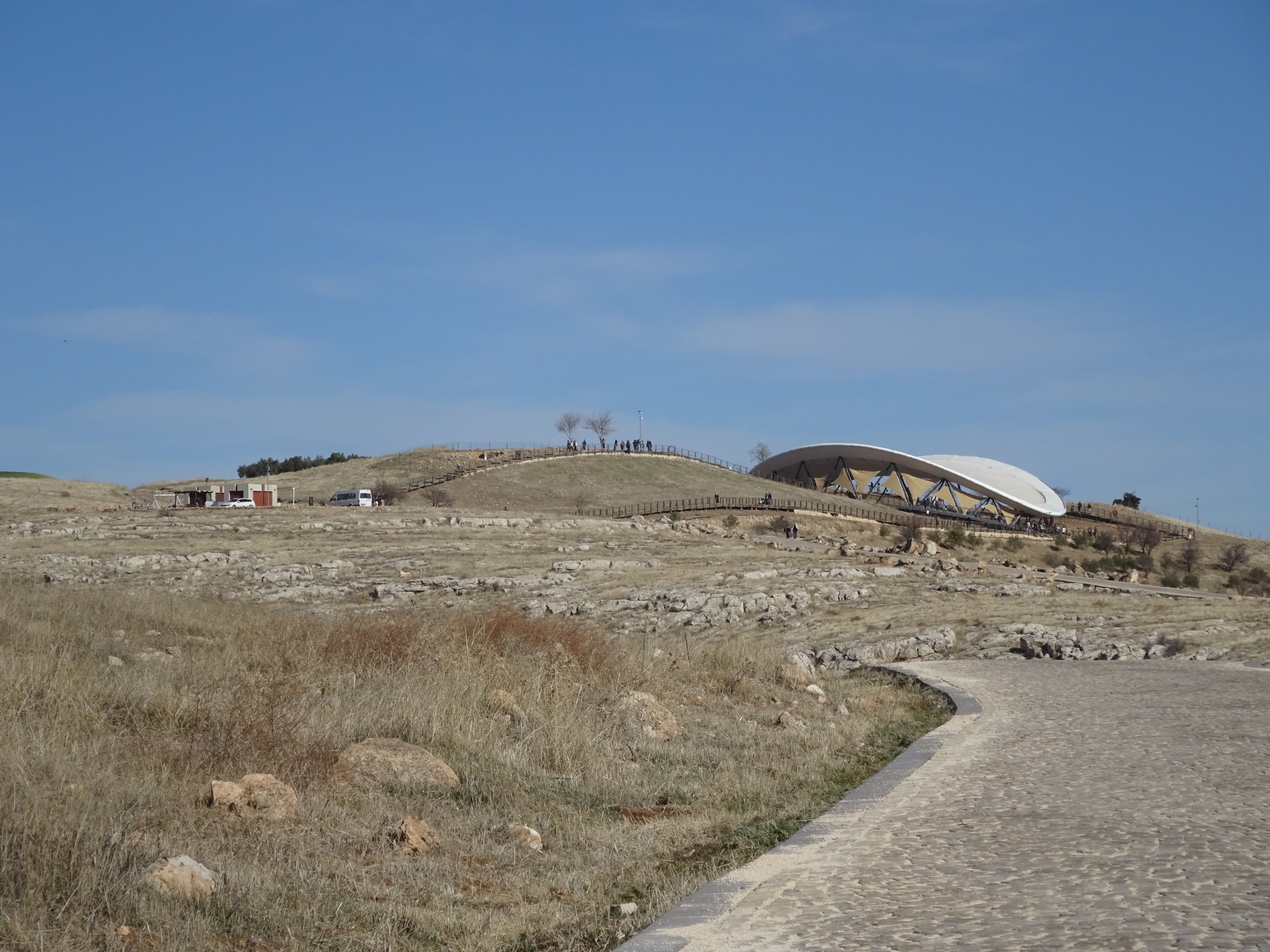
Any visitor to Göbeklitepe will probably be struck first by its most large-scale features, which are its siting and its shape. It is located on the top of a hill – indeed, the name Göbeklitepe is the traditional Turkish name for its hill that predates the discoveries of what were its hidden archaeological treasures. Yet, the name is, of course, nowhere near as old as the site itself.
At the beginning of his masterpiece "Moby Dick," Hermann Melville asserts that human beings are drawn to large bodies of water. Yet, it may be a greater truism that human beings are actually drawn to the sky. I am not here referring to attempts to fly from the mythical soarings of Icarus, through Hezarfen Ahmed Çelebi’s launching himself from the Galata Tower to the motorized airplane of the Wright Brothers. What I mean is that the heavens have long held a fascination for human beings.
One reason is due to the sun. Though modern science has dramatically changed our understanding of it, the sun’s role as the provider of light and warmth, without which life would be impossible, is as obvious today as it has always been. It is also fair to assume that the benevolent role of the sun has played a significant role in equating light with goodness, which has surely been pretty much a constant throughout human history.
Then there are the heavenly bodies of the night. Once again, the idea of light is associated with the heavens, but this time due to contrast. For most of the night sky is jet black. This, however, serves to set off the seeming pinpricks of light that are the stars. The heavens also, to the human eye at least, are a place of immutability. Although they appear to move, their movements, save for the planets, are regular, even those of Juliet’s “inconstant moon.” Thus, compared with the unpredictability of life on earth, the heavens inspire the idea that perfection lies above us.
This surely explains why numerous religious buildings have been sited on high ground. They are there to literally be located closer to the heavens. It was surely with such a mindset that the site for Göbeklitepe was chosen as well.
Scientists have discovered that human beings have a predilection for symmetry. And the circle is the only shape that is symmetrical, however it is approached, making it an ideal of perfection. This ties in, once again, with the heavens. The heavens also instil or reflect a feeling in human beings of perfection, manifesting itself as a circle. It is not just that its two most obvious bodies – the sun and the moon – are spherical. It is that at night the heavens seem to make a spherical movement over the Earth, awareness of which is intensified on higher ground. As the English writer Thomas Hardy puts it in his 1874 novel "Far From the Madding Crowd," “To persons standing alone on a hill during a clear midnight ... the roll of the world eastwards is almost a palpable movement.” One feels “a stately progress through the stars.” It is a powerful experience.
The idea of the circular movement of the heavens is not one that we have lost. We still speak of sunrise and sunset or the setting of the stars. Yet, the sense of awe in being underneath them has been considerably lessened in our modern urban world. Of course, the sun is still our primary source of light, warmth and life. Yet, we are less familiar with even the sun than our ancestors would have been. Many working lives mean time spent in buildings from which the sun is obscured by roofs and ceilings. Even from the building’s windows, a view of the sun is often obscured by towering skyscrapers. Moreover, we no longer use the sun as a means of telling the time and the transition from day to night, which marked such a profound change for our ancestors, has been lost to us. As the natural light dims in our workplaces or homes to a point at which we can no longer comfortably see what we are doing, we simply turn on an electric light and continue with our tasks without any further thought. Furthermore, the modern city dweller is almost completely alienated from the night sky due to the light pollution of urban lighting. This prevents the night sky from being seen as it used to be seen and disconnects us from the past.
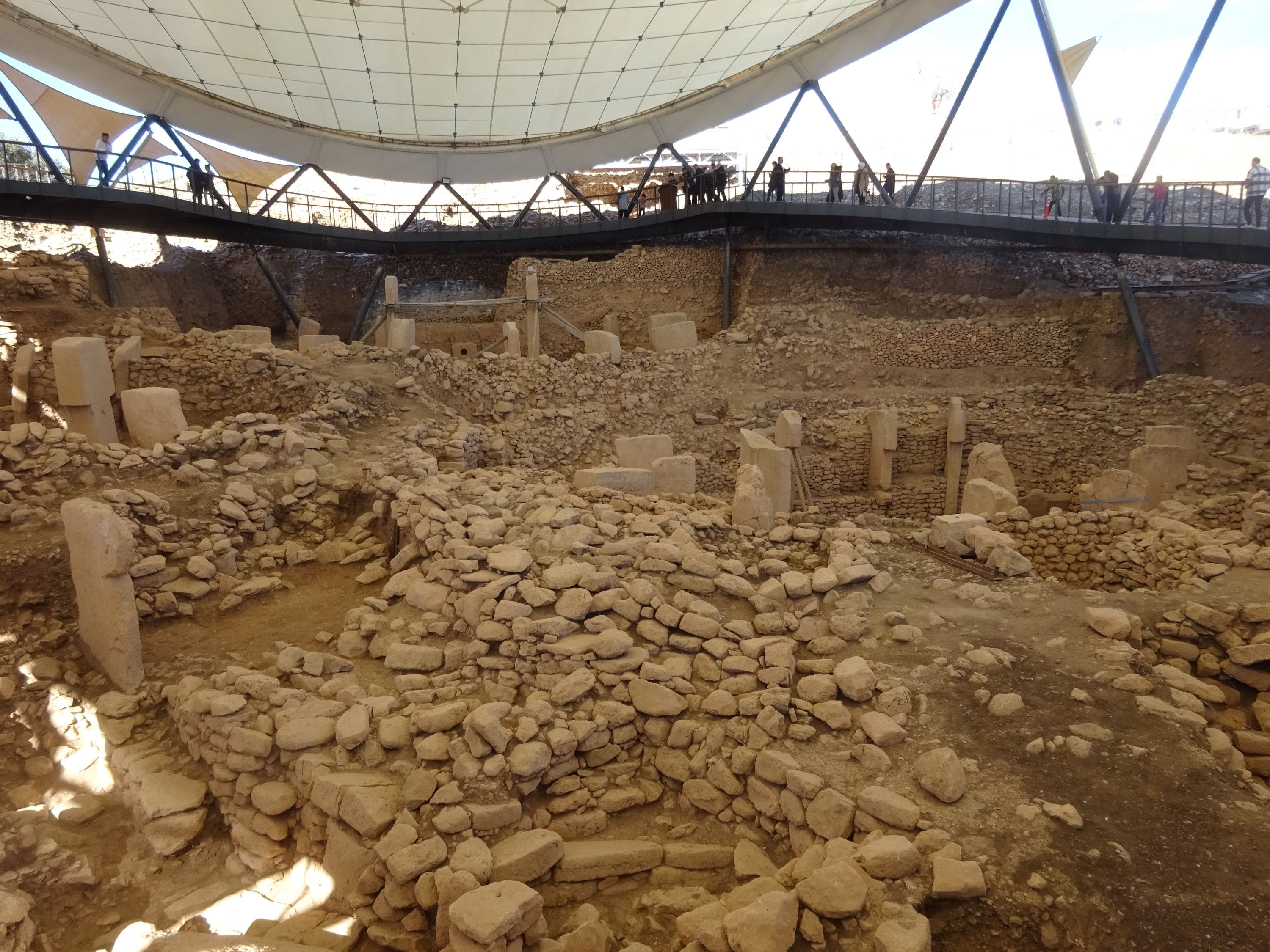
Yet, the human beings from a much earlier time who erected Göbeklitepe would have had a far greater sense of the heavens both by day and night than we modern city dwellers do. Awareness of this explains its hilltop position. It is both closer to the heavens and upon it, one gets the impression of the heavens forming a dome, half of a perfect circle in three dimensions. As much of Göbeklitepe remains buried I do not know if the whole extended site is in fact in the shape of a circle, but each of the individual sections with their plinths that are viewable to the public are. This presumably connects them with a heavenly function, perhaps a desire to attach to perfection or the passing of time.
The presence of animals in our technologic and urban world is less felt than at any time in human history. Not only have the numbers and species of animals been devastatingly reduced by us, but the urban landscape effectively insulates us from threatening animals that have traditionally inspired fear. While there is the occasional news story of a snake popping up through someone’s toilet, dangerous animals are generally kept at a distance and are usually easily dealt with if they break through the cordon. Moreover, if someone is unfortunate enough to be, for instance bitten or stung by a venomous animal, there is medical assistance for them if it can be reached in time.
Yet, to human beings from most of human history, animals would inspire fear and awe. Even into the 20th century, the horse was still a symbol of military might. Now, this animal seems only to connate sedate rides into the countryside. It is true that there is one sense in which we still connect horses to power and that is in the term “horsepower.” But this term is applied to that which dethroned the horse itself from its position of power – the machine. And a being of power in our modern mythology is the cartoon character Superman. The phrase associated with him is, “Is it a bird? Is it a plane? No, it’s Superman!” This builds up a hierarchy of flying speed. He is also described as “faster than a speeding bullet” and called “the Man of Steel.” So save for the mention of the bird which is immediately surpassed by that of the plane, all references to Superman are done through industrial not zoological might. Having built for ourselves machines that can outperform animals in any sphere of activity and having insulated ourselves from animals, the raw power that these beasts were seen to have in earlier times is lost to us. But that power would have been very evident to the people who built Göbeklitepe.
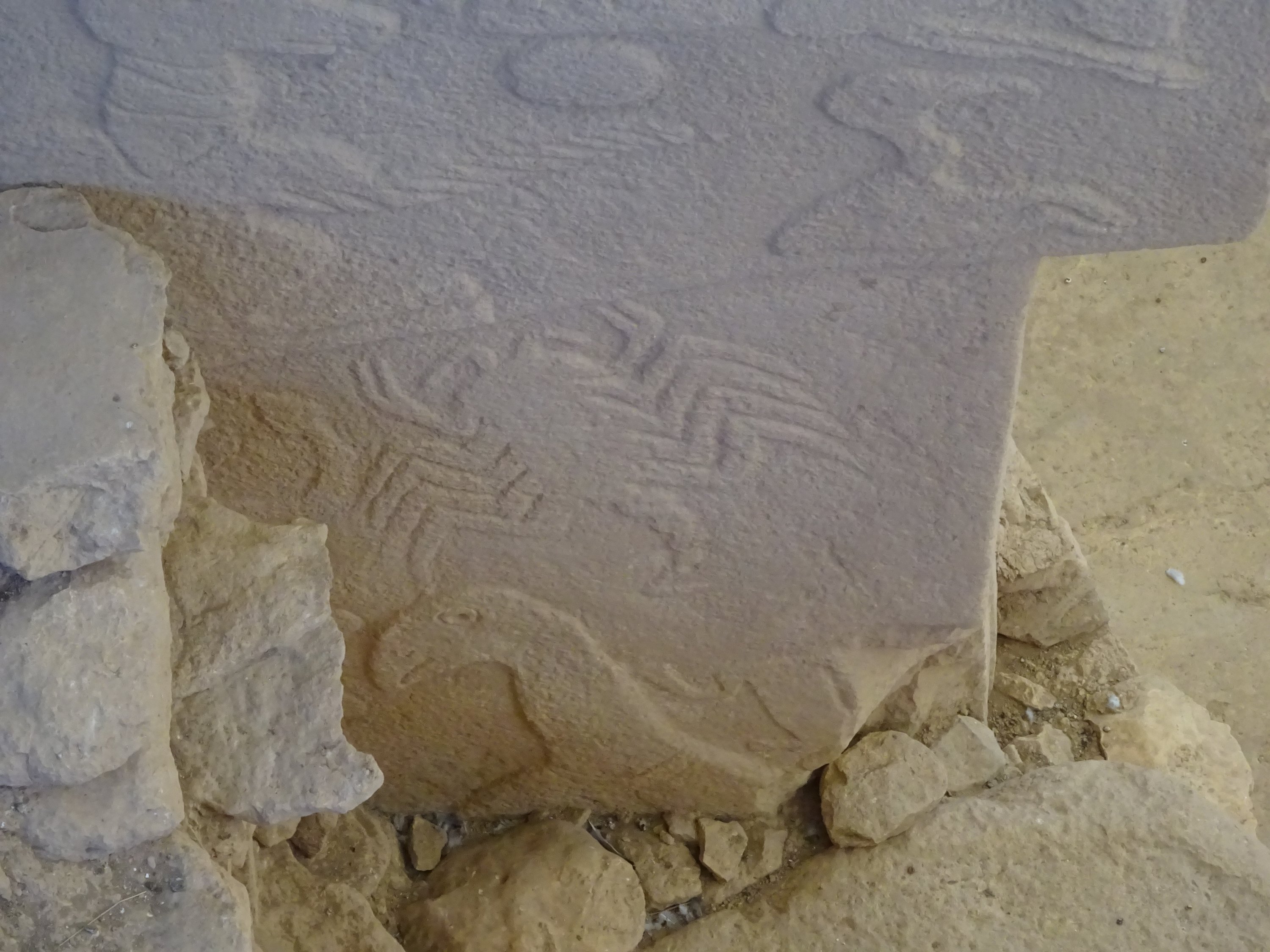
Yet, if we imaginatively put ourselves back into the pre-industrial and pre-urban world, into a natural world in which animals roam free in their power, then the threat that they would have posed to early humans becomes easily comprehensible. And then, I think, we can start to understand why among the images carved onto the stones at Göbeklitepe are a feline animal, a bird that has been identified as a vulture, a snake and a scorpion.
They are not simple decorations. The intense labor involved in preparing and setting these stones would have demanded what these ancient people must have believed to be a recompense for the work. It is also noteworthy that from these symbols, the question of whether this was a site for hunter-gatherers or for early agriculturalists is rendered moot. For the animals depicted are those that pose risk to human life regardless of whether those humans foray for their food or are settled in an agricultural community.
Thus, the whole of Göbeklitepe could be seen as a giant insurance policy in stone, its task being to protect the humans of this area from the scary beasts around them. This could either be through some form of worship offered to these animals or an attempt to spiritually subdue them. Depiction and naming were thought forms of control. The ancient Greeks named the Black Sea the Euxine, meaning “hospitable” not because this is a good description of that potentially treacherous body of water, but because they wished to make it so by giving it the name. The same thought lay behind the name of the Pacific, i.e. peaceful, Ocean.
At Göbeklitepe, it is also possible that these animals, being great threats to the people of the time, were deified by them or their deities were given animal attributes. If we return to the heavens, it is a notable that of the 12 constellations of the zodiac, the majority of them are animals. Ancient humans saw patterns of animals in the stars, and as such, they reflected their own concerns, thus making the constellations effectively communal results of a sky-wide Rorschach test. The possibility of the plinths at Göbeklitepe also being connected to the heavens in this way is argued by Samuel Shepherd who claims that, “The depiction of animals such as snakes, scorpions and vultures could represent constellations or celestial phenomena, serving as a form of proto-zodiac.”
Whether the plinths represent celestial animals in the sky or real ones on the ground, surely the motivation behind their construction is the same. These early humans were surrounded by natural threats and at great expense of labor, they built this site with the objective of protecting themselves from these threats by representing them.
Of course, all this is pure speculation. And it is of course impossible that we can completely enter into the mindset of the people who created and used Göbeklitepe. Yet, I do feel that this mental exercise allows the visitor to view elements of the site in a way that must be closer to those who built and used it, providing a better appreciation of it. The mindset can also be adapted to deal with new finds such as the fantastic human statue recently unearthed there.