In the pursuit of a better life, "Los Turcos," ("The Turks") a group of Ottomans who immigrated to various Latin American nations during the 19th century, achieved remarkable accomplishments in a wide range of domains, including politics, business, art and literature.
There were various waves of migration from the Ottoman Empire to Latin America from 1860 to the end of World War I, while World War II forced even more people to migrate to Latin America.
Some immigrants were first greeted by the Christ the Redeemer statue in Rio de Janeiro, Brazil, and preferred to stay in Latin America although they set off to the U.S. hoping to see the Statue of Liberty.
Immigrants who arrived in the Americas from the Ottoman Empire in search of a better future were called "Los Turcos" in the region.
Although some Arabs, Jews and Armenians objected to being described as "Los Turcos," the term is still quite common among Latin Americans.
Also, diplomatic and consular relations between the Ottoman Empire and some Latin American countries began in the same period.
According to some open sources, Latin America is home to around 30 million "Turcos," mostly Arabs, who came to the region in the 19th century with Ottoman passports.
Among the reasons for migration to Latin America are post-war economic difficulties, population change, and internal dynamics.
Most immigrants arrived in Brazil, Argentina and Chile, while some settled in Honduras, El Salvador and Colombia.
Around 103,000 people went to Argentina from Ottoman lands until 1920, and Los Turcos became the fourth nation that immigrated to this country after Italians, Spaniards, and Russians.
Political, social, and economic developments in Latin America were also linked to the causes of migration to this region.
While industrial development has created wealth in the region, it has also created a market for commercial activities of interest to Middle Eastern immigrants.
Meanwhile, due to Latin America's colonial past, the arrival of immigrants was seen as a threat to the identity of their country by European-origin Latin American elites.
Los Turcos began to be exposed to cultural and religious discrimination in the Latin geography they migrated to.
In 1927, the Mexican Government passed an immigration law that discriminated against Syrians, Lebanese, Armenians, Palestinians, Arabs and Turks.
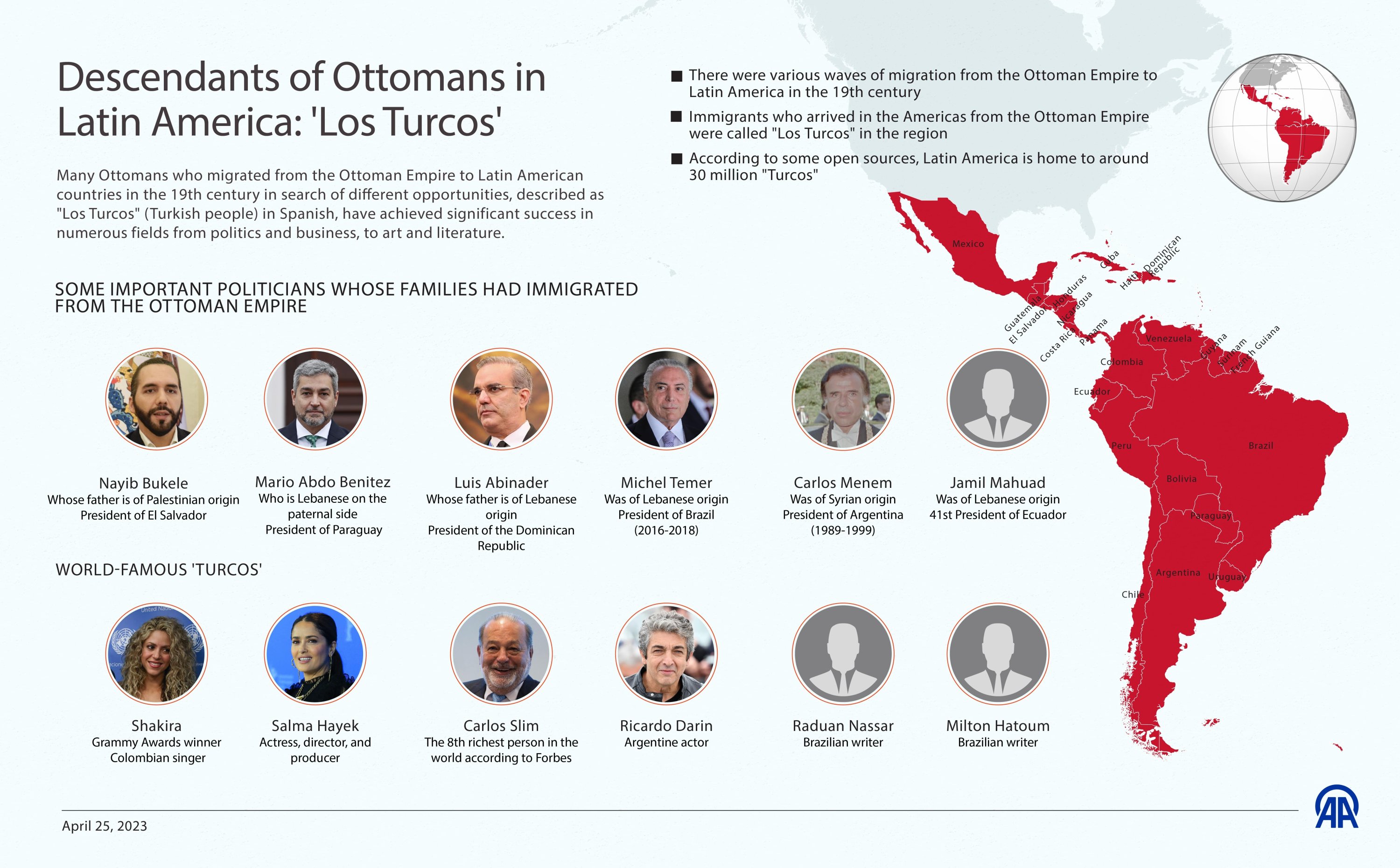
Descendants of Los Turcos have key positions in the politics, bureaucracy, and business world of the region, as well as trade.
Ottoman immigrants also had a say in politics in Argentina, Brazil, El Salvador, Dominican Republic, Ecuador, Paraguay and Brazil.
Among the current examples of these are Nayib Bukele, the president of El Salvador, whose father is of Palestinian origin, President of Paraguay Mario Abdo Benitez, who is Lebanese on the paternal side, and Luis Abinader, the president of the Dominican Republic, whose father is of Lebanese origin.
Michel Temer, the former president of Brazil, and 41st President of Ecuador Jamil Mahuad were of Lebanese origin, while the president of Argentina from 1989-1999, Carlos Menem, was of Syrian origin and his family had immigrated from the Ottoman Empire.
In addition to trade and politics, many Ottoman-origin Latin Americans achieved world recognition with significant achievements in culture, science, sports, social, and artistic fields.
Colombian singer Shakira, the winner of 16 Grammy Awards, and Salma Hayek, actress, director, and producer, are at the forefront of these examples.
Other prominent Arab Latinos include Carlos Slim, the eighth richest person in the world according to Forbes, and Brazilian writers Raduan Nassar and Milton Hatoum, and Argentine actor Ricardo Darin.
There are also cultural or social organizations run by immigrant communities of former Ottoman subjects in almost every country in Latin America.
The most striking example of these organizations is the 103-year-old professional football team called "Palestino" of the Palestinian-Chilean community in Chile, which has nearly half a million Palestinian origins.
Palestinians in Chile also have an influential group of lawmakers and politicians who belong to different parties but are united around the Palestinian cause.