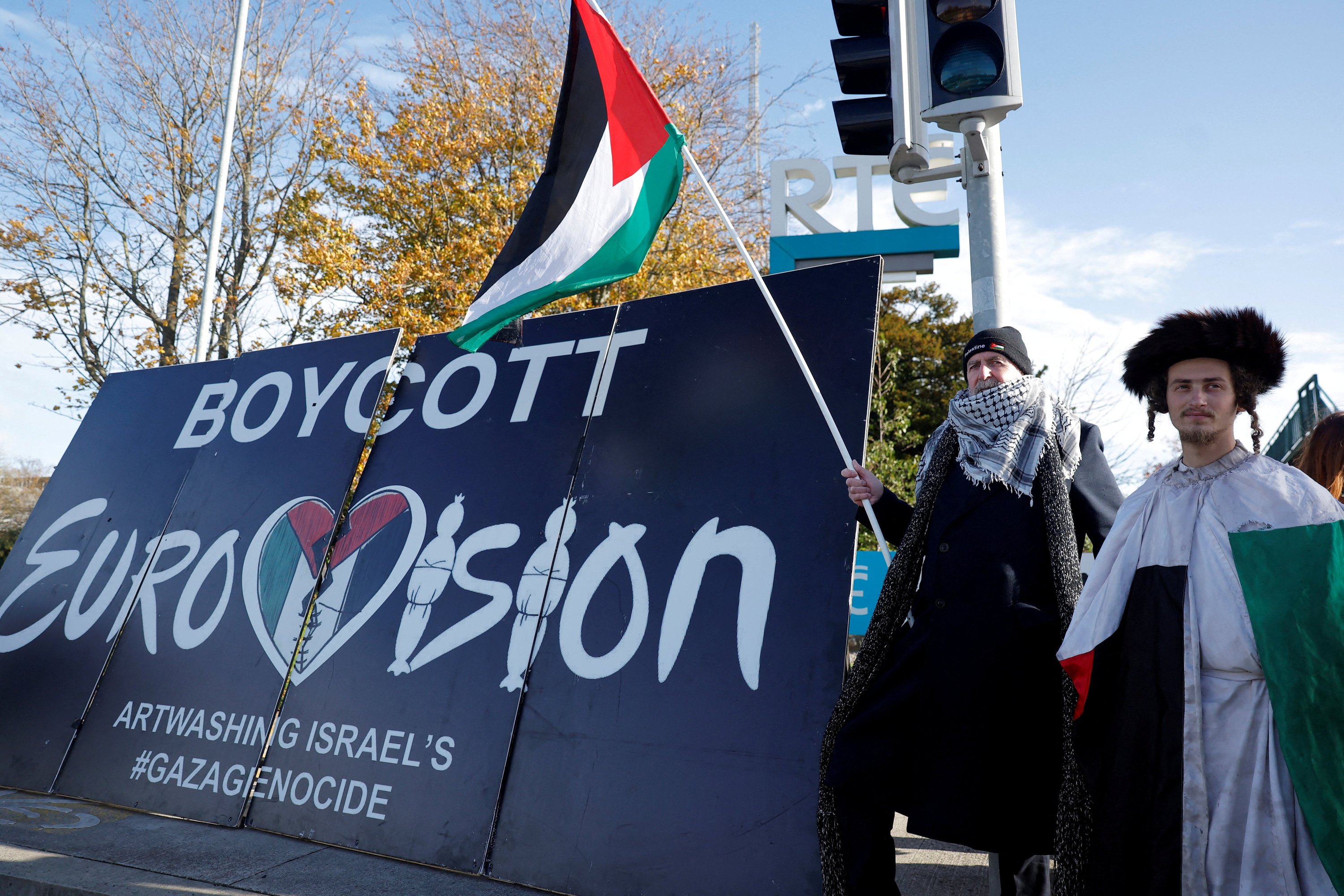
Ireland, the Netherlands, Spain and Slovenia announced their decision to boycott the 2026 Eurovision Song Contest after Israel was authorized to take part in the music competition over its genocide and ongoing violations in the blockaded Gaza Strip.
"The situation in Gaza, despite the ceasefire and the approval of the peace process, and the use of the contest for political goals by Israel, make it increasingly difficult to keep Eurovision a neutral cultural event," Spanish public broadcaster RTVE's secretary-general Alfonso Morales said in a statement.
Spain is one of the "big five" nations that make the biggest financial contributions to the European Broadcasting Union, the organizer of Eurovision, that automatically qualify for the final of the contest.
Ireland will also boycott next year's Eurovision Song Contest, the public broadcaster RTE said.
"RTE will not participate in the 2026 Eurovision Song Contest, nor will RTE broadcast the competition," the Irish broadcaster said in a statement.
"Ireland's participation remains unconscionable given the appalling loss of lives in Gaza and the humanitarian crisis there which continues to put the lives of so many civilians at risk."
Dutch broadcaster AVROTROS said that the participation of Israel "is no longer compatible with the responsibility we bear as a public broadcaster."
The pullouts came after members of the European Broadcasting Union, which organizes Eurovision, voted to adopt tougher voting rules in response to allegations that Israel had manipulated the vote in favor of their contestant.
"Eurovision is becoming a bit of a fractured event," said Paul Jordan, an expert on the contest known as Dr. Eurovision. "The slogan is 'United by Music'... unfortunately it's disunited through politics."
"It's become quite a messy and toxic situation," he said.
Natalija Gorscak, head of Slovenia's national broadcaster RTV Slovenija, said her country had also withdrawn.
"We will not participate in the ESC if Israel is there. On behalf of the 20,000 children who died in Gaza," she said.
The contest, whose 70th edition is scheduled for Vienna in May, pits acts from dozens of nations against one another for the continent's musical crown.
It strives to put pop before politics, but has repeatedly been embroiled in world events. Russia was expelled in 2022 after its full-scale invasion of Ukraine.
Israel's war in Gaza has been its biggest challenge, with pro-Palestinian protesters demonstrating against Israel outside the last two Eurovision contests in Basel, Switzerland, in May and Malmo, Sweden, in 2024.
The war in Gaza has also exposed rifts in the European broadcasting world. Austria, which is set to host the competition after Viennese singer JJ won this year with "Wasted Love," supports Israel's participation. Germany, too, is said to back Israel.
Iceland, Ireland, the Netherlands, Slovenia and Spain are among the countries that have threatened to sit out the contest, if Israel is allowed to take part.
Opponents of Israel's participation criticize the conduct of the war in Gaza, which has left more than 70,000 people – mostly women and children – dead, destroyed civilian infrastructure, including hospitals, schools, places of worship, soup kitchens and more. A number of experts, including those commissioned by a U.N. body, have said that Israel's offensive amounts to genocide.