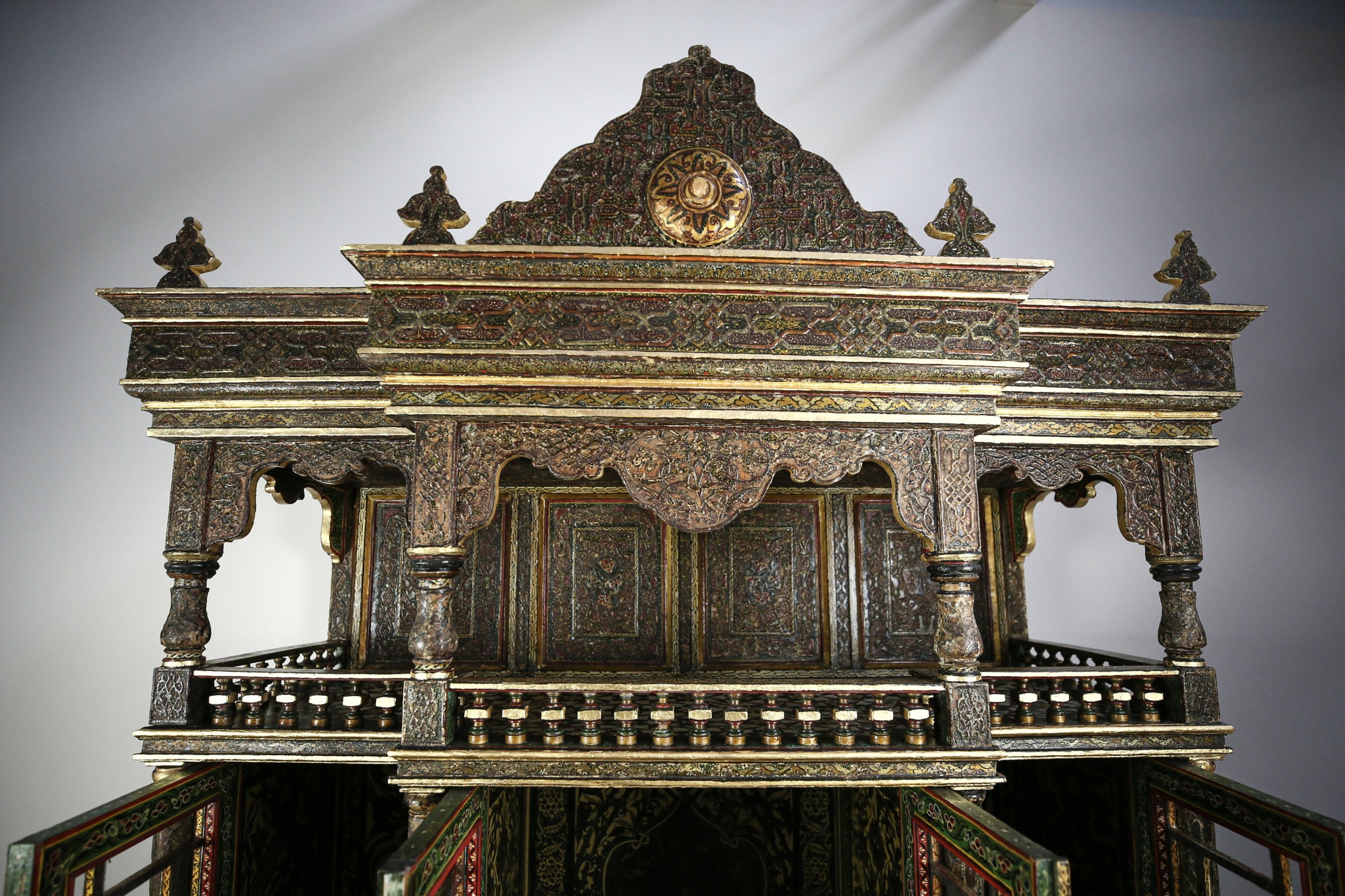
A historic wooden cabinet donated by Abdulhamid II for a charity exhibition benefiting families of fallen soldiers and war veterans after the Greco-Turkish War of 1897 has been restored to its original condition following years of conservation work.
The cabinet was originally sold at a charity exhibition held in Istanbul in 1898. In the 1970s, it entered the inventory of the General Directorate of Cultural Assets and Museums and was later transferred to the Bursa Turkish and Islamic Arts Museum.
When the museum underwent renovations in 2019, the cabinet was moved to the Bursa Restoration and Conservation Regional Laboratory. After nearly six years of gradual restoration and conservation work, the elaborately decorated piece has been returned to its original appearance.
Hüseyin Gürsel Bilmiş, director of the laboratory, said the cabinet’s story emerged during research into its archival records.
“We discovered from a sentence in the artifact’s identification file that it had been included in a charity exhibition organized for the relatives of martyrs and veterans,” Bilmiş told Anadolu Agency (AA).
Researchers later located the exhibition catalog, which revealed that the event was organized to raise funds for families of soldiers killed or wounded in the Greco-Turkish War. According to Bilmiş, the exhibition included donations from prominent figures in the Ottoman Empire and abroad, including the German emperor, the French president, the Austro-Hungarian emperor, the Khedivate of Egypt and members of the Ottoman dynasty.
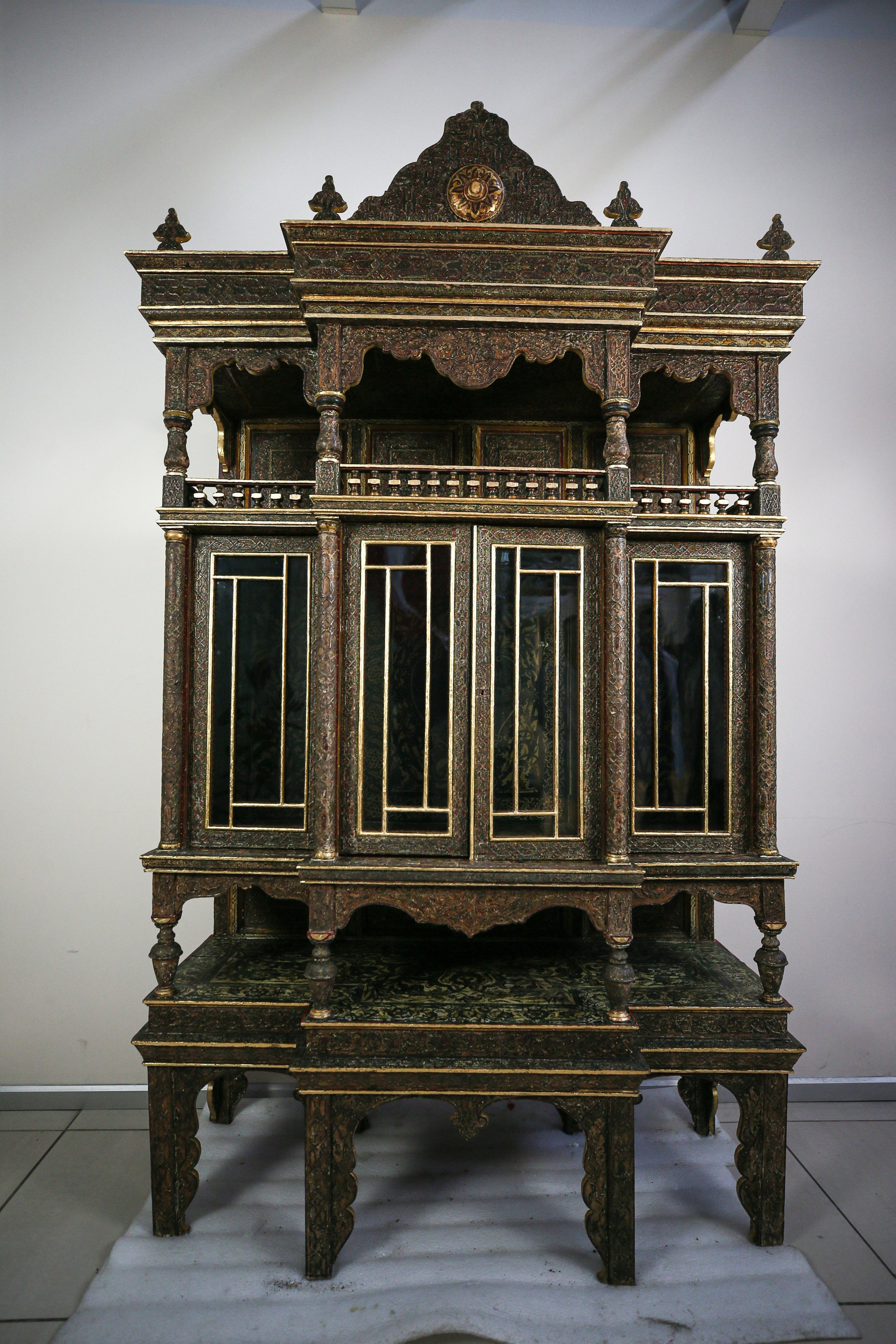
Bilmiş said photographs of the catalog were found in the Istanbul University Rare Manuscripts Library, where the cabinet appears exactly as it does today.
Archival records indicate that works personally produced by Abdulhamid II were displayed together in one section of the exhibition hall.
“The cabinet appears at the front of the section containing works donated by the sultan,” Bilmiş said, adding that it was most likely produced at the carpentry workshop at Yıldız Palace and may have been crafted by the sultan himself.
About 2 meters tall, the cabinet was described in the exhibition catalog as “an ornate glass cabinet, 2 meters in height, made in an Arab style.”
Bilmiş said the piece features geometric ornamentation and the traditional Edirnekâri decorative style, with extensive gold-leaf details and painted designs covering nearly all surfaces.
“This is a very important work,” he said. “There is a very strong possibility that it came directly from Abdulhamid II’s workshop and was donated to the exhibition for charity.”
Restorer Serdar Yaşar said the cabinet first underwent technical documentation and structural analysis after arriving at the laboratory.
Conservators discovered severe insect activity in the wood and placed the cabinet in a nitrogen tent to eliminate the infestation before beginning restoration.
Yaşar said the cabinet features a plaster layer beneath the paint and extremely delicate decorative work.
“The craftsmanship is as fine as manuscript illumination,” he said, noting that the most significant challenge involved flaking and peeling paint layers.
Conservators stabilized the paint using a method known as “facing,” temporarily securing fragile areas to prevent further damage. After about a year of conservation work to strengthen the wood, restorers carried out retouching, color adjustments and renewed gold-leaf applications to restore the cabinet’s decorative details.
The cabinet will eventually be displayed to visitors at the Bursa Turkish and Islamic Arts Museum once museum officials determine an appropriate exhibition space.