When the Ankara Opera is run by someone without any opera knowledge, when the title of chief stage director is held by someone without a conservatory education and when these two decide who gets cast, expecting anything of artistic value from the stage is little more than a fantasy.
The conclusion I draw from this concert is clear: the Ankara Opera, once the most elite institution of our operatic tradition, continues to be managed like a street troupe devoid of artistic value. The concert I attended unfolded at precisely the low level described above.
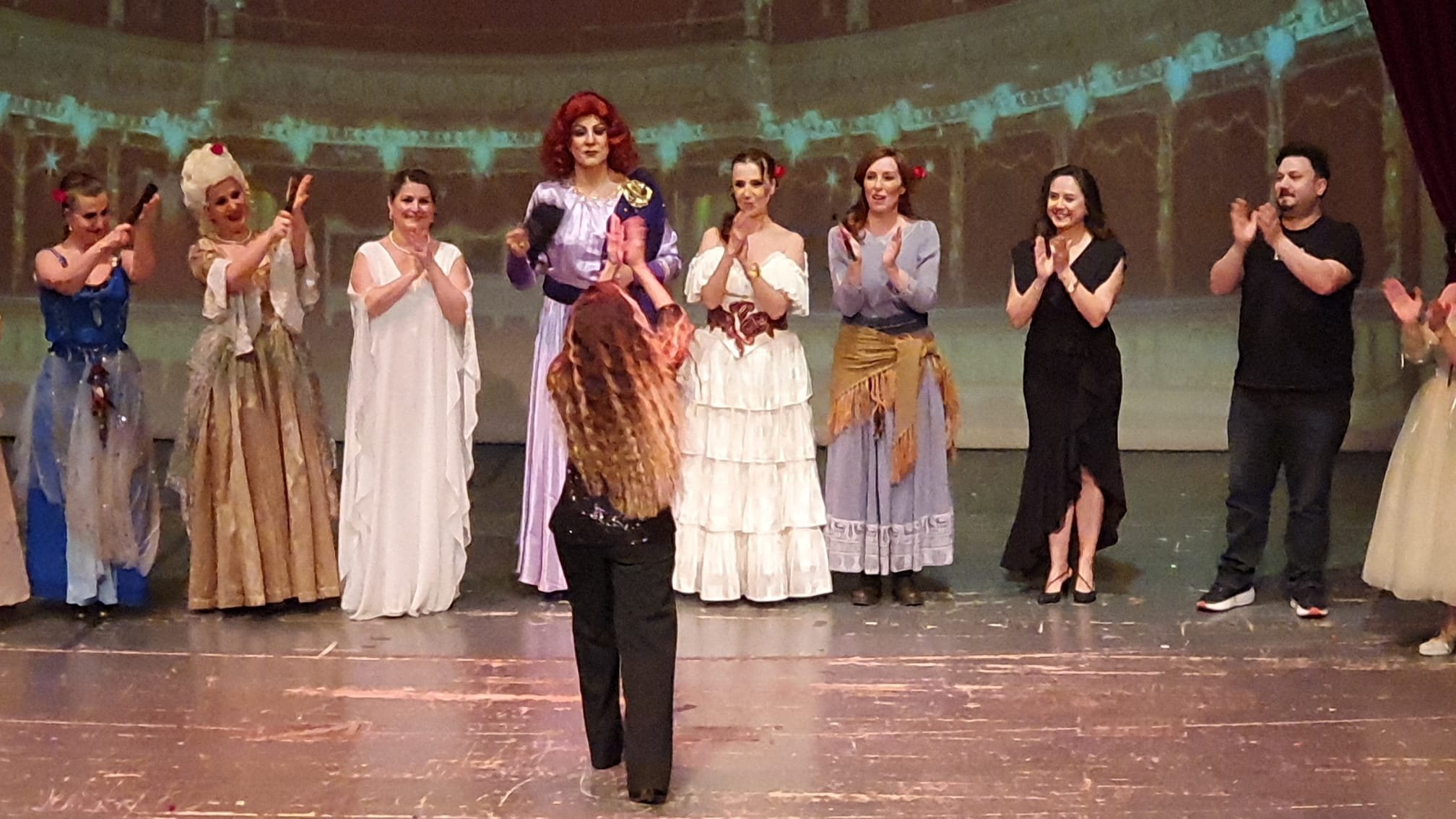
My evaluations of the performers who took the stage are as follows.
S. Ilayda Büyükyörük was the only young performer among the elderly soloists and was the best of the evening. With her dark soprano timbre, not only the beauty of her voice but also her technical mastery stood out unmistakably. While nearly all the soloists on stage are of an age close to retirement, the young Büyükyörük is a true asset to the Ankara Opera. Listening to her felt like witnessing a future prima donna in the making. Yet this young talent does not even hold a chorus contract and can only find a place in the opera under a supernumerary’s contract. To consign such a talent to that status is shame enough for both the opera and its administrators.
When Esin Talınlı took the stage with a duet from “The Tales of Hoffmann” (“Les contes d’Hoffmann”), her high notes at times turned into shrieks, worn down by time. This is among the most unacceptable technical flaws for a soprano. The issue became even more apparent in her solo performance of Rusalka’s “Song to the Moon.” Talınlı struggled to maintain a lyrical line in the aria; singing in an excessively dark and wide manner, her voice became constricted in the upper register and turned into a cry. This technical deficiency disrupted the aria’s magic.
E. Özge Türkoğlu, performing alongside Talınlı in the same duet, displayed a beautiful, warm mezzo voice that sounded homogeneous across all registers. However, in Azucena’s aria, her voice wobbled due to an overly darkened and broadened placement. She struggled to convey the opera’s dramatic impact and was stronger in the duet. I came away with the impression that she would make a very fine Carmen – far superior, in fact, to the three lyric sopranos at the Ankara Opera who identify themselves as mezzo.
Feryal Türkoğlu, once Ankara’s coloratura soprano, the “Queen of the Night,” has lost much of her voice since moving into the dramatic spinto repertoire. After the disastrous "Turandot" performances at the beginning of the season (I saw one of them), I saw no sign of improvement in this concert. Overly forced chest tones in the lower and middle registers, in an attempt to achieve a dramatic effect, and high notes turning into screams, I cannot understand how she is still being put on stage in this condition. Is it because she shares the stage in the Harput Symphony group with chief director Mehmet Yılmaz, or because she was a schoolmate of Opera Director Demet Gökalp? I believe she should retire and make way for younger performers. If not, she should refrain from appearing on stage except within the chorus.
While listening to Ferda Yetişer in the Flower Duet, I could not help but wish she were a mezzo-soprano. Unlike her sister Feryal Türkoğlu, she demonstrated highly refined musicianship. With vocal control that clearly reflects careful work across all registers, she offered a lesson in how mezzo repertoire can be performed – even without being a mezzo. She delivered a masterful interpretation of the Habanera aria and an impressive performance marked by excellent vocal control. She showed, in effect, how Carmen should be sung.
Esra Çetiner appeared somewhat underpowered in Fiorilla’s aria, perhaps due to the initial excitement of opening the concert. However, she shone like a star in Juliette’s “Je veux vivre.” It was evident from the quality of her interpretation that she had carefully considered every phrase and every word. Her costume, however, did not align with the aria she performed; had Romeo seen her like that, he might well have withdrawn from the story altogether. Despite the distracting negative effect of the costume, Çetiner's mastery of interpretation and ease in delivering the high notes greatly impressed the audience; she became larger than life on stage as Juliette. Alongside Büyükyörük, she was one of the finest performers of the concert that night.
As for Arda Aktar, I had previously noted when I saw him as Lord Enrico in Lucia di Lammermoor that he has an ongoing issue with vocal volume. This time, even with piano accompaniment instead of an orchestra, his performance again resembled that of a mime artist: There was image, but little to no sound. His vocal instability was especially apparent in the upper register. However, I quite appreciated his acting that evening. His portrayal of Donna Agata – a female role performed by a baritone in disguise – was memorable, evoking less the character itself and more a sharp, flamboyant persona reminiscent of Huysuz Virjin, a famously abrasive Turkish drag figure.
Melahat Ismail, the Azerbaijani pianist, was among the weakest links of the concert, alongside Feryal Türkoğlu. Instead of accompanying, she played as if she were performing Rachmaninoff’s Piano Concerto No. 3. She attacked the keys so aggressively that at one point I thought the piano might break.
Narrator Berkay Veli created a gloomy atmosphere with a monotonous, uninflected tone that lulled the audience toward sleep. Much of what he said was inaudible, as his voice seemed trapped in his throat. The stage lighting was insufficient, and the emphasis felt careless, almost perfunctory.
Staging a concert with a clear directorial vision is no easy task; however, Zeynep Utku proved that she is capable of handling such a responsibility with competence. One hopes she will be given the opportunity to take on larger-scale works.
Gülümden Alev Karaman, meanwhile, emerged as a text writer unable to fully convey the focus on the opera’s female characters and their arias. Her underdeveloped narrative, which aimed to foreground lyricism, ultimately failed to satisfy the audience.
In conclusion, this concert at the Ankara Opera seemed designed less around the music itself and more as a platform to foreground the soloists.
The recurrence of the same names in opera productions and such concerts constitutes a troubling vicious cycle. Melahat Ismail and Feryal Türkoğlu, who delivered weak performances in this concert, once again took their places on stage. Moreover, Ünüşan Kuloğlu – who, like Ferda Yetişer, has lost much of his vocal quality – continues to be sent abroad in the name of opera. These four individuals, despite their technical inadequacies, have been repeatedly chosen for years to represent our country. While many artists are capable of delivering far better performances in opera, I find it difficult to understand why these names are sent abroad as representatives of our country.
Zaira Memmedova, the wife of Ünüşan Kuloğlu, serves as the international relations coordinator of the State Opera and Ballet. The repeated selection of the same artists for international appearances and their constant presence on stage suggests that artistic criteria are not being properly applied in casting decisions.
The voices capable of truly doing justice to the works performed in this concert were not the ones I heard that evening. Rather than merit-based selection, the process gives the impression of choices made within a closed circle. How else can one explain the persistent dominance of the same names in casting?
Finally, the concert consisted largely of arias portraying not opera’s heroines, but rather its helpless women. Aside from Aida, no true heroine appeared on stage. If the concept had genuinely centered on opera’s heroines, accomplished artists such as Seda Ayazlı and Mehlika Karadeniz – both of whom have performed heroic repertoire in the past – should also have been included.
The acting general director of the opera, Barış Salcan, merely watches all of this unfold. Is it because he does not know anything about opera, or because, as an instrumentalist, he seeks to protect another instrumentalist, Ankara Opera Director Demet Gökalp, that he takes no action? At a time when the Ankara Opera has reached its lowest point in artistic production, how much longer can it continue under the direction of someone who does not understand opera?