February 2026 marks a month in American political history where popular culture transformed from a "soft power" into a direct "cultural front." Bad Bunny first won Album of the Year at the 68th Grammy Awards on Feb. 1 with his all-Spanish song "Debí Tirar Mas Fotos," shattering 68 years of English-language hegemony in American culture. But what transformed him from an artist into a political phenomenon was his first cry upon receiving the award: "ICE out!" (Immigration police out!)
These two words were not just a slogan; they were a declaration of war against Trump's border policies, the harsh immigration operations stretching from Minneapolis to California, and the deep sense of "alienation" felt by the Latino community. These words symbolize the United States' refusal to succumb to exclusionary and narrow-mindedness, a country built on a culture of immigration and diversity. Bad Bunny, by saying "We are not foreigners, we are human beings and we are Americans," directly attacked the exclusionary and white supremacist definition of "citizenship" and "belonging" that the American right has been trying to establish in the post-Trump era.
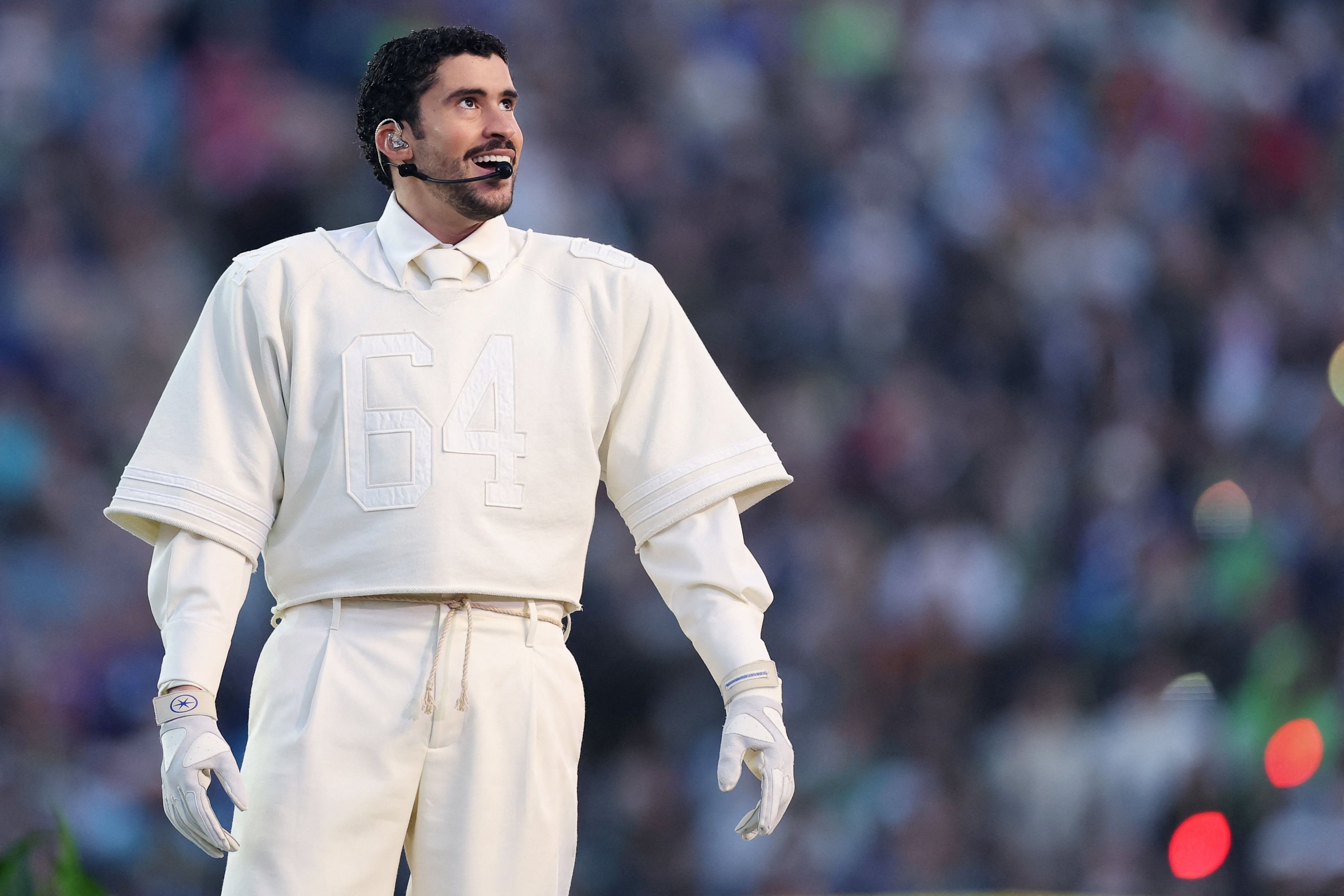
This challenge on the Grammy podium transformed into a visual revolution just a week later on the Super Bowl LX stage at Levi's Stadium. An event that could have remained within the confines of American local entertainment evolved into a global spectacle with Trump's harsh outburst against Bad Bunny, becoming one of the biggest shows ever televised in human history and a massive cultural manifesto viewed hundreds of millions of times on YouTube within 24 hours.
When Bad Bunny said "God Bless America" in English at the start of the Super Bowl show, conservatives expected a "surrender." However, immediately after this sentence, he reclaimed the patent on the word "America" from Washington by listing Latin American countries one by one. Puerto Rico planted its dust-blue flag, a symbol of the independence resistance, right in the middle of a temple of American popular culture.
It reflected the cultural rebellion of the Latin American world, which Trump, referring to as "our hemisphere," was trying to bring under U.S. imperial and cultural hegemony. Trump's characterization of this show as "the worst in history" and "a disgusting dance in an incomprehensible language" was actually an expression of the great fear felt by the American right: a "New America" had been born, one that could no longer be assimilated, refused to surrender to English and carried its own tragedies (such as the stage references to Hurricane Maria and the power outages) as badges of honor.
Bad Bunny, whose real name is Benito Antonio Martinez Ocasio, is one of the most influential and paradoxical figures in the modern music world. Born on March 10, 1994, in Puerto Rico, he went from working as a cashier in a supermarket just 10 years ago to becoming a global phenomenon today. From the beginning of his career, his refusal to assimilate and his decision to only make music in Spanish made him a symbol of "dignity" for the Latin world. The name "Bad Bunny" comes from a photograph of him as a child, forced to wear a rabbit costume at school, where he looked unhappy and angry. This name is now his trademark for his rule-breaking style.
While Bad Bunny's music is primarily Latin Trap and Reggaeton, he boldly blends genres like rock, punk and soul. He held the title of "the world's most streamed artist" on Spotify for many years and became the first artist to reach 5 billion streams in 2025.
Bad Bunny is also a political activist: in 2019, he was at the forefront of the protests that resulted in the resignation of the Puerto Rican governor. His "ICE out" statement in his 2026 Grammy acceptance speech and his references to Puerto Rico in the Super Bowl made him the strongest voice of the "liberal-Latin" alliance in American politics.
After the “Benito Bowl,” Bad Bunny is no longer just an American Latino singer, but a cultural symbol, the flagbearer of a political-cultural movement. The beginning of 2026, when globalization evolves into a time of radical disruption of the global order, points to a cultural revolution, a neo post-situationist rebellion.
Bad Bunny's Grammy victory and Super Bowl performance bear striking similarities to the revolution Marcel Duchamp started in the art world in 1917 by turning a urinal upside down and exhibiting it under the name "Fountain." This comparison helps us understand how popular culture has transformed from just "entertainment" into a tool for "institutional upheaval" and "political intervention."
Duchamp asked the question "What is art?" by bringing an ordinary industrial product (a urinal) into the most sacred space of art (the gallery). Bad Bunny, on the other hand, brought street culture, ghetto music (Reggaeton) and most importantly, "the language of the other" (Spanish), to the most sterile strongholds of the American establishment (Grammy Awards and Super Bowl).
While the introduction of a urinal into the gallery was shocking, the fact that an all-Spanish album won a Grammy and that "ICE Out" slogans echoed during the Super Bowl is equally a form of institutional "invasion." Duchamp had written his pseudonym "R. Mutt" on the urinal instead of his own name. This was a mockery of the artist's authority. The Bad Bunny and Trump duel, however, transformed what could have been just entertainment at the Super Bowl into a global "challenge" thanks to Trump's opposition. Trump's hatred turned Bad Bunny's performance, which he performed for free despite potentially earning millions of dollars, from a mere music show into a historical "conceptual work," much like Duchamp's urinal. Viewed hundreds of millions of times within 24 hours, this performance is no longer just a playlist, but a political manifesto signed by both Trump and Bad Bunny.
Duchamp's urinal was initially rejected, then later declared one of the most important works in art history. Similarly, Bad Bunny, initially dismissed as "neighborhood music," is now accepted by major institutions like the Grammy Awards and the NFL (Super Bowl) in order to survive. This is the most modern example of a system legitimizing itself by swallowing its own antithesis (opposite).
Bad Bunny, by combining the "ICE out" anger at the Grammys with the slogan "The only thing stronger than hate is love" on the glittering stages of the Super Bowl, became the new "savior" figure of American liberalism. By creating a popular rebellion against Trump's lawless, white supremacist mentality, he revealed the missing piece that the democratic current was looking for.
But the question we must ask at this point is: Does this figure, who shouts for immigrant rights and solidarity language on the one hand and bases his music on drugs and unlimited hedonism on the other, offer real freedom to the youth, or does he imprison them in a shallow "non-culture"? Before surrendering to the Benito Hurricane, we must examine the paradox created by Bad Bunny, the "conceptual invader' of popular culture: this figure, who transforms institutions like the Grammys and Super Bowl into political manifestos by using them as "ready-made" objects, while simultaneously shouting for refugee rights and building his music on drugs and objectified sexuality, is he truly liberating the masses? Or is he creating a new illusion within that infamous "non-culture," reducing political anger to a shallow consumption product for the profit of the American music industry? Are we witnessing another example of the capitalist establishment swallowing its dissent?
The truth is, Bad Bunny is no longer just a reggaeton star. In a geography where Trumpism has built "walls," he is not someone who jumps over those walls, but a political catalyst who paints those walls in his own colors and sings songs in Spanish over them. In this new era where politics is shaped not from podiums but from Spotify playlists and halftime shows and social media serves as a global communication platform for all of humanity, Bad Bunny stands at the very intersection of both the greatest rebellion and the deepest cultural void. However, this figure stands on that fine line between a "Spanish barricade" erected against the walls of Trumpism and the "shallow popular and decadent culture" of the modern world.