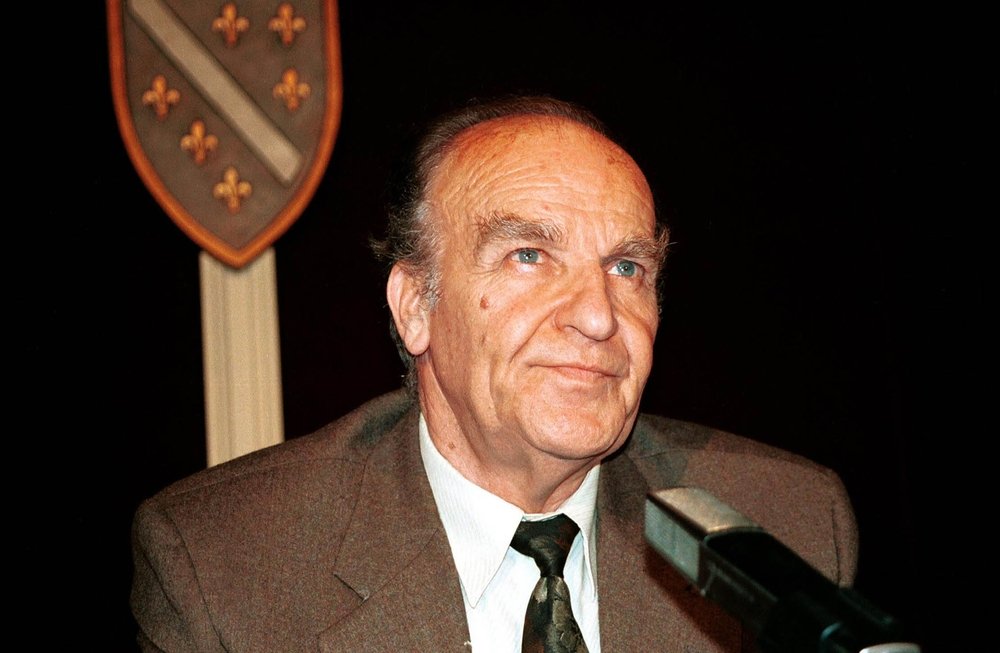
In the summer of 2011, I traveled to the Balkans with my children for the first time. Our first stop was Sarajevo. The first place we visited in Sarajevo was the grave of Alija Izetbegović. Buried at the Martyrs Cemetery in Kovaci, Izetbegovic rests among his wartime comrades – many of whom gave their lives in Bosnia’s long, agonizing fight for survival.
The grave sits on a hill, surrounded by centuries-old Ottoman tombstones, in what was once a children’s playground. For a leader who spent much of his life dreaming of peace, it is both a poetic and tragic place to lie.
Alija Izetbegovic is best remembered as the wartime president of Bosnia-Herzegovina during the 1990s, but his life and legacy extend far beyond the battlefield. He was a lawyer, a philosopher and a political visionary. He endured years of imprisonment for his beliefs and played a central role in shaping the modern Bosnian identity – one that sought to reconcile Islam, democracy and European belonging.
Born in 1925 in Bosanski Samac, Alija lived through almost every seismic event of the 20th century: the fall of the Ottoman Empire, World War II, the rise and collapse of Yugoslavia and finally, the brutal Bosnian War. If he had lived, he would have turned 100 this August.
Yet, perhaps his most enduring legacy is that Bosnia, despite all odds, managed to pull a fragile peace from the wreckage of the 1990s. Sarajevo – often called the “Jerusalem of the Balkans” – today lives in relative calm. This quiet endurance, however tenuous, may be Alija’s most significant project: a multiethnic society that, while still bearing its wounds, continues to breathe.
The Bosnian War was not simply a conflict over land. It was a war of erasure. The aim was to expel the Muslim identity from the Balkans – not only by displacing and killing people, but by destroying mosques, libraries and historical memory itself. Sarajevo, the city where World War I began, was under siege. Towns were emptied. Srebrenica became the site of Europe’s worst genocide since the Holocaust.
In the face of these horrors, Izetbegovic led a resistance that was both military and moral, intellectual and cultural. With limited weapons and international indifference, he held a fragile republic together through ideas. He called for dignity in the face of annihilation, for solidarity in the face of silence.
Not all of those who fought alongside him shared his faith or worldview. One of his most loyal commanders was Jovan Divjak, a Serb of ethnic origin. Izetbegovic’s genius was not in ideological purity but in his capacity to bring people together under a common idea: that Bosnia, multiethnic and multireligious, deserved to live.
In times of deep darkness, his words were a compass: “Life is a game which no one wins except those who believe and do good.”And this: “In the end, what we will remember is not the words of our enemies, but the silence of our friends.”
These were not mere aphorisms; they were reflections formed in prison cells and tested in the fire of war.
Today, the Alija Izetbegovic Museum in Sarajevo preserves his letters, speeches and the story of a life lived between prayer rugs and diplomatic tables, trenches and parliaments. His Bosnia was not one of revenge, but of restoration. He once said that the only future worth fighting for was a peaceful one, and that if Bosnia could live in peace, it could serve as a model for other wounded lands, such as Palestine and Kashmir.
He saw culture not as a luxury, but as a form of resistance. During the siege, Sarajevo’s philharmonic orchestra played in candle-lit basements. The Sarajevo Film Festival began as a symbol of defiance, a cinematic scream in a city surrounded by tanks. For Izetbegovic, survival was not enough. Memory had to survive, too.
Now, 100 years after his birth, we find ourselves in another moment of global silence. As we witness the destruction of Gaza and the deafening indifference of world powers, Izetbegovic’s example feels both distant and urgent. What would he say today? What would he do?
Perhaps he would remind us that neutrality in the face of injustice is not peace – it is complicity. Moral leadership is not loud, but steadfast. That even in the deepest night, thought and faith can still light a path forward.
Alija Izetbegovic died in 2003. But Sarajevo still remembers him not just as a president or wartime leader, but as a son of the city – a man of dignity who made the impossible seem imaginable.
On his 100th birthday, we remember him not only for what he accomplished, but also for what he taught us about what it means to lead, to hope, and to persevere.
Happy 100th, Alija. You still have much to teach us.