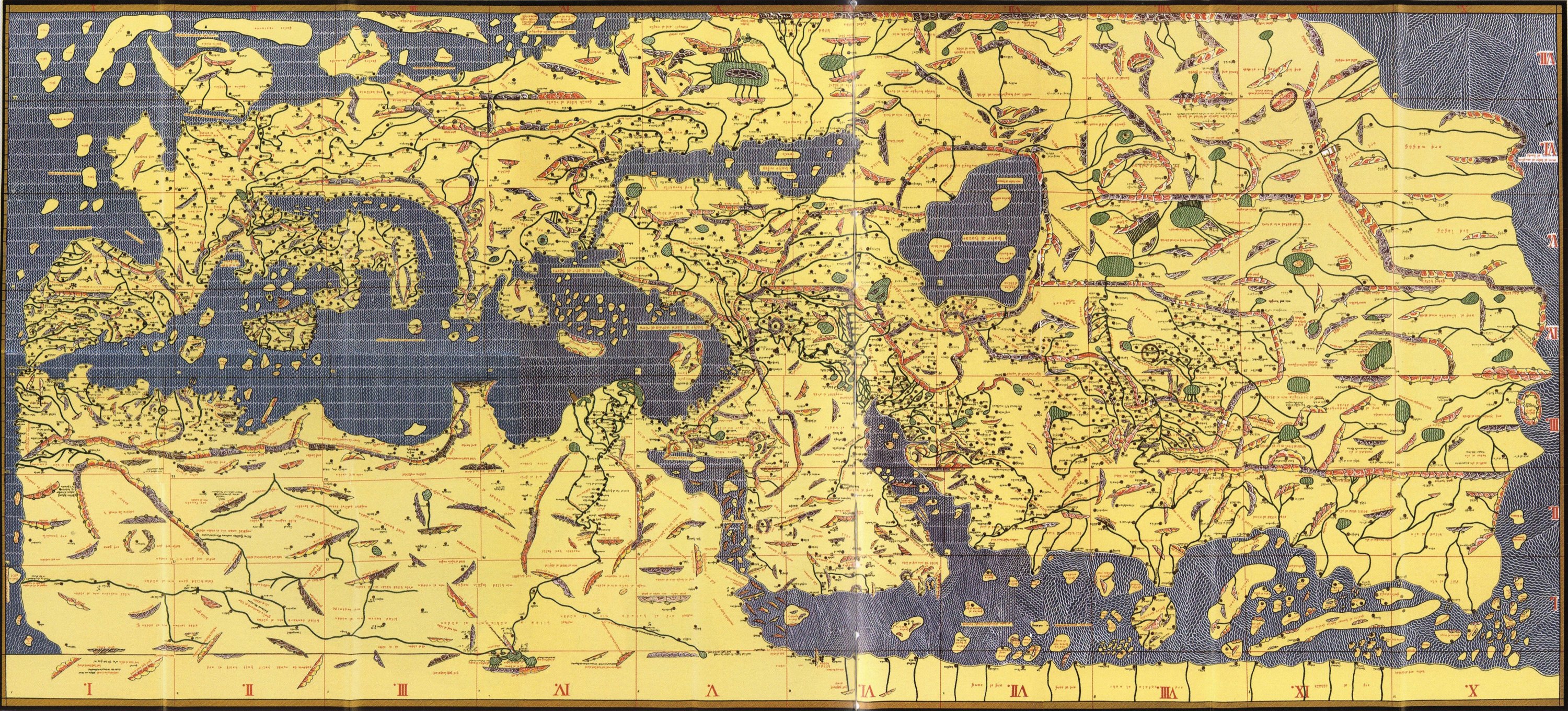
In the first piece I wrote on the man regarded as the greatest Muslim and medieval geographer, Muhammad al-Idrisi, that came out last week, I looked at his life and contextualized it within its time. Here, however, I want to look at what made him famous – his geographic work, "The Book of Roger."
According to the historian Marina A. Tolmacheva, there are 10 surviving manuscripts of this great work and eight of them have maps. However, she also notes that “there is no good complete translation.” Not being proficient in Arabic, I myself was only able to access part of this great work and not in English. I only managed to find a French translation of what al-Idrisi wrote on Africa and Spain. I have relied on this, rendered into English of course, to give a direct taste of his work in addition to extensive quotations of other parts that I found in secondary sources.
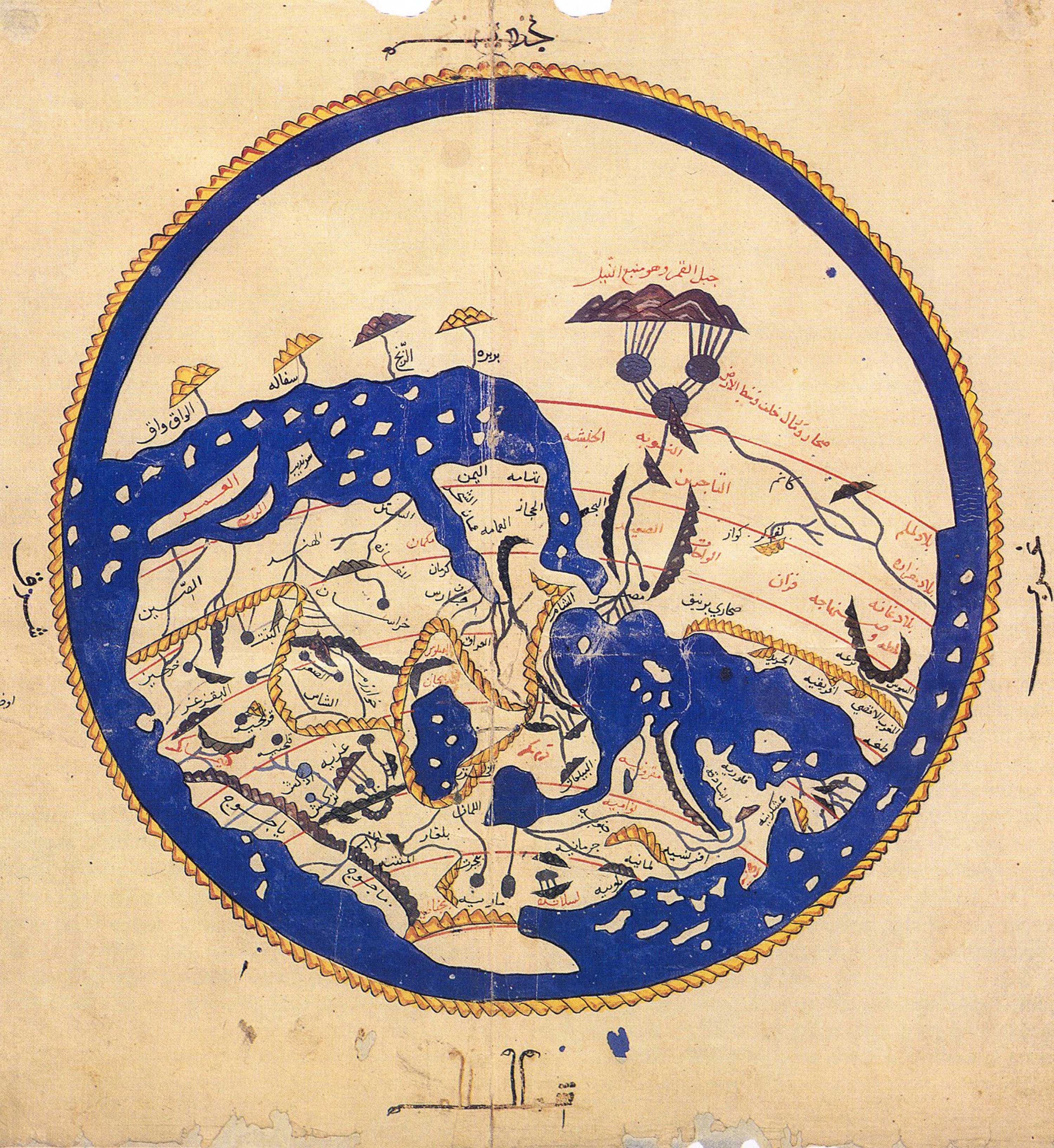
To give a bit of an overview of "The Book of Roger" itself, al-Idrisi, as with other scientists both classical and medieval, knew that the Earth was spherical. Al-Idrisi states at the beginning of his work that “the earth is round like a sphere, and the waters adhere to it and are maintained on it through natural equilibrium, which suffers no variation.” The world is then divided by him into seventy regions. This is done by accepting the seven latitudinal climatic zones of the Ancient Greek geographer Ptolemy and crossing them with 10 lines of longitude. As a Moroccan, al-Idrisi obviously personally knew what was considered the end of the world in the West in his own time, but his geography stretches in the other direction as far as Korea, known to him as Sila, in the East. Not only is his geographic knowledge wide, it is also, as Tolmacheva reveals, commendably “academically unbiased,” with “all locations” in it getting “more or less equal attention.” The importance of al-Idrisi as a geographer can especially be gauged from Tolmacheva’s comment that “he describes many identifiable locations for the first time in the geographical literature.”
In order to give a direct taste of al-Idrisi’s work, I have chosen to focus on the Algerian city of Constantine. This is perhaps not one of the best-known cities in North Africa, let alone the world, but it is certainly a city that al-Idrisi personally visited, and his presentation of it reveals much about the geographer himself.
Al-Idrisi opens his remarks on Constantine by noting that it “is a populous and commercial city” and that “its inhabitants are wealthy,” the surrounding area also provides the city with agricultural wealth. This is capable of being stored against harsh times, for al-Idrisi also reveals that “the subterranean storerooms are so excellent that they are able to preserve wheat for a century.”
In explaining the position of Constantine, he notes that “this city is built on a sort of isolated promontory, in the form of a square that is slightly rounded” and it “is only possible to enter it from the western side, where there is a relatively small gate.” Al-Idrisi also notes that close by is where the people of the city bury their dead, the typical position of a cemetery in cities of that time. Due to its particular shape, although the city is walled, these walls are only 3 feet tall except on the side of the Gate of Mila, the small aforementioned western gate, which is the side that connects the promontory to the rest of the higher land. For on the other sides, it is protected by its elevation and its being surrounded by the bends of a river. As such, “Constantine is one of the strongest places in the world; it dominates the extensive plains and the enormous fields of wheat and barley.” Furthermore, should it face a siege, it has a supply of water kept in a large stone trough next to the city walls.
As for what the city contains, “all that remains of the ancient citadel of the city are ruins, but the theatre constructed by the Romans and whose architecture resembles that of the theatre of Tsirma (Taurominium) in Sicily, still remains.” And then there is the city’s Roman bridge. Al-Idrisi notes of this that:
The bridge constructed by the Romans is an impressive structure. Its height, (above the level of the waters) is more than one hundred cubits (or 47 meters). It is made up of five upper and lower arches, which span the breadth of the valley.
As for the arches of the bridge:
These arches are supported by piers, which break the violence of the current of the river and which are pierced at the top of them by small openings, which are ordinarily of no use. During the exceptional floods that happen from time to time, though, the waters that rise above the levels of the piers pass through these openings.
Having given his more extensive notes on the bridge that I have quoted here, al-Idrisi even then feels compelled to exclaim that “this, we repeat, is one of the most amazing constructions that we have ever seen.”
As for the houses of the city, al-Idrisi reveals that all of them are made of earth with paved ground floors. He also notes that “there exist in all the houses two, three or four cellars that have been cut out of the rock; the temperature in them is constantly fresh and moderated, helping with the preservation of the grain.”
What is immediately obvious about this account is how much it differs from the popular image of cities in the historic Islamic world as provided by "The Thousand and One Nights" or the tales of Orientalist travellers. Those are colourful and exotic, while al-Idrisi’s approach avoids all unnecessary embellishment and exotic imagery. It is focused on what an analyst would find interesting about a city today – its economic basis, its defensive capabilities and its landmarks. It is especially in regard to one of these that al-Idrisi reveals his character. This Roman bridge of Constantine clearly impresses al-Idrisi. The detail that he goes into regarding its structure and its special design to deal with flooding shows his eye for the marvels of engineering. It is also noteworthy that the people differ from the latter Orientalist stereotypes of being endearing but rather silly by being instead implicitly rational in making the best use of their environment to enrich and protect both themselves and their goods, the latter through a kind of refrigeration system.
Although Constantine was a city that al-Idrisi knew personally, his geographic work covers areas that he would not have known himself and would instead have relied on written and spoken accounts to depict. Here, for instance, is what al-Idrisi has to say about the South Asian city of Multan, now in Pakistan. He writes of it that it is “a large city commanded by a citadel, which has four gates and is surrounded by a moat.” Although in al-Idrisi’s time the city had been conquered centuries before by Muslims in the Umayyad Era, it was either then still a city with a notable Hindu presence or al-Idrisi was anachronistically drawing on reports from earlier pre-Islamic times when he reveals that there was a grand temple to what he designates the Sun-god of the Hindus. Al-Idrisi claims that “there is no idol in Hind or Sind more highly venerated” and that “the people obey it as law and make it the object of pious pilgrimage.” Although as a pious Muslim, al-Idrisi obviously does not believe, with “its inhabitants,” that “its presence secures divine protection,” his portrayal of the temple and its worshippers is dispassionately descriptive rather than pejorative, once again betraying al-Idrisi’s scientific geographic approach.
Moreover, with Multan, as with Constantine, al-Idrisi is interested in the welfare of its inhabitants. He notes that it is a city well stocked with provisions and that the population, which is well-off, pays little in tax.
The latitudinal zones that al-Idrisi believed in have already been touched on. These cut across the world, with the middle zone at the equator, and then three other zones to the north and the south. These zones reflect climatic differences. They also cause al-Idrisi to make certain errors whilst simultaneously revealing his scientific mindset. One error, the lesser of the two to be looked at here, concerns England. Of this al-Idrisi claims:
England is set in an Ocean of Darkness. It is a considerable island whose shape is that of the head of an ostrich, and where there are flourishing towns, high mountains, great rivers and plains. This country is most fertile; its inhabitants are brave, active and enterprising, but all is in the grip of perpetual winter.
The only “perpetual winter” to be found in England is in the first of the Narnia books by C.S. Lewis, so al-Idrisi is wrong here. Moreover, he seems to have engaged in a logical fallacy, for even if England was perpetually wintery, it would not be possible that the country be “most fertile” if all the flora in it were subject to constant freezing conditions. Yet, it must be that his theory of the zones forces al-Idrisi to combine the reports that reach him about England with the idea that, its being in a freezing zone, it must be constantly cold.
The opposite occurs when he deals with the Nile. According to the historian Nehemia Levtzion, al-Idrisi believed that the Bilad al-Sudan, the capital of Ghana, lay on the Nile, which ran through Ghana itself. As Levtzion puts it, “Al-Idrisi followed Ptolemy in assuming that all of the southern lands are in an arid torrid zone, where life depended completely on the river [Nile].” As cities require water to survive, but according to the zone theory, no rain fell in this southern zone, Levtzion notes that “the Nile of al-Idrisi was indeed a very strange river that meandered in order to pass through all the towns of the region.”
As for the source of the Nile (or Nil), al-Idrisi believed that it came from lakes fed by spring waters in Jabal al-Qamar. Al-Idrisi claims that:
This lake is just beyond the equator and touching it. In the lowest part of this lake, in which the rivers collect, a mountain protrudes, splitting the main part of the lake into two and extending the lake to the northeast. One of the branches of the Nil flows along this mountain on the western side. This is the Nil of Bilad al-Sudan, on which most of the towns are situated. The second branch of the Nil comes out of the lake on the eastern rift of the mountain and flows to the north, through the country of Nuba and the country of Egypt.
Thus, for al-Idrisi, there were two Niles and not the Blue and White Niles that we know today. Rather, there was the Nile that ran north through Egypt and another great river that flowed to the west and exited in the Atlantic Ocean. This leads to the question of whether al-Idrisi knew something of the Congo and the Niger rivers and conflated the two somehow. It is noteworthy though, that al-Idrisi is somewhat right, for the source of the White Nile is indeed found in a lake region of equatorial Africa.
Despite this, al-Idrisi is wrong in his understanding of the arid geography in the region of the equator. He is, of course, not the first or the last scientific thinker to make errors. His errors, though, are understandable and even commendable in that he had compelling reasons to hold them. Firstly, in his wanderings, he would have found empirical support for his climatic zone theory. Having travelled from west to east across the Mediterranean world, he would have been aware that the climate was essentially the same, and that it was temperate. This would allow him to conclude that latitudinally, climate does not vary. He would also have known, from North Africa and the Hijaz, that to the south of the Mediterranean region there stretched an enormous desert with an extremely hot and dry climate. He would have had no compelling reason to think that, as actually happens, this would change and the land would turn green under tropical rainfall again before the equator.
Moreover, to the north, some regions much further towards the pole do indeed seem to have what could be regarded as a perpetual winter despite the nominal change of seasons. And there is no way that al-Idrisi could know that England has something approaching a temperate climate in spite of its latitude, due to the hidden Gulf Stream that runs through the Atlantic Ocean and warms it.
The scientists who deserve reproach are those who adhere to a logical theory when empirical evidence clearly falsifies it. Yet, al-Idrisi had no empirical reason to challenge his logical theory, for he did not see the tropics himself. His theory that as one goes north it gets colder and icier and as one goes south it gets hotter and drier is eminently logical, and it is not empirical to accept the stories of other people as true, especially as travellers’ tales at this time could contain what the historian Richard Hall calls, in reference to one of them, “many fantastical anecdotes.” Al-Idrisi clearly prefers the logicality of his theory to the dubiousness of what travellers might relate.
Al-Idrisi died in 1165 or 1166 and there are conflicting views as to whether this happened in Sicily or back in his native Sabtah, now Ceuta. What is certain is that he spent much of his life on Sicily, an island which had recently been conquered from its Muslim rulers by the Christian Normans. At the time, al-Idrisi could not have known that their Catholic cousins in Iberia would conquer all of al-Andalus as well and even come to launch offensives across the Strait of Gibraltar into his native Morocco. Although those campaigns have left little in the way of legacy and the Strait of Gibraltar today effectively marks a civilisational boundary, there is still a tiny Spanish presence left in its North African enclaves of Ceuta and Melilla, the former being al-Idrisi’s Sabtah. Within this tiny territory, there is a statue of a proud-looking al-Idrisi. This seems apt. For this scientific thinker from the Islamic Golden Age was an intellectual colossus that spanned the Muslim and Christian worlds, influencing both. For instance, he is credited with influencing Ibn Khaldun, arguably the most original and profound thinker of the Islamic world, and in Europe, his significance can be gauged from his work of geography being, as Tolmacheva reveals, “the first secular Arabic work printed in Europe.” Thus, the life, work and legacy of this remarkable Muslim scholar were truly all intercontinental.