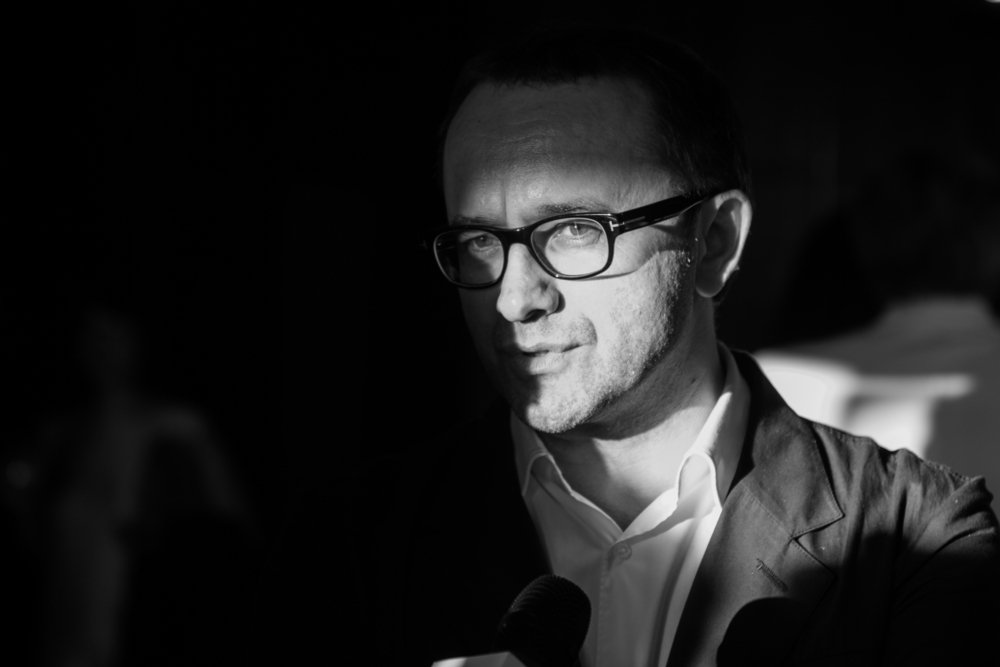
Istanbul's Russian bookshop Poltory Komnoty hosted one of its most exciting events last week of July: a conversation with the world-renowned film director Andreyy Zvyagintsev. Zvyagintsev is a great conversationalist, as I had discovered several years ago at a film festival in Doha when I interviewed him for Daily Sabah. Since then, I have been trying to follow his career and I was quite alarmed when I read that he had been hospitalized for COVID-19 and had not heard of him since. So it was a great relief and pleasure to see him in the flesh in Istanbul.
Zvyagintsev is known for his hard-hitting social commentary films like "Elena (2011)," "Leviathan (2014)" and "Loveless (2017)." The director starts the conversation with a preamble about the ethos of his films: that his characters are ordinary people who are put in situations where they must make tough choices. He then immediately turns his camera to the audience, which is made up mostly of Russians and a couple of Turkish husbands who’ve clearly been dragged there by their Russian wives. "You, you too have made a choice by coming to and settling in Istanbul."
This sadly does not lead to a collective discussion of Russia’s war on Ukraine and what it means to have left Russia and chosen Istanbul. Zvyagintsev says that it is a miracle that we see him before us, that he was ill for a long time and could not lift a finger. He is now working on a film called "Minotaur" (clearly hoping to replicate the success of his former mythical creature "Leviathan") with the French and has been shooting since October last year.
The first question he gets from the audience is how he gets the actors to work so naturally. Zvyagintsev’s example is from "Loveless," and he says he had hundreds of boys read Alyosha’s lines without giving them any direction. For him, he says, it is important to see how the actor interprets a scene and if their visions match, then they’re the right person for the role. He praises Maryana Spivak, who played the role of Zhenya and who reported to him that her neighbor had censored her saying: "Aren’t you the woman who plays that horrible mother."
To the question of how he picked his locations, Zvyagintsev spoke about the location of "Leviathan" the film, he reminded us that it got prominent people in the Russian cultural establishment, like Vladimir Medinsky and Vladimir Solovyov (who continue to have a lot of influence in the Putin regime), to ask him to apologize to the Russian people because of the way he portrayed his country. Zvyagintsev and his team traveled the length and breadth of the country – let’s face it, Russia is big – and finally settled on the town of Teriberka on the Barents Sea Coast.
As the name of the film calls for it, the production needed the skeleton of a whale and Zvyagintsev could not find one that would meet his needs. So, taking their inspiration from The Natural History Museum in London, they made one that suited the film’s theme. Trying to explain how "directorial decisions" work, Zvyaginstev shared that the material of the skeleton and where it would be situated were all decided on how much each option would cost, and that he went for the cheapest one.
To bring Zvyagintsev’s work in conversation with world cinema, one member of the audience asked what he thought about Bong Joon Ho’s admission that "Parasite" was inspired by Zvyagintsev’s "Elena." The director’s answer to this was very demure, saying that everyone in the film industry was inspired by everyone else, and that we are all "mirrors to one another." He related how, when "Parasite" was first shown in Moscow, the screening started with a short message from Joon Ho citing Zvyagintsev as an influence. Zvyagintsev says he was told that his films seemed to be inspired by Chantelle Ackerman, whom he said he had never seen at the time.
Keeping with the international aspect of his work, one viewer asks if he would think of setting one of his films in Istanbul and whether he follows the work of any Turkish directors. He starts with the second question, looks a bit lost and then a Russian lady sitting close to me shouts "Fatih Akın" to which he seems quite unmoved and then she has to explain that he is Turkish but lives in Germany. And then a few voices say Nuri Bilge Ceylan, which sounds much more familiar to Zvyagintsev, and then one of the few Turkish-looking members of the audience calls out "Zeki Demirkubuz" to which, again, there is no reaction. Zvyagintsev returns to the first part of the question much later, when he is talking about a project about the last days of Socrates, how the producers told him that it needed women to be more "relatable." The director said that the setting he had in mind had no women and introducing elements just to please the producers was not something he would do. So yes, if a story called for it, he would set it in Istanbul, but not for the sake of it.
And then the boon of all creative artists: someone asks if there was a specific meaning/message he wanted to convey in his films or were the audience to make their own meaning out of them. To this, he poetically answers: as we watch the film, the film watches us as we make our own meaning. What you see on the screen are mere shadows, the actual film is inside the audience’s mind.