Routine is one of those words that at first feels uninspiring, even dull, and yet it quietly shapes the way human beings live, think and create. To call something a routine is to suggest predictability, repetition and the absence of surprise. But if one looks closer, what appears monotonous often carries within it the hidden architecture of freedom. It is the framework that supports the weight of our days. The philosopher Marcus Aurelius reminded himself to rise each morning with duty in mind, noting that “at dawn, when you have trouble getting out of bed, tell yourself: I have to go to work as a human being.” Routine in his understanding was not the enemy of life, but the discipline that protected the mind from scattering itself in all directions. Soren Kierkegaard, in his reflections on repetition, saw the daily return of tasks as a way to affirm existence, to say yes to life not just once but again and again.
Modern psychology tells a similar story. Habits conserve energy; they reduce the friction of decision-making, leaving us free to direct attention to higher pursuits. William James observed that “all our life, so far as it has definite form, is but a mass of habits.” What he called habit, we now call routine: the small gestures that give life shape, the pattern into which creativity can flow. Yet for artists, this structure is both a blessing and a curse. Some thrive in daily order, while others rebel against it, fearing that predictability will kill invention. Jean Cocteau once warned that “routine is the death of the soul,” voicing the anxiety that repetition could calcify sensitivity. But Picasso countered with his oft-repeated line: “Inspiration exists, but it has to find you working.” Between these poles lies the paradox every artist must navigate, discipline and freedom, habit and improvisation.
Looking back at the lives of Western painters, one begins to see how differently this paradox has been resolved. Claude Monet, for example, relied on strict rhythms. He rose before dawn, setting up his easel outdoors in order to capture the changing light of the morning. His famous series of haystacks, cathedrals, and water lilies were not the product of sudden bursts of inspiration but of daily repetition, a ritual of watching and recording. Monet himself said he wanted to paint not the objects but “the air in which the bridge, the house, the boat is to be found.” Such a statement makes sense only when we realize how carefully he trained his eye through repeated observation; his routine was what allowed him to see the ephemeral.
Paul Cézanne followed a similar path but with a different temperament. He was not chasing the fleeting, but the enduring. Every morning he set out with his easel, returning again and again to mountains. For his neighbors it was an almost comic sight, this solitary man painting the same mountain endlessly. Yet Cézanne was not repeating for repetition’s sake. He believed genius was “the patience of long practice.” In his ritual, sameness became revelation. Routine was not monotony, but a pilgrimage in which each day’s encounter with the mountain revealed something new.
Vincent van Gogh, often imagined as a creature of feverish spontaneity, also relied on ritual. In Arles he painted from morning until late afternoon, ate simple meals, and wrote letters to his brother in the evening. He repeated subjects, the sunflowers, the wheat fields, the cypress trees, not to bore himself but to wrestle with their mystery from every angle. His letters are full of references to these rhythms, small anchors for a turbulent mind. “I am seeking, I am striving, I am in it with all my heart,” he wrote. For him, routine was survival as much as it was art.
Picasso, by contrast, embodied restlessness, yet he too was bound by daily practice. His friend Brassaï recalled how Picasso would spend the entire day in his studio, beginning after breakfast, breaking only for short meals, and often working into the night. He created thousands of works not because he waited for inspiration but because he accepted work as a daily necessity. In this sense, his studio routine was a furnace in which invention was ceaselessly fed. He knew instinctively what Flaubert once counseled writers: “Be regular and orderly in your life, so that you may be violent and original in your work.”
Henri Matisse demonstrates another dimension of the power of routine. Stricken by illness later in life, he could no longer stand at an easel. Confined largely to his bed, he developed the practice of cutting colored paper, arranging it into collages, and guiding assistants to pin the shapes onto the walls. What might have been a tragedy became a new form of freedom because he allowed routine to adapt to limitation. Day after day he returned to the scissors and paper, and from these modest rituals came his radiant cut-outs.
Leonardo da Vinci presents yet another variation, one that unsettles our usual understanding of order. His routine was famously unconventional, almost fragmentary. He worked in bursts of intensity, sketching anatomical studies, designing machines, painting, and writing notes often within the same day. Sleep came to him in short intervals rather than long stretches; some accounts describe him taking brief naps through the day and night, following a polyphasic rhythm that maximized his waking hours. He could spend hours watching the movements of water, or studying the flight of birds, as though routine itself meant constant observation rather than repetitive labor. In his notebooks he advised: “Every now and then go away, have a little relaxation; for when you come back to your work your judgment will be surer.” For Leonardo, routine was not linear discipline but a cycle of curiosity, rest, and return. His genius was fueled by these strange rhythms, a reminder that even irregularity can be a kind of order.
And then there is Jackson Pollock, the anti-routine, who sought chaos rather than order. He poured enamel onto canvases spread across the floor, circling, dripping, flinging in gestures that seemed to defy discipline. Yet even here, one senses a kind of ritual: the preparation of the canvas, the mixing of paints, the circling of the body over the surface. What looked like chaos had its own pattern. The absence of conventional routine became itself a repetitive gesture, a new rhythm born of resistance.
The tension between order and chaos is not unique to painters. Writers too have spoken of it. Gustave Flaubert urged regularity in life precisely so that the work might explode with originality. Maya Angelou described how she kept a hotel room where she wrote every morning, returning home only when the day’s work was finished. Haruki Murakami wakes before dawn, writes for five or six hours, runs in the afternoon, and goes to bed early. W.H. Auden went so far as to claim: “Routine, in an intelligent man, is a sign of ambition.” These voices remind us that for many, routine is not an enemy of creativity but its most reliable companion.
Still, the suspicion lingers. Cocteau’s fear that routine deadens the soul is not without foundation. There are times when repetition does harden into stagnation, when an artist begins to repeat gestures mechanically. The brush no longer seeks, it merely executes. At such moments, routine does indeed become curse rather than blessing. The challenge is to remain awake inside repetition, to find freshness even in familiar acts.
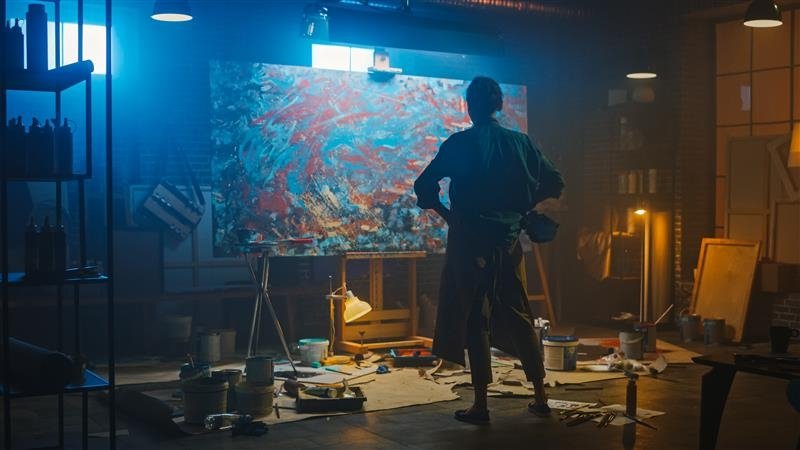
In my own practice, I have found that ritual can be physical, even playful. Before I begin a new painting, I dance. Not a performance for anyone, but a private ceremony that gathers my energy. Sometimes it is a slow movement of the whole body, sometimes just the dancing of my hands, letting them sway and circle in the air. This warms them, loosens them, makes them alive. I feel as though I am gathering invisible threads of beauty and pulling them into myself. By the time I pick up the brush, the studio is already charged with vitality. It is a routine, yes, but one that is alive, filled with joy, never mechanical. It is not about discipline in the narrow sense but about preparing my body and spirit to meet the unknown on canvas.
Nietzsche remarked that “only strong natures can endure the monotony of routine; it is the weak who are devoured by it.” Endurance here does not mean passive submission but active transformation. The strong artist does not collapse under routine; she bends it into a living rhythm, like a musician transforming a scale into endless melody. For Monet, the repetition of light was a ladder to transcendence. For Cézanne, the repetition of a mountain was a search for permanence. For van Gogh, the repetition of sunflowers was a fragile anchor against madness. For Picasso, daily labor became an inexhaustible furnace of invention. For Matisse, ritual made limitation fertile. For Leonardo, irregular rhythms of work and rest fed insatiable curiosity. And for Pollock, even the refusal of routine became its own kind of ritual.
What we learn from their lives is that routine is never neutral. It is always either a source of energy or a form of decay. It can be blessing or curse depending on how one inhabits it. To embrace routine with awareness is to create the conditions for freedom. To fall asleep inside it is to risk suffocation.
In the end, routine is what allows art to exist not as a single flash of inspiration but as a sustained flame. It gives shape to days, protects the fragile thread of concentration, and makes space for the unpredictable arrival of vision. It is not opposed to creativity but intertwined with it. The artist must only learn how to keep it alive, how to let repetition remain open to wonder. Perhaps that is the true art of routine: not to abolish surprise, but to give it a place to return to, day after day.