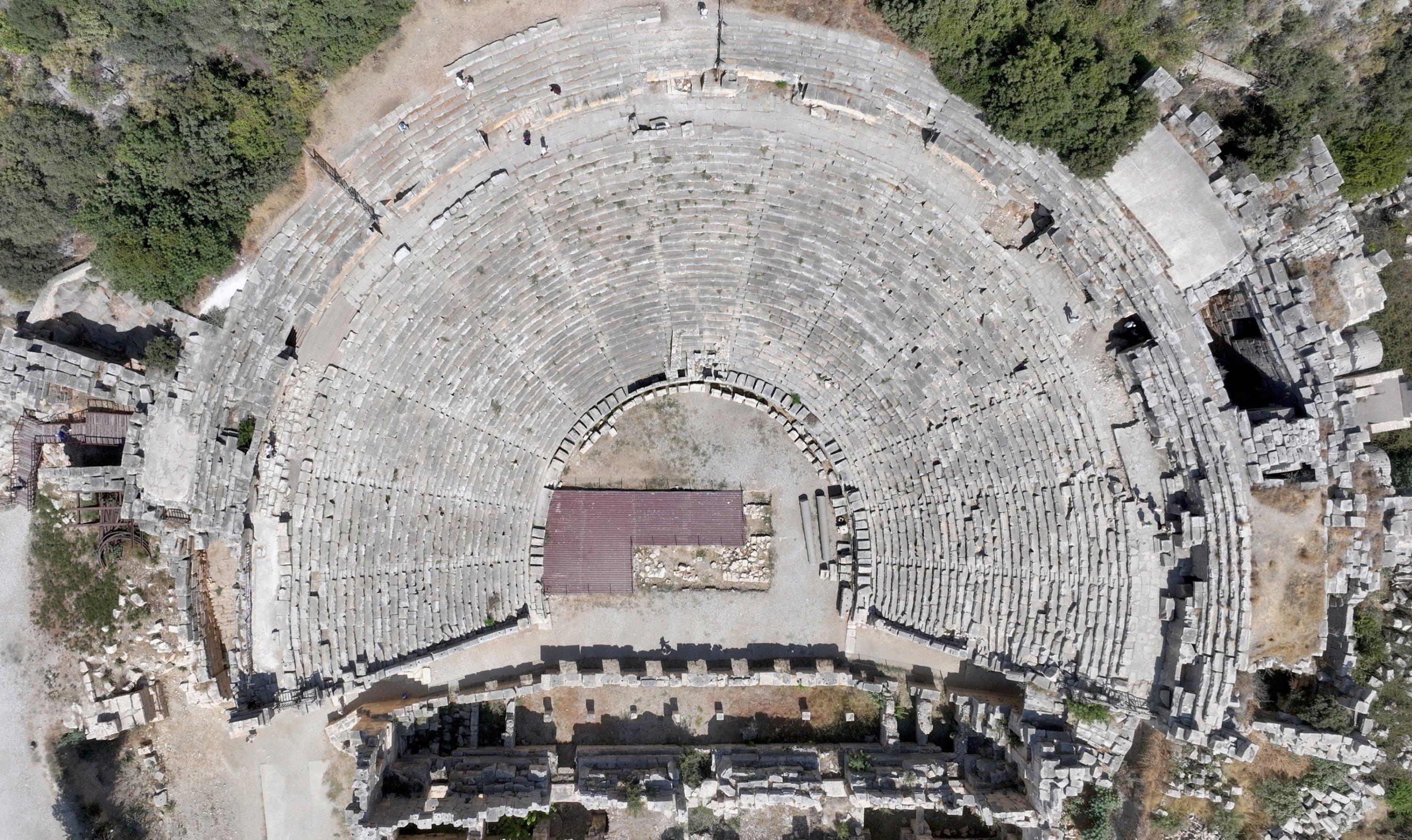
The ancient theater in Myra, one of the six most important cities of the Lycian League, is set to regain its original appearance through the reconstruction of its stage building with original stones.
Excavations at Myra Ancient City, located in the Demre district of Türkiye's Antalya and renowned as a metropolis during the Classical, Hellenistic and Roman periods, have been ongoing since 2009.
Led by professor Nevzat Çevik, a faculty member of the Archaeology Department at Akdeniz University and head of the Myra-Andriake excavations, these efforts have focused particularly on the city’s famous Classical-era rock tombs and the massive ancient theater. With a seating capacity of 11,000, the theater’s stage building will be rebuilt under the Ministry of Culture and Tourism’s “Legacy for the Future” project, which includes detailed surveys, restitution and restoration plans.
Following approval by the Antalya Conservation Board, the project will be put out to tender by the Survey and Monuments Directorate. The first floor of the stage building will be completed, with missing columns, capitals and other architectural elements restored in a specially established “stone hospital” facility before being reinstalled.
Çevik told Anadolu Agency (AA) that the theater is the largest ancient theater in Antalya, capable of accommodating 11,000 spectators.
Since 2009, extensive excavation and research have identified numerous original blocks and their exact positions. “Within the project, we will reconstruct the stage building up to the first floor using these original stones. The structure will reach approximately 14 to 15 meters in height. Once the first floor is restored, it will be both preserved through consolidation and partially opened for use, transforming it into the region’s largest cultural event center – much like Aspendos,” he explained.
Emphasizing Myra’s significance as a metropolis throughout history, Çevik revealed that the city is covered with alluvial deposits ranging from 4 to 10 meters deep, resembling an Anatolian Pompeii. “We conducted a yearlong geophysical survey in the area and obtained data about the ancient remains beneath the district. Beneath Demre lies a large ancient city spanning 1.5 to 2 kilometers in diameter. We only see the theater, but one can imagine how vast the city must have been to host such a large venue,” he said.
Çevik also noted that Myra boasts 103 highly sophisticated Classical-period rock tombs, with the earliest archaeological finds dating back to the Chalcolithic Age.
“The region, with its ancient city and harbor, continues to attract attention as it did in the past. We run projects aimed not only at rescuing, restoring and preserving the ruins but also at revealing the deep and rich history and culture of the settlement through scientific research. These efforts undoubtedly contribute significantly to tourism and the socio-economic life of the area,” Çevik concluded.