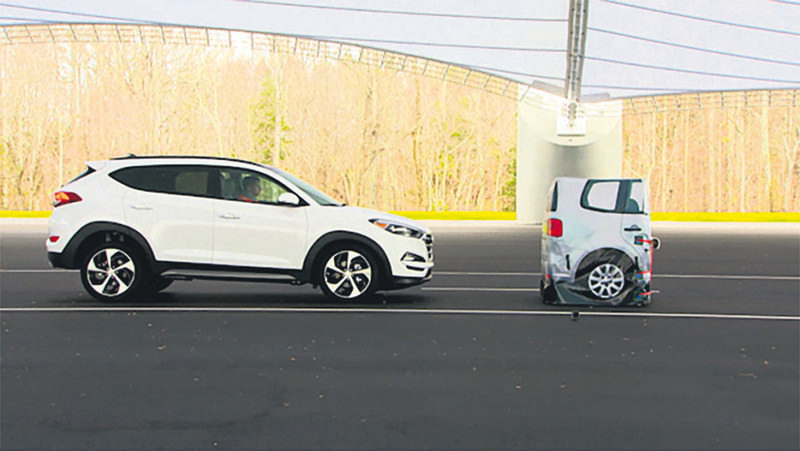
Major automakers and the U.S. government have reached an agreement to make automatic emergency braking standard equipment on most cars by 2022. Automakers will phase in the equipment on nearly all models except some with older electronic capabilities and some with manual transmissions.
Automatic emergency braking uses cameras, radar and other sensors to see objects in the way and slow or stop a vehicle if the driver doesn't react. The technology already is available as an option on many models, but automakers are struggling with how to fit it into current product plans that might not be ready for the electronics. Making the feature standard equipment on nearly all cars will speed adoption of the technology.
NHTSA chief Mark Rosekind wouldn't comment, but he indicated that the agreement would cover tractor-trailer rigs as well as cars and other light vehicles.
Auto safety chief's car recalled for Takata air bags
A family car owned by the nation's top auto safety regulator's family has been recalled to fix a faulty Takata air bag, but like millions of others, he's waiting for parts to make the repair. National Highway Traffic Safety Administration chief Mark Rosekind said Wednesday that a car normally driven by his wife was recalled to fix an air bag inflator. When she checked the vehicle identification number in a recall database, she found there were no replacement inflators available. Takata inflators can explode with too much force and spew shrapnel at drivers and passengers. They're responsible for at least 10 deaths worldwide and more than 100 injuries. So far 14 automakers have recalled 24 million U.S. vehicles with Takata inflators in what is now the largest auto recall in the country's history. About 7.1 million inflators have been replaced, and NHTSA has said the recalls almost certainly will grow larger. Rosekind wouldn't identify the type of car, but he said the family is fortunate to have another vehicle for his wife to drive in California, where she lives. The agency has taken over management of the recalls and is sending replacement parts to older vehicles and to those in high-humidity areas along the Gulf Coast. Takata uses the chemical ammonium nitrate to create a small explosion and fill the air bags in a crash. But tests have shown that the chemical can deteriorate over time when exposed to high temperatures and humidity. Rosekind said he's not getting special treatment, though, and the car is going to be fixed at the "appropriate time."