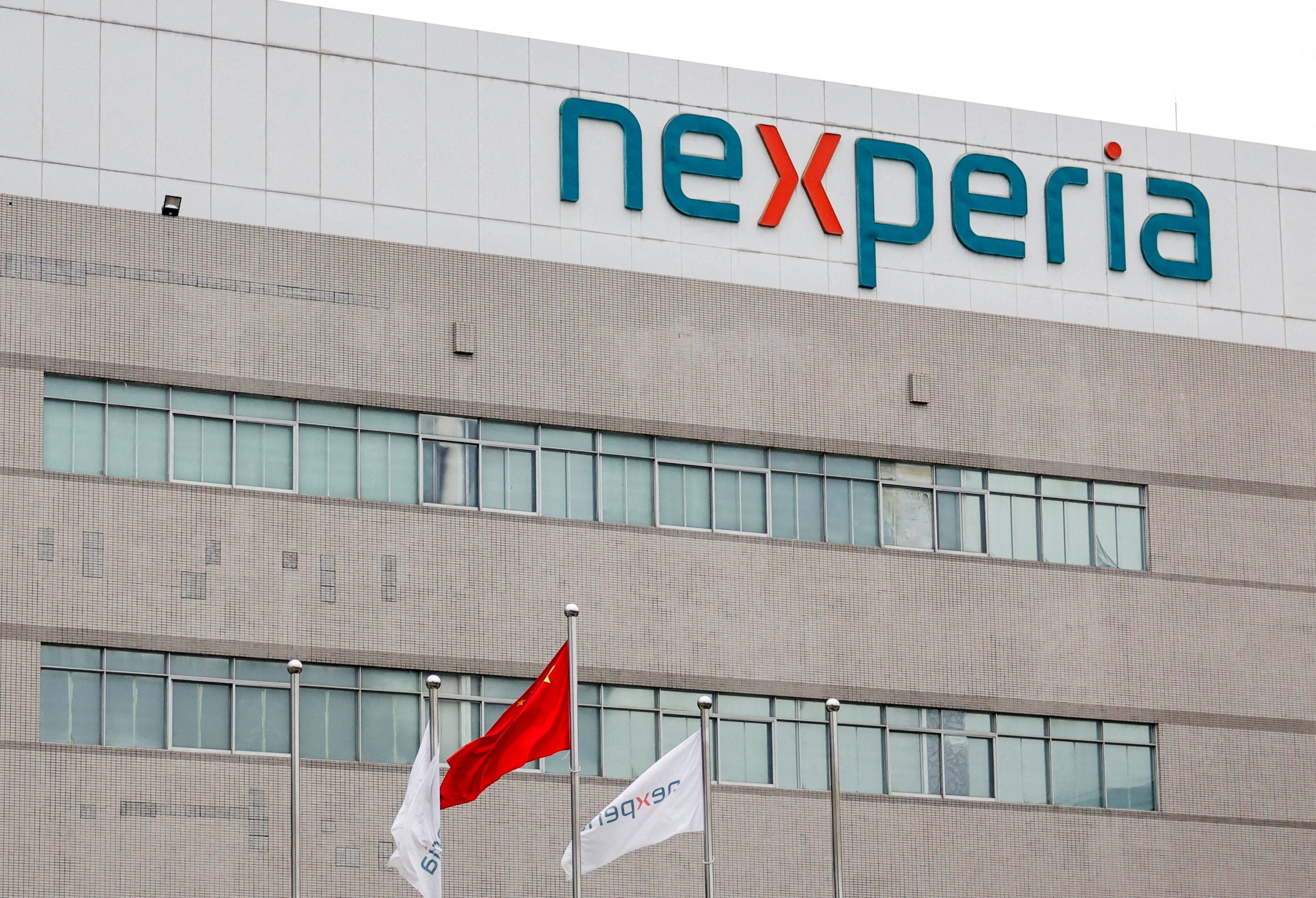
A plant beside a weed-ridden lot in southern China has emerged as a global bottleneck for auto chips, rattling an industry that promised it had learned its lesson on supply-chain disruptions just a few years ago.
Automakers vowed to strengthen supply lines after COVID-19 snarled semiconductor output in 2020 and a Japanese factory fire aggravated the shortage a year later. But the crisis engulfing Dutch chipmaker Nexperia's plant exposed a blind spot: The industry never envisioned low-tech chips would become a lever for China against the West.
"No one prepared for geopolitical disruption, and they're still not prepared," said Ambrose Conroy, CEO of U.S. firm Seraph Consulting, which advises automakers.
The Dutch government took control of Netherlands-based Nexperia in late September, citing concerns its technology could be passed on to the Chinese owner Wingtech. Beijing retaliated by halting exports of finished Nexperia chips packaged at the plant in the Pearl River Delta.
The Netherlands last week reversed course from its decision to take control of Nexperia, signalling a potential breakthrough.
From its Dongguan factory, Nexperia ships semiconductors used in everything from car brakes to electric windows. They sell for fractions of a penny each, yet the shortage forced Nissan and Honda to cut production and drove German supplier Bosch to curtail factory working hours.
This account of how the industry scrambled to respond to the unforeseen crisis is based on interviews with a dozen people, including auto executives, suppliers and chip distributors, who described how just-in-time inventory practices and limited supply-chain diversification left automakers vulnerable to geopolitical shock.
The reporting shows how China's dominance reaches beyond cutting-edge technology and rare earths to mundane yet critical components and how Beijing wields that power to paralyze global production. Some details, including the size of Bosch's exposure and companies' struggles with requirements to trade in yuan, haven't previously been reported.
While the Dutch government took control of the headquarters in Nijmegen, the operations in China remained under the control of Nexperia's Chinese parent.
"The Dutch thought they had seized Nexperia, but they only took over an office building," said Li Xing, a professor of international relations at the Guangdong Institute for International Strategies, a think tank.
"What this shows is that, even in mid- and low-end segments, they depend on China. If China wants to get a grip on you, it still can. You have no way out."
In a statement, a spokesperson for Wingtech said Nexperia has become an industry leader since being acquired. "The current crisis shows that breaking up international companies harms supply chains and puts key industries at risk," the spokesperson said.
China's commerce ministry didn't respond to requests for comment.
A Nexperia spokesperson said the semiconductor industry's global complexity made it hard to foresee the impact of geopolitics.
Nexperia's chips were seen as so cheap and available that one European automaker didn't normally prepare alternative supplies, said one person at the carmaker. The chips are "very ordinary electronics with low prices," said this person, who, like most of those interviewed, spoke on condition of anonymity to discuss sensitive information.
The Nexperia episode shows that manufacturers' strategic vulnerability stretches beyond high-tech components, said Alfredo Montufar-Helu, a managing director at Ankura Consulting in Beijing.
Bosch didn't initially have sufficient alternatives ready, despite ordering 200 million euros ($231 million) worth of Nexperia products a year, according to a person with knowledge of the matter.
Bosch declined to comment.
Nexperia resumed sales to some domestic distributors in late October but required payment in yuan, instead of the foreign currencies used previously. The currency change was an apparent bid by the Chinese business to operate more independently of Dutch headquarters, Reuters has reported. Ready-to-ship chips piled up at the Dongguan plant because it wasn't able to handle all the yuan transactions, according to two people briefed on the matter.
The situation has since eased, they said.
A Wingtech spokesperson said there hadn't been a chip backlog or system issues with yuan payment, but didn't elaborate. China allowed some Nexperia exports to resume this month after U.S. President Donald Trump met with China's Xi Jinping in Busan. That came just in time for Bosch and suppliers Aumovio, ZF Group and Hella, which were days away from halting some production, according to a person briefed on the matter.
Bosch, Aumovio and ZF declined to comment. A Hella spokesperson said it has maintained supply-chain stability.
When Reuters visited the Dongguan plant on a recent weekday, some blinds were drawn and trucks came and went from a docking area. Dozens of scooters were parked outside.
Austria's Melecs and Apple supplier JABIL have managed to source chips from Nexperia. Both have used Chinese entities, allowing them to settle in yuan, the two people briefed on the matter said.
A Melecs spokesperson declined to comment. JABIL did not respond to multiple requests for comment.
The chip shortage showed automakers hadn't heeded lessons from the previous shock, said Julie Boote, autos analyst at Pelham Smithers Associates in London.
"You would expect them to have several months' worth of supply inventory for chips," she said. "That's what they said after the last crisis."
Nissan Chief Performance Officer Guillaume Cartier said replacing vulnerable supply chains takes time.
"I know what everyone will tell me, 'Ah, but you didn't learn from the past,'" he told Reuters last month. "Yeah, OK. But do you believe you will change all your supply in three years?" The Nexperia shortage forced Nissan to cut production of its top-selling Rogue SUV, Reuters has reported, and poses a continuing risk for this year.
Conroy, the consultant, advises clients to hold extra inventory of critical components in the region where they're needed. That's a costly change for an industry that relies on "just-in-time" inventory management to minimize costs.
Not all carmakers got whiplashed. Toyota instructs suppliers to stockpile several months' supply of chips as part of the business continuity plan developed after the devastating 2011 Japan earthquake, Reuters has reported.
A Toyota spokesperson said there were risks that could impact vehicle production and they would continue to monitor developments closely.
Another supply speedbump involved how chips are integrated into vehicles. Nexperia semiconductors are widely used in components like power modules, which manage electricity, and are often soldered straight onto the components. That means they can't just be swapped out for another chip, said Nori Chiou, investment director at White Oak Capital Partners.
Any new vehicle component needs to undergo testing that can add months to the process of securing alternative parts, Chiou said. Nexperia's spokesperson said substitution can't be completed "overnight" because parts that seem identical can perform differently in vehicles.
Germany's Hella is considering alternative suppliers for Nexperia's chips, but testing and approvals could take up to a year, longer than initially expected, according to one person in the auto-supply industry.
Hella's spokesperson said it was shifting to "already qualified second sources wherever possible" to maintain stable supplies.
Ankura Consulting's Montufar-Helu said preparing for chip choke points will not be easy – or cheap.
"Everyone is going to start talking once again about building resilience, about diversification," he said. "And then they're going to realise how expensive it is."