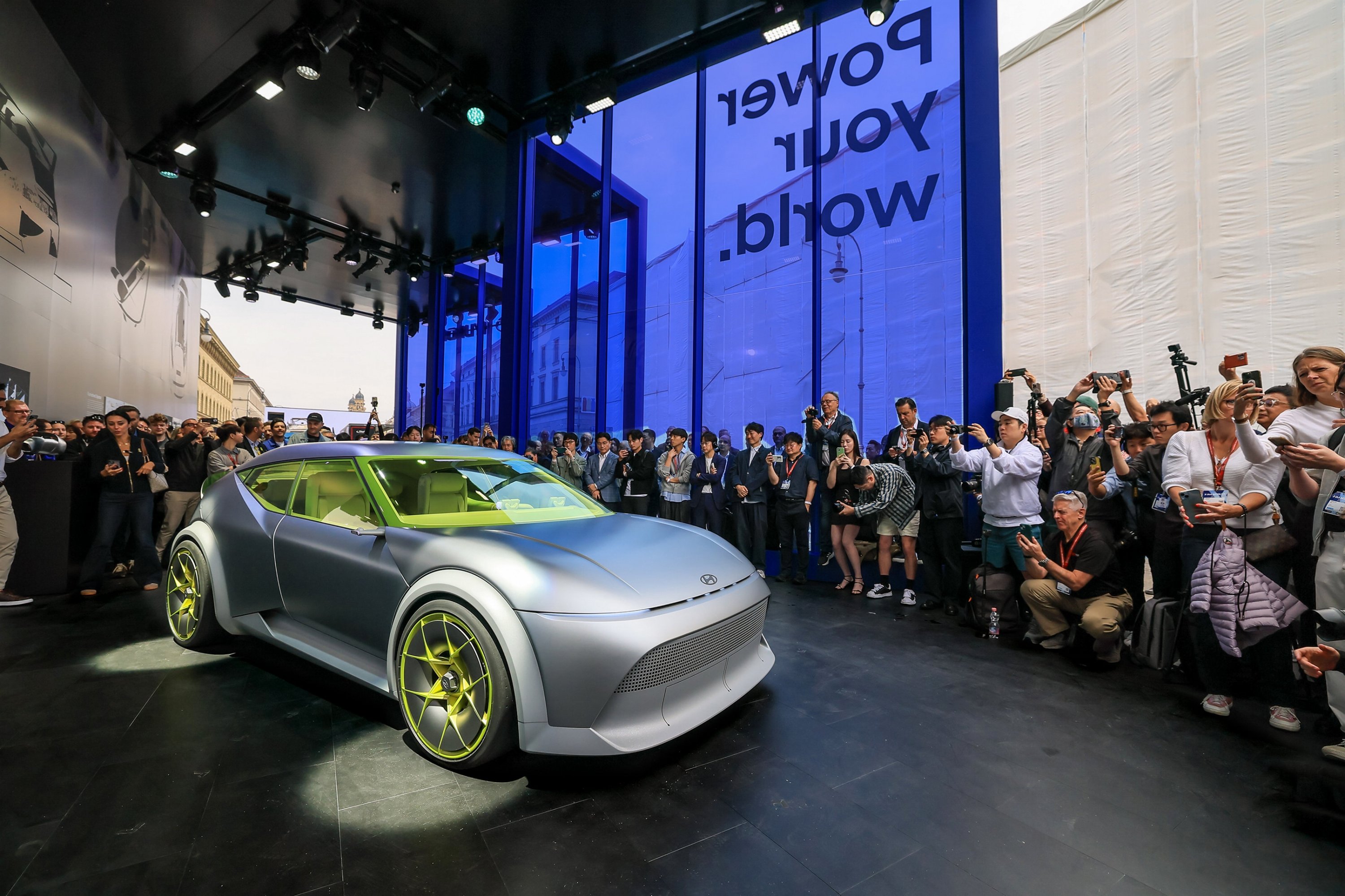
Hyundai will begin producing its newly unveiled Concept THREE in Türkiye in 2026, marking the carmaker's first electric vehicle (EV) production in Europe and making it the first foreign carmaker to manufacture battery-powered cars in the country.
Hyundai's first compact EV concept under the IONIQ sub-brand, the Concept THREE made its global debut at this week's IAA Mobility, Europe's biggest auto show, in Munich.
"This will be the first Hyundai electric vehicle manufactured in Europe, and it will be produced in Türkiye," Murat Berkel, Hyundai Türkiye general manager, told Anadolu Agency (AA).
Hyundai will become the second EV producer in Türkiye after homegrown brand Togg, and the first among foreign automakers.
The Concept THREE will be built at Hyundai's plant in northwestern city of Izmit, which has an annual production capacity of 245,000 vehicles and currently produces the i10, i20 and Bayon models.
In 2027, the company will unveil fully redesigned versions of the i20 and Bayon, along with their hybrid variants, according to Berkel.
The new model will be based on Hyundai's Electric Global Modular Platform (E-GMP), a flexible EV architecture supporting models from the A to E segment, which Berkel said will mark a turning point for Türkiye's automotive industry.
"Hyundai will be the first foreign manufacturer to bring this technology to Türkiye," he stressed.
Berkel noted that Hyundai's investment aligns with a rapidly expanding EV market. Global EV sales surpassed 10.5 million units in the first eight months of 2025, capturing an 18% market share, while Europe sold more than 1.2 million units over the same period.
In Türkiye, EV sales have surged from just 1% of the market five years ago to 15% today, placing the country as Europe's fourth-largest electric car market.
"Türkiye is experiencing exponential growth in electric vehicles, and by 2030, we expect market share to exceed 30%," Berkel said.
The number of electric vehicles in Türkiye has surpassed 200,000, and is projected to reach 1 million by 2030.
Addressing consumer concerns, Berkel highlighted the country's improving charging network, which has grown over 50% in the past year to more than 30,000 points.
"Measured by vehicles per charging point, Türkiye is in a strong position compared to Europe. Long-distance travel with EVs is now feasible," he said.
To meet the 20230 target, he said the number of charging points is also expected to approach 100,000.
The second-hand market for EVs is also maturing, reducing concerns about depreciation, according to Berkel.
"The old perception is gone. People no longer worry about resale value or range anxiety," he said, adding that EVs are proving cost-efficient: a home-charged battery can power a 600 km journey for about TL 450, much cheaper than combustion engines.
Hyundai Motor Group plans to invest $90 billion globally by 2030, launching 21 fully electric and 13 hybrid models. Within this strategy, Türkiye is set to become an important hub, Berkel said.
"As Hyundai grows globally, we will also grow in parallel in Türkiye. By 2030, we target sales of 90,000 vehicles in Türkiye, with a significant share from EVs," he added.