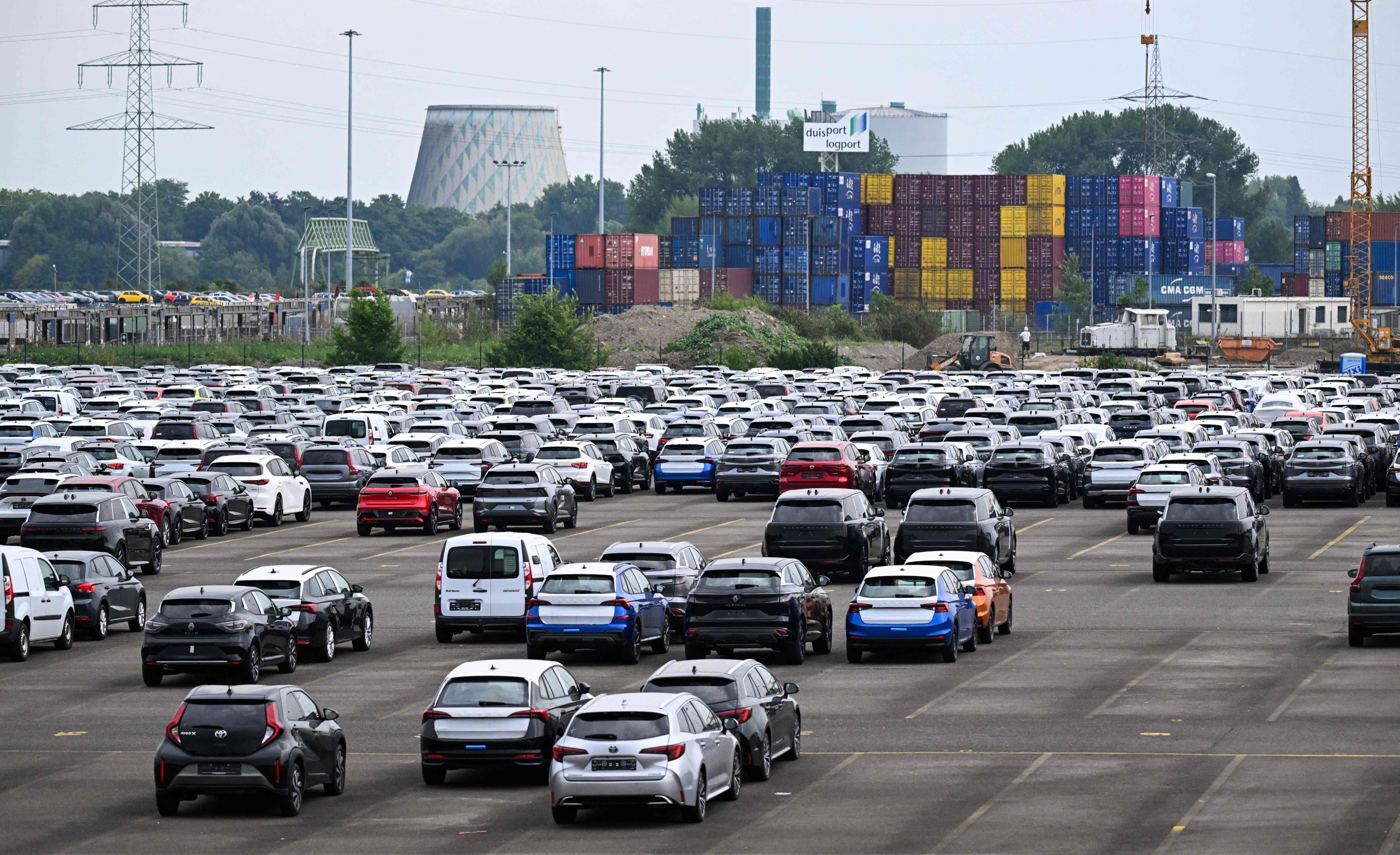
European carmakers viewed the trade deal struck with the U.S. as a de-escalation, but were still bracing for damages, which some industry insiders said could reach "billions."
German auto companies in particular were in for a great deal of export pain, as their share prices indicated.
Shares in Porsche, Volkswagen, BMW and Mercedes-Benz all lost more than 3% in trading on Monday, a day after European Commission President Ursula von der Leyen, on behalf of the European Union, shook hands with U.S. President Donald Trump, reaching a preliminary trade deal.
The agreement eases "the intense uncertainty surrounding transatlantic trade relations in recent months," Europe's main auto group, the European Automobile Manufacturers' Association (ACEA), said in a statement welcoming the deal "in principle."
But it noted that the 15% U.S. tariffs imposed on EU goods, including cars, "will continue to have a negative impact not just for industry in the EU but also in the U.S."
German Chancellor Friedrich Merz said his country's economy – the biggest in Europe – would face "substantial damage" from the U.S. tariffs agreed in the deal.
But, he said, "we couldn't expect to achieve any more."
The U.S. is a key market for European automakers, which last year sent nearly 750,000 of their cars to the U.S., representing nearly a quarter of the sector's overall exports.
While the 15% rate is less than the 27.5% tariff Trump imposed in April, it is far higher than the 2.5% levy European car manufacturers faced before Trump's return to the White House.
A German analyst, Stefan Bratzel, said it could be expected that U.S. consumers would pay two-thirds of the price hike caused by the tariff, while car exporters would probably swallow the other third.
For those companies, "we might have to see whether it is possible for cost-cutting somewhere else," he said.
The 15% rate was similar to one reached in the deal the U.S. struck with Japan, another major car-exporting country.
For German carmakers, the U.S. represents around 13% of their total exports.
In the short term, a 15% tariff will cost them "billions each year," said Hildegard Mueller, head of the national automobile manufacturers' association VDA.
The situation has compelled all automakers to lower their 2025 profit forecasts and seek ways to alleviate the pressure.
BMW boss Oliver Zipse suggested in June that Europe could get rid of its own tariffs on imported vehicles made in the U.S.
That could benefit his company, which last year exported 153,000 vehicles from the Americas, and imported into Europe 92,000 cars that were assembled in the U.S.
Similarly, Mercedes is seeking assistance from the national or EU level.
"The deal reached between the EU and the U.S. is a first, important step that needs to be followed by other measures," a company spokesperson told Agence France-Presse (AFP).
"Politicians need to keep working to get rid of obstacles getting in the way of free trade. We are counting on the EU and U.S. to continue their constructive dialogue in the future," she said.
Volkswagen is also facing tariff hardship for vehicles it manufactures in Mexico for the U.S. market, announcing that its first quarter results were shaved by around 1.3 billion euros ($1.5 billion) compared to the same period a year earlier.
Its Porsche and Audi cars are also exposed as they have no production factories in the U.S.
On Monday, Audi reduced its revenue and profit targets for this year, although it expects them to rise next year.
Volkswagen CEO Oliver Blume has suggested reaching a side deal with the U.S. that would take into account investments his company could make in that country.
Volvo Cars, the Swedish carmaker owned by China's Geely Holding, has announced steep second quarter losses because of tariffs.
The European auto sector is now lobbying the European Commission to delay the timetable for transitioning the European car market to all-electric and to provide some form of industry stimulus.
With no help, European car factories, already facing uphill challenges, "will have to reduce production," said Ferdinand Dudenhoeffer, director of the Center for Automotive Research.
That, he said, could affect up to 70,000 jobs in Germany alone.