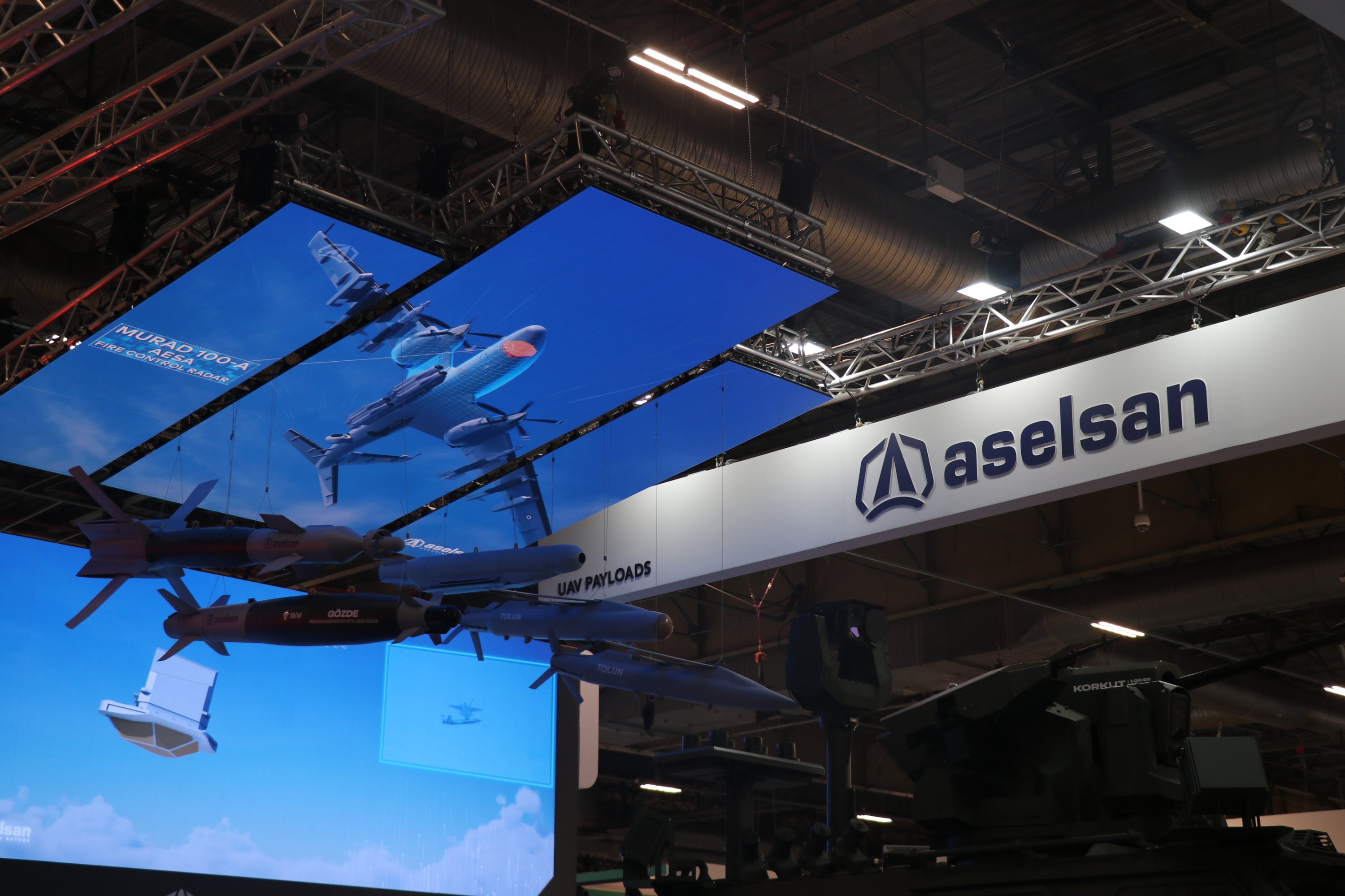
Türkiye's defense giant Aselsan has signed a 780 million euros ($905 million) contract with the Presidency of Defense Industries (SSB) for the procurement of air defense systems, the company said on Tuesday.
In a statement, Aselsan said the agreement covers systems aimed at strengthening the country’s air defense capabilities.
The contract is expected to contribute to Türkiye’s Steel Dome, a multilayered air defense architecture developed under SSB coordination as a domestic "system-of-systems" project covering all air defense components.
Steel Dome is designed to neutralize aerial threats across all altitudes and ranges.
The system includes multiple layers, ranging from cost-effective low-altitude defense elements against drone swarms and kamikaze unmanned aerial vehicles (UAVs) to systems such as Korkut and Gurz, as well as radars operating at different altitudes.
Hisar systems form the middle layer of the architecture, while Siper is positioned in the upper layer.
Aselsan said that Steel Dome brings together several air defense weapon systems, radars, electro-optical solutions, communication modules, command-and-control stations and artificial intelligence capabilities.
The company is also developing Hakim, a higher-level command-and-control solution designed to coordinate the systems within Steel Dome, along with sensor systems and communication solutions.
Aselsan said Türkiye’s air defense capability is being built through the company’s technological know-how accumulated over more than half a century.
Steel Dome, which continues to gain new capabilities, is being strengthened with new components, the company added.
Meanwhile, the new version of the Siper long-range air defense system, Siper 2, has successfully completed its latest firing test.
"The distributed architecture-based, long-range regional air and missile defense system SIPER 2, which plays a critical role at the strategic level, successfully destroyed a maneuvering target," SSB head Haluk Görgün wrote on the Turkish social media platform NSosyal.
"The SIPER 2 system will assume duties at longer ranges and higher altitudes compared to SIPER 1, playing an effective role in air and missile defense," Görgün added.