Türkiye has the capacity, a strong industrial base and supply chains, and is ready to provide this capacity to most of the allied nations, the chief executive of a leading defense company said Wednesday.
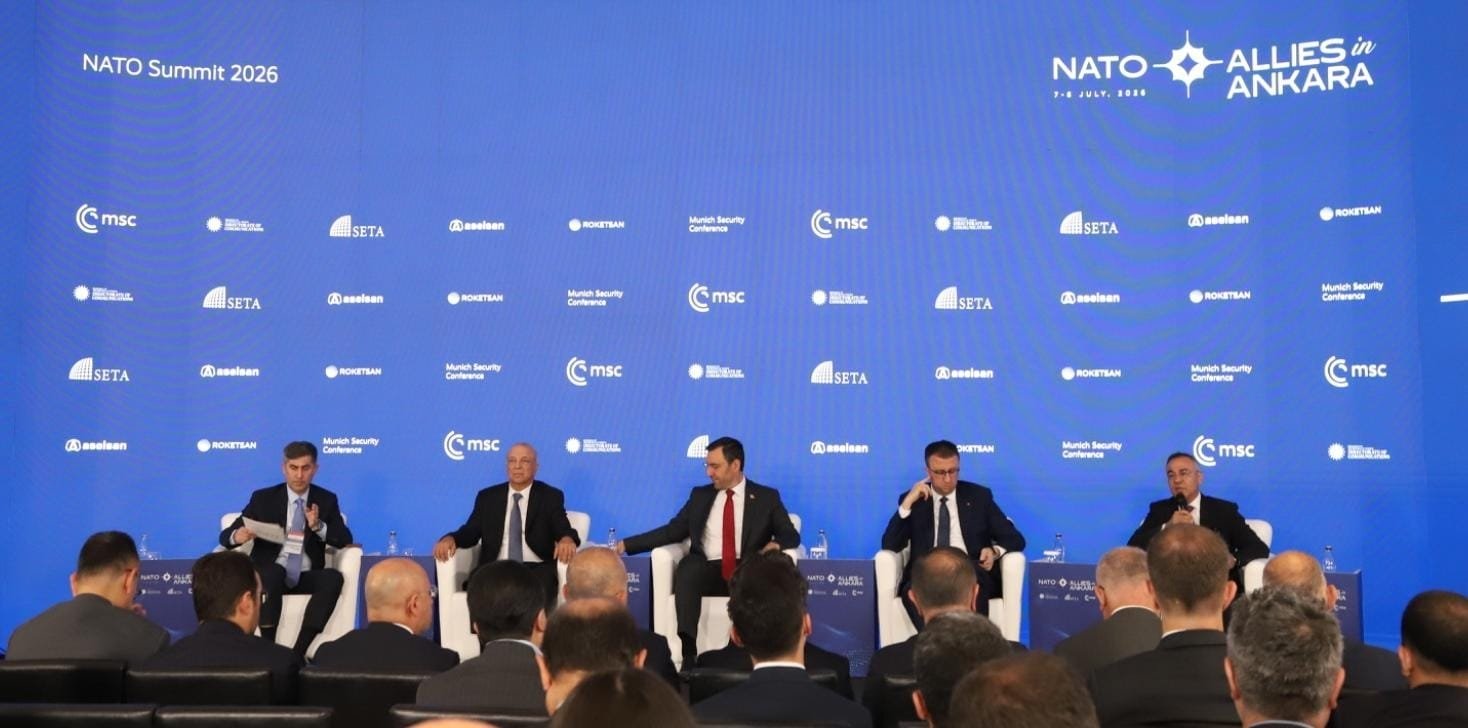
Speaking during the panel organized as part of the "Allies in Ankara" program, held on the sidelines of the NATO summit, Roketsan CEO Murat Ikinci lauded the capacity, manufacturing base and production of the Turkish defense ecosystem.
"Türkiye has much more capacity than most of the allied countries. We are exporting our products," Ikinci said in response to a question asked by Daily Sabah.
He went on to say that 35% of Roketsan's revenue comes from exports, adding that they are investing all of that revenue "to our infrastructure, to increase our production line's capacity."
Ikinci spoke alongside the CEO of Aselsan, Ahmet Akyol, with both underscoring the advanced technological capabilities of the Turkish defense industry, its expertise and fast delivery processes. They also evaluated the role of artificial intelligence in modern warfare.
Roktetsan and Aselsan are among the leading Turkish defense firms, which have contributed notably to the expansion of the domestic industry with advanced systems, munitions and electronics.
The Turkish defense industry has witnessed a strong boom, particularly in the last half of the decade, with annualized exports now surpassing $11 billion (TL 515.43 billion).
"We should talk about supply chain capacity. If you are depending on a single component from another country in the time of conflict, when you are out of ammunition, for example, and not to produce ammunition, if you cannot find one single component, you are not able to create, you are not able to manufacture this ammunition," Ikinci explained.
"So, sustainability and the supply chains are the most important part for capacity," he added.
He cited the Iran-Israel war as an example, noting that "sustainability and continuing to fight is more important than the first attack."
"So, in order to make you fighting in the battlefield during the war, it is very important for your supply chain to support your production lines. Türkiye, right now, is ready to provide this capacity for most of the allied countries," Ikinci said.
"And Türkiye, right now, is investing too much to actually make all of the critical subcomponents of the Turkish defense industry. Right now, the Turkish defense industry is creating, manufacturing a lot of ammunition without getting any spare parts, without getting any critical components from other countries. This is really an important point," he also said.
The remarks of Ikinci and Akyol, who said that the delivery of their products, "whatever it is," can come in "less than two years," came a day after it was announced that the companies would be contractors in the NATO projects covering areas such as strike capabilities and integrated air and missile defense systems.
"Whatever you order us, we can deliver in less than two years. This is a very clear announcement. We have huge capacity," Akyol said.
Also answering questions during the same panel, NATO senior advisor Yavuz Türkgenci underscored the contribution to NATO and said that the Turkish defense industry "can build 50 warships at the same time."
"And also, fast patrol boats, we could easily design and build and manufacture, I mean, fast patrol modes, that's important. And in addition to that, uh, I think our armored fighting vehicles," he added, as he cited main battle tanks and light battle tanks production, through BMC and FNSS companies.
The panel was titled "Inside the Architecture: Türkiye’s Defense Industry as a Structural Asset for NATO" and was organized in cooperation with the Directorate of Communications, the Munich Security Conference and the Foundation for Political, Economic and Social Research (SETA).
Türkiye stands ready to be one of the main forces behind the industrial transformation NATO needs, Haluk Görgün, head of the Presidency of Defense Industries (SSB), said earlier Tuesday.
This year's NATO summit is taking place at a critical time for the alliance, with Europe being urged to step up its efforts for collective defense.