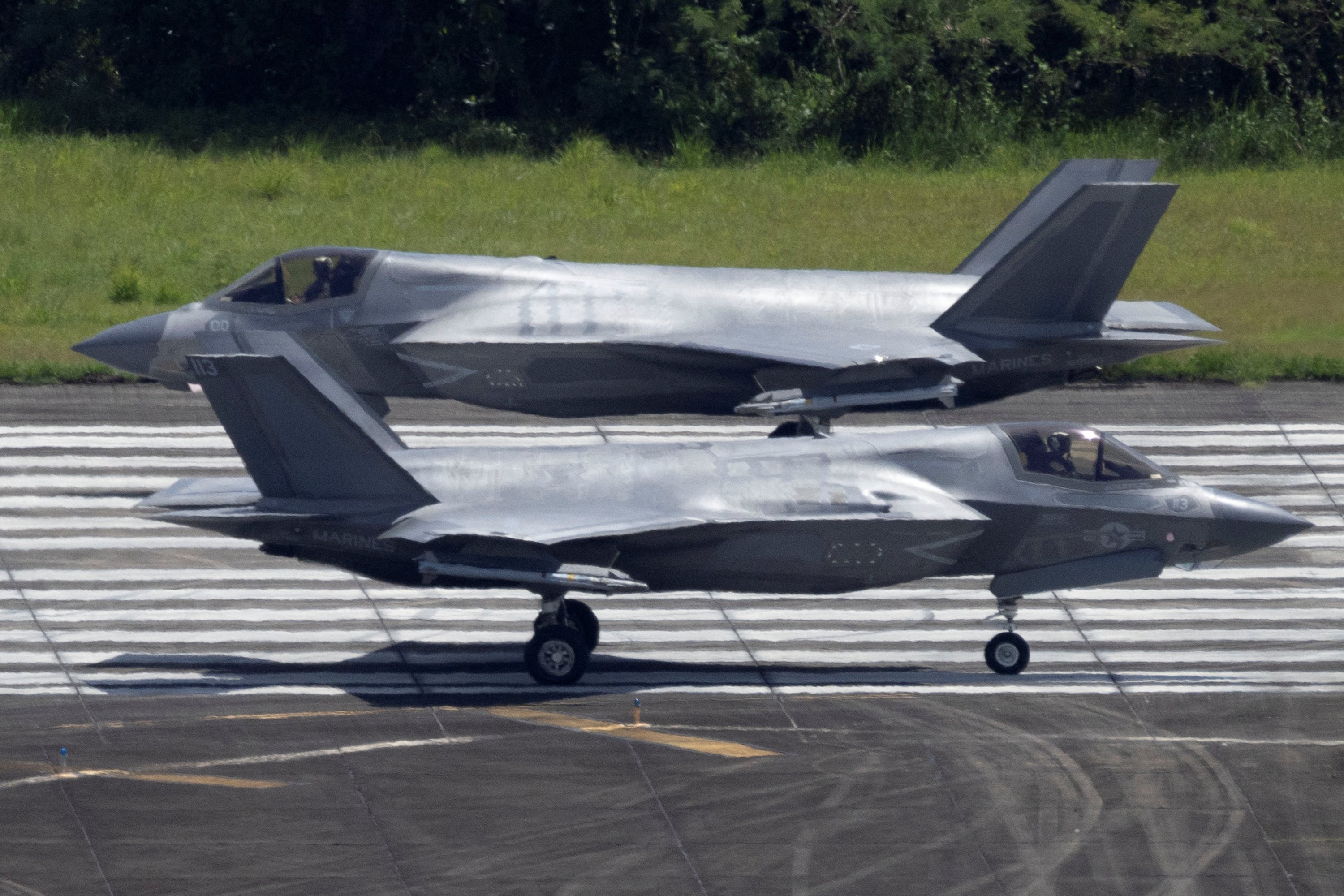
U.S. President Donald Trump said Monday the United States was considering selling top-end F-35 fighter jets to Türkiye.
"We're thinking about it very seriously," Trump said when asked about an F-35 deal for Türkiye as he met Israeli Prime Minister Benjamin Netanyahu at the U.S. leader's Florida club.
Israel has opposed the move. Trump, however, has warm relations with President Recep Tayyip Erdoğan, who has been one of the most vocal critics of Israel's genocidal actions in Gaza.
Ankara has sought reentry into the U.S.-led F-35 fighter jet program. It was excluded in 2019, and Washington imposed Countering America's Adversaries Through Sanctions Act (CAATSA) sanctions due to its purchase of Russian-made S-400 missile defense systems.
Last year, Türkiye secured a $7 billion deal with Washington for 40 F-16s. But talks have reportedly been dogged by Turkish concerns about the price and desire to buy F-35s instead.
Erdoğan raised the issue of F-35s during the September meeting with Trump at the White House.
Israeli policymakers argue that F-35s would benefit Türkiye in a potential war. Türkiye and Israel are also at odds over Syria, which neighbors both countries.
Asked about the potential for conflict between Türkiye and Israel, Trump called Erdoğan "a very good friend."
"We're not going have a problem," Trump said of Israel and Türkiye. "Nothing's going to happen."
Trump, in his first term, also agreed to sell F-35s to the United Arab Emirates (UAE) after it recognized Israel.
He more recently voiced support for F-35 sales to Saudi Arabia, despite a longstanding U.S. policy that Israel must have a military edge over potential regional adversaries.
Türkiye, meanwhile, signed an agreement in late October worth about 8 billion pounds ($10.7 billion) that covers 20 Eurofighter Typhoons jets that Türkiye will buy from the United Kingdom.
Ankara also plans to purchase 12 secondhand Eurofighters from Qatar and 12 others from Oman. The jets from Qatar could potentially arrive early next year, officials have said.
Despite boasting NATO's second-largest army, Türkiye often faced arms embargoes in the past. That pushed it to significantly boost domestic capabilities and curb foreign dependence over the last two decades.
Today, it produces a wide range of vehicles and arms types domestically, including its own drones, missiles and naval vessels. It's also developing its own fifth-generation fighter jet.
Named Kaan, the stealth fighter is sought to replace the Air Force Command's aging F-16 fleet, which is planned to be phased out starting in the 2030s.