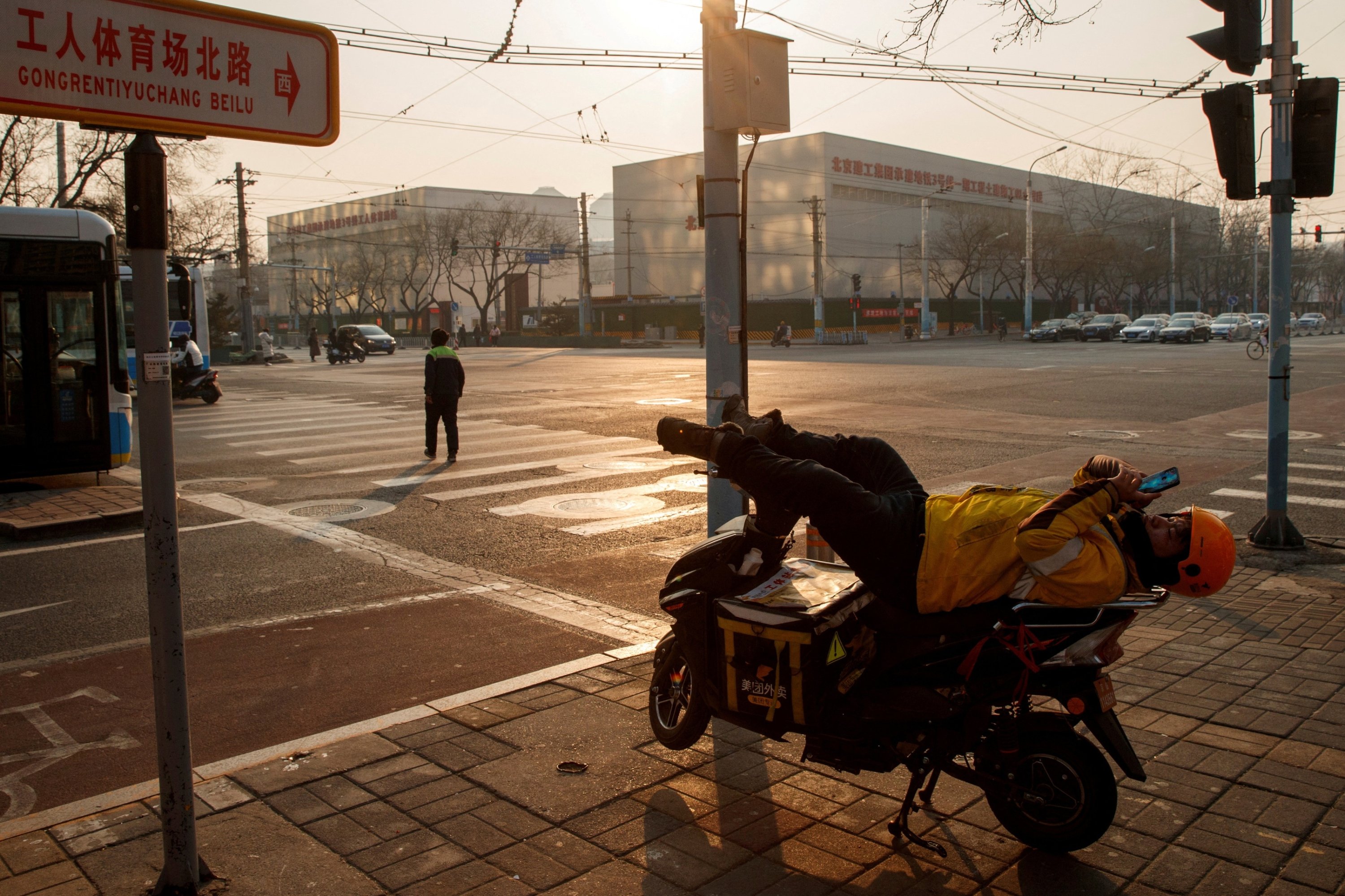
Bao Zhang began driving for a Chinese ride-hailing app this year after losing his job as a software tester and says the weak job market gives him little hope of returning to the tech sector.
His story is increasingly common in China, where tens of millions are shifting from formal employment into the gig economy as meager unemployment insurance, record numbers of graduates and a shortage of jobs squeeze opportunities.
"Those who used to take taxis now have to drive them themselves," said the 30-year-old, who works from 7 a.m. until nearly midnight in Beijing to earn about 6,000 yuan ($885) a month after vehicle rental and charging costs.
The China New Employment Forms Research Center, a think tank, estimates the number of people in flexible employment – without a permanent full-time contract – rising to 320 million this year from 280 million in 2025, a cohort almost as large as the U.S. population and about 44% of China's workforce.
Analysts say China's gig economy has become a crucial employment buffer as the property crisis wipes out construction jobs and manufacturers shed workers through automation and cost-cutting amid tariffs, overcapacity and price wars.
Increasingly, it hires educated youth and white-collar workers squeezed by weak domestic demand and AI adoption.
"The proportion is extremely high," said Yang Zhan, a cultural anthropology expert at the Hong Kong Polytechnic University. "It's no longer limited to rural migrants and has spread to the middle class and university graduates."
"China is upgrading manufacturing, and many industries that used to absorb large numbers of workers are being phased out. Then there is AI," Zhan said.
China's human resources ministry and the State Council Information Office, which answers media queries on behalf of the cabinet, did not immediately respond to comment requests.
As elsewhere, gig economy work mitigates the income shock of losing a formal job.
But in China, one government adviser said the rise of gig jobs – where social insurance contributions are not mandatory – heightens long-term risks to an inadequately funded welfare system.
A 2019 Chinese Academy of Social Sciences report warned that the national pension fund could run out by 2035 as the population ages. A 2024 update said delaying retirement could push depletion back eight to nine years.
"It may not be easy to find a solution," due to unstable incomes and contracts in the gig sector, said the adviser, suggesting Beijing should support the formal services industry to create better jobs.
Central government transfers that plug social insurance budget gaps roughly trebled over the last decade to about 3 trillion yuan, doubling as a percentage of total expenditure to 10%, a Gavekal Dragonomics analysis showed.
A second government adviser said further taxing gig workers, many of them rural migrants, to reduce the burden, would be "highly unreasonable." Birth subsidies could be a preferable long-term fix, he said.
Only two of the 12 flexible workers Reuters interviewed said they were voluntarily contributing, while two others said they paid through formal part-time jobs outside their gig work. The rest said they preferred to save on their own.
"I can take control, rather than wait for decades for others to pay me," said Angel An, 24, who earns more than the average ride-hailing driver by promoting her services to tourists in Shanghai and nearby Suzhou on social media.
Zhang suffers recurring ankle and knee pain from long hours in traffic, but has chosen not to buy medical insurance, adding that pension felt "too far away" and would be small anyway.
Gig jobs lack the pay and security many Chinese expect, said HSBC Asia economist Frederic Neumann, warning this drags on consumption and growth.
"A whole new generation is growing up unaccustomed to the security and confidence that their parents for a long time enjoyed," Neumann said.
A December 2025 government report found that by end-2024 only 70.6 million flexible workers were enrolled in the urban employee pension scheme, which supplements basic retirement benefits. Most migrant workers contribute small amounts only to the basic scheme, where payouts can be as low as 163 yuan a month.
There are no estimates for how many gig workers pay into all social insurance schemes – pension, medical, work injury, unemployment, maternity and housing – but the numbers are likely much lower.
A Peking University survey of 30,000 delivery workers found fewer than 10% would support mandatory social security contributions, which would cost employees about 10% of their income and employers roughly a quarter.
"The urgent priority is to make it easier for flexible workers to be included in the employee social security system," said Nomura's chief China economist Ting Lu, who estimates only tens of millions are fully enrolled.
"We need to reduce anxiety," he said, "so that they save less and consume more."
Zhan, the anthropologist, said the government faced a tough trade-off between making the industry's employers contribute more to needed welfare improvements and preserving their ability to create jobs.
"The government very much needs the platform economy to absorb workers," and maintain social stability, Zhan said.
Significant regulatory changes could cause "a major shock" to the industry's profits, she added.
Although China's unemployment rate has hovered around 5%-6% for a decade, gig work has helped keep those numbers in check because anyone working even one hour a week is considered employed.
Yet an influx of gig workers is increasingly outpacing demand in some sectors, slowing incomes.
The think-tank report said China's 16 million food delivery riders saw their income rise 11% on average to 37.3 yuan per hour in 2025, but wages shrank 1.8% for the 37.2 million ride-hailing drivers.
At least four cities, including the tech hub of Shenzhen, have issued warnings of ride-hailing market "saturation" since April.
The second government adviser said authorities only meant to raise awareness and not to prevent people from taking more such work, as "that would become a social stability issue."
Li, a cleaner in his early 50s who delivers food until 10 p.m. for an extra 40-100 yuan a day, suspects the growing number of riders is compressing earnings per order, but has "no choice" but to keep going.
"At my age, without education, what could I possibly do? In Beijing, most college students also have to deliver food," said Li, who only gave his surname.