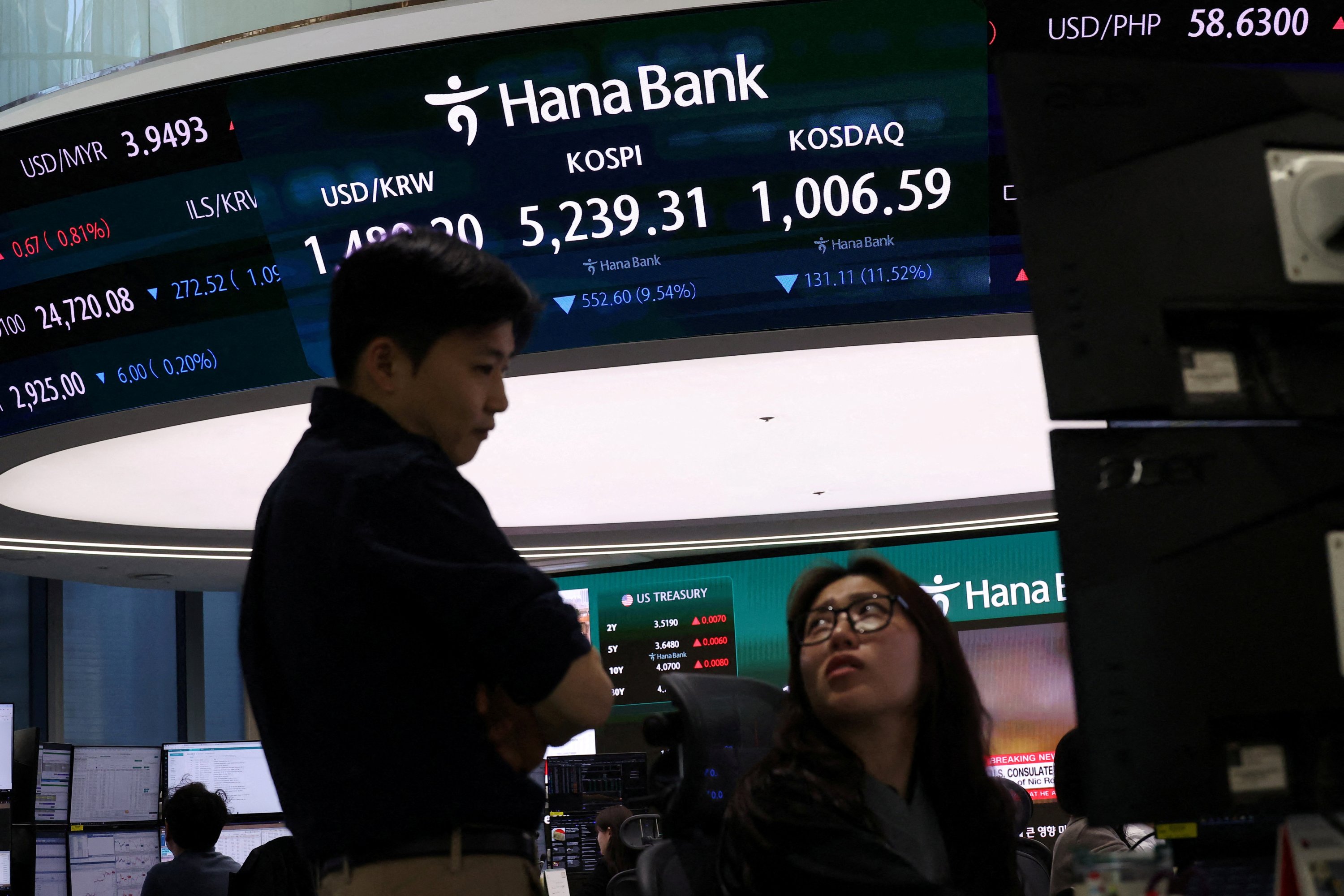
A surge of cash leaving risk assets has unsettled emerging markets since war engulfed the Middle East, but some investors are wagering that solid fundamentals and geopolitical fragmentation will allow the year-long rally to resume.
The United States and Israel's bombardment of Iran pressed emerging market currencies and stocks toward their biggest weekly losses in three years, while bonds also tumbled sharply.
JPMorgan reduced its overweight stance on emerging market foreign exchange and local currency bonds to marketweight, citing uncertainty. Citi also halved its emerging market foreign exchange exposure.
But veteran investors say emerging economies, barring further big shocks or prolonged high energy prices, can rebound, with green shoots already pushing through.
"I don't think yet that we've seen ... let's call it real money, or crossover money, saying 'I'm out,'" said Cathy Hepworth, head of PGIM fixed income's emerging market debt team. "There are people on the sidelines who were waiting for a market correction to get in or to increase the degree to which they are involved."
From stocks to bonds to currencies, emerging markets had outshone all expectations until this week.
Flows into the asset classes had ballooned since U.S. President Donald Trump started his second term in office in January 2025. Emerging nations – led by Saudi Arabia, Mexico, Türkiye and Poland – issued a record amount of debt in January, equities soared and yield-hungry investors ploughed cash into local currency debt across frontier markets.
However, investors had already warned that some of the "hot" money from hedge funds and other non-specialist investors could leave quickly if the market turned. The U.S.-Israeli bombing campaign in Iran caused just this to happen, with investors fleeing to safer assets. The dollar rose, along with gold, and investors piled into cash as they sought a port in the storm.
"We've seen a big shock to markets...there is more to go, should oil prices rise further," said James Lord, global head of FX and EM strategy at Morgan Stanley.
Data showed MSCI's emerging market equities index lost more than a trillion dollars in market capitalisation from its peak last Thursday to Wednesday's close.
One of the most notable drops was for Korea's KOSPI equity index, which shed nearly 20% over the course of Tuesday and Wednesday in its biggest-ever crash. The index, heavily influenced by the rush to AI and chips, had been the top performer in emerging equities.
"That's clearly panic selling in some sense," said Jonas Goltermann, deputy chief markets economist with Capital Economics, adding that it was a sign of the "market machine" overriding underlying fundamentals. On Thursday, the KOSPI clawed its way back, gaining nearly 10% and it is still up more than 30% this year.
Investors said that the years spent by many emerging and frontier markets to shore up their finances and bolster confidence in their central banks could also aid their appeal during a prolonged crisis.
Many central banks, Morgan Stanley's Lord said, had taken "a very cautious and credible approach to the easing cycles," getting inflation in check and underpinning currencies against the dollar.
Egypt and Nigeria, countries where it was once difficult to repatriate cash, reformed investor access. The outflows in recent days, some say, prove they are a reliable destination for the money.
"Frontiers that received a large amount of inflows are now demonstrating their ability to absorb the demand for foreign exchange and also demonstrating the FX flexibility, which we think is helpful in this context, to manage exogenous shocks of this nature," said Yvette Babb, portfolio manager with William Blair.
"We think the fundamentals within EM are clearly strong to withstand an exogenous shock, as long as the story does not derail the global growth narrative."
Oil prices are the biggest threat. A prolonged period above $100 per barrel could send global inflation soaring, dent growth and keep some emerging market central banks from continuing to cut rates.
However, Elias A. Elias, a portfolio manager with Templeton Global Investments, said Latin American commodity exporters could benefit from the higher prices, while cheaper valuations for emerging market equities more broadly bolstered their appeal despite the current turmoil.
"We're very constructive on the EM equities as an asset class," he said, adding emerging stocks remained at a roughly 28% discount to developed markets, with higher earnings growth expectations.
The changing nature of risk and global money flows could also shield emerging markets from a broader rush for the exit. Trump's return to the White House and his shifting tariffs, sanctions and combative foreign policy has changed how some investors calculate risk.
Additionally, increasing "South-South" investment, where cash flows from pools such as Asia's growing wealth or deep-pocketed Gulf sovereign wealth funds, has provided a buffer for some economies, most notably the likes of Egypt.
Such investors are less likely to abandon emerging markets.
"Today, funds and excess capital in Asia (are) being produced, and they're investing in other markets," said Dhiraj Bajaj, Head of Asia Credit at Lombard Odier. "The dynamic is changing."