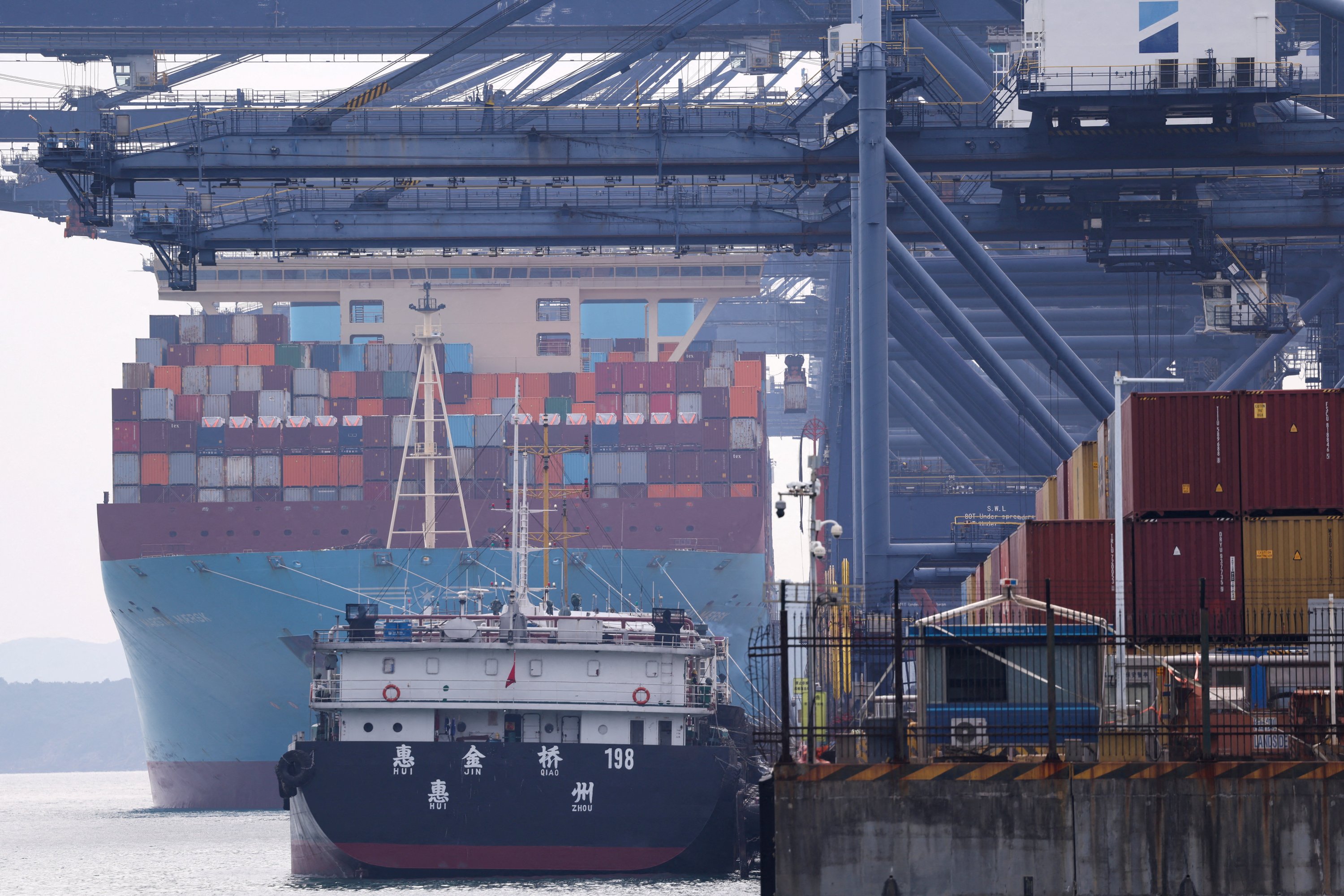
The European Union is considering a fundamental change to its trade policy with China amid a widening trade deficit, rising dependence on strategic sectors and growing pressure from China’s state-sponsored production model on European industry.
China, the world’s largest manufacturing hub, is boosting its outreach in global markets through state-sponsored industrial policies as it rapidly expands production capacity in many fields, especially electric vehicles, batteries, solar panels, critical raw materials and high-tech products, putting pressure on Europe’s competitiveness.
European Commission President Ursula von der Leyen said at the G-7 summit in Canada that the EU’s trade with China is unsustainable.
She said the EU needs to grow its production capacity, expand its network of free trade agreements around the world and diversify supply chains, especially because critical minerals and raw materials are concentrated in China, urging the bloc to avoid heavy reliance on a single supplier.
China’s dominance in global trade will be among the topics discussed during an EU leaders’ summit in Brussels on Thursday and Friday.
The European Commission emphasized that economic relations with China should continue through risk mitigation, but current trade and investment relations between the bloc and the country are deemed unsustainable.
High-level consultations in Brussels showed that economic and security threats can no longer be assessed separately, prompting more comprehensive and coordinated policies toward China, including new tariffs, import quotas, supply chain diversification requirements and new defensive tools against economic risks emerging from the world’s manufacturing hub.
Last year marked a turning point for the EU in its trade with China, as all member states recorded a trade deficit with the country for the first time.
The EU’s imports from China reached 559.4 billion euros ($695.3 billion) in 2025, while its exports totaled $231.5 billion, marking a record high trade deficit of $417.4 billion, according to data from Eurostat.
Intense competition from China in electric vehicles, solar panels, batteries, steel, chemicals and machinery is placing massive pressure on European manufacturers, prompting Brussels to view the impact of cheap, state-sponsored Chinese products on the European market as not only a commercial issue but also a strategic one.
The London-based Center for European Reform reported that Germany faces a serious deindustrialization risk amid China’s growing capacity, warning that Chinese firms are grabbing market share from German producers in their domestic markets, in third countries outside Europe and directly in Europe.
Reports show China could account for around 40% of the world’s industrial production by 2030, putting severe pressure on Europe’s production, research and development, or R&D, and innovation capacities.
The EU is working on new mechanisms to combat this. The commission is discussing launching broad safeguard investigations into specific sectors, developing new tools to counter excessive production from China in strategic areas and implementing sector-specific safeguard measures.
Some proposals by France, Italy, Spain, the Netherlands and Lithuania go beyond current anti-dumping processes and would impose direct, blanket customs tariffs on specific sectors instead of relying on lengthy investigations.
One of the most notable regulations the bloc is working on would mandate the diversification of supply chains for critical products to prevent European firms from sourcing resources such as chips, rare earth elements and critical industrial inputs from a single country or supplier.
The proposal would require companies to maintain at least three different sources and would place an upper limit on the share of any single supplier in the total supply.
Maros Sefcovic, the EU commissioner for trade, proposed the diversification tool to prevent potential supply disruptions, especially in semiconductors and critical raw materials.
The diversification strategy involves additional costs for firms but should be viewed as an insurance premium because the costs of supply disruptions could be much higher, according to the Leibniz Centre for European Economic Research, or ZEW.
Another option is a new mechanism to preserve the bloc’s resilience, allowing the direct imposition of additional customs duties and import quotas when market-distorting practices threaten the bloc’s economic security. The legal basis is expected to rest on national security exceptions under World Trade Organization (WTO) rules.
The EU’s hardening stance toward China is due to concerns over strategic dependence and its growing trade deficit. Beijing’s export restrictions on rare earth elements, magnets and other critical technologies have raised concerns in Europe.
Brussels does not want to see a repeat of the energy crisis that followed the outbreak of the Russia-Ukraine war, but there is still no complete consensus within the bloc on imposing very strict trade measures against China.
Some countries, led by France, are calling for stronger tariffs, while Germany and Spain have adopted a more cautious approach because of their close economic ties to China.
The general trend in the bloc is moving toward reducing dependencies and preserving competitiveness rather than completely severing ties with China.
The new trade defense tools under discussion at this week’s summits will shape the future of economic relations between Brussels and Beijing.