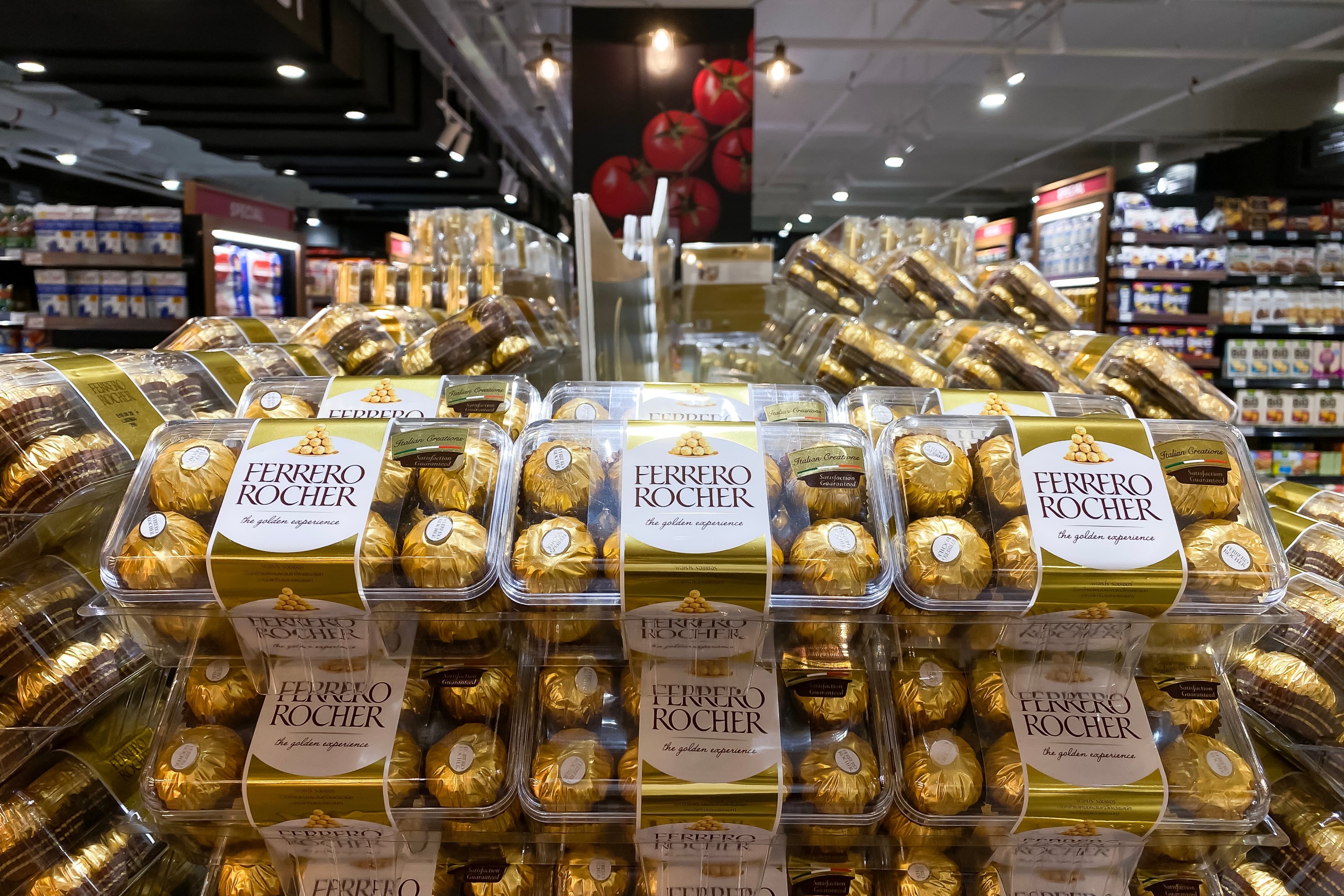
It is imperative for the Italian company Ferrero, the maker of the worldwide popular spread Nutella, which has been operating in the Turkish market for many years, to fulfill its commitments completely, both in terms of commercial ethics and for the Turkish public, the head of the top Turkish competition body said on Monday.
Recent debates in the sector are not merely a commercial issue, "this issue is about protecting the labor of producers and maintaining a fair market order," Competition Authority President Birol Küle told Anadolu Agency (AA).
He conveyed that in recent statements reflected in the international press and understood to originate from Ferrero, Türkiye's hazelnut producers, traders and market dynamics were unfairly accused. "Our country is being portrayed as a 'market subject to speculation,'" Küle said.
"However, the investigation conducted by our institution in 2024 and the commitments made as a result show the exact opposite. Therefore, this approach goes beyond distorting the facts; it is a clear injustice directed at Türkiye's producers," he added.
Pointing out that hazelnut production in Türkiye has decreased significantly this year due to climatic conditions and pests, Küle said: "Farmers have suffered yield losses, yet they have continued to produce with dedication.”
"So there is no 'game' as alleged. Farmers are trying to adapt despite the conditions of nature and the market."
Last week, British daily The Financial Times (FT) alleged there were "games" as, reportedly, according to some traders, prices have gone up "as Turkish intermediaries bought aggressively from farmers."
According to FT, the Ferrero Rocher and Nutella maker is said to be "in a standoff with Turkish hazelnut dealers." The report acknowledged the frost but rather focused on insights from traders.
Türkiye stands at the top of the supply chain of the Italian company, which still gets most of its nuts from Türkiye despite a push for diversification.
In a season when supply is low, there is no behavior more natural than producers selling their products gradually, Küle stressed.
He noted that this is not a rule unique to Türkiye but is "a universal market rule that anyone who understands the basic workings of the economy can see."
He argued that the company cannot pass on the cost of its wrong strategy to Türkiye, saying that Ferrero's delay in purchasing hazelnuts was its own choice, that its competitors made early purchases and that the company chose to wait.
He said that it was unacceptable for the firm to try to shift the consequences of its choice onto Turkish farmers, traders and Turkish institutions, adding: "If a global company has planning mistakes, that is not Türkiye's problem.
"If there is a mistake, it should be accounted for internally. Prestige should not be gained by blaming Türkiye.”
Küle said that Türkiye's hazelnut producers are the "sweat of the country,” that producers struggle with nature and add value to the country with their labor.
Pointing out that the labor of Turkish farmers is present in many products seen on chocolate shelves around the world today, he said: "No approach that belittles this labor and tries to discredit it with unfair accusations will find a response in Türkiye."
"The competition board's decisions and expectations regarding the sector are clear," he said, noting: "No one should make a promise and then attempt to undermine their own commitment through the foreign press."
In Türkiye, the market operates based on law and rules, not threats, he underlined.
He said that no one should try to portray themselves as victims; there is no victimhood.
"Statements suggesting that product prices may increase or content may change using Türkiye as an excuse are unacceptable," he stressed, adding: "I view these attempts as an effort to suppress hazelnut prices in a year when hazelnut supply is limited."
Earlier this year, Türkiye suffered a major frost event that impacted dozens of provinces, not only the northern Black Sea region, which is famed for its hazelnut production. Other crop production, including fruits such as apples and apricots, was also impacted.
In its assessments, the Turkish Statistical Institute (TurkStat) has pointed to expectations of lower volumes in production this year. Turkish officials and the central bank have also warned about its impact on food prices.
Küle, meanwhile, also pointed out that the country's market order cannot be shaped according to anyone's whims, noting that the labor of producers is protected.
He said that market order cannot be manipulated, and international pressure tactics cannot be applied.
"Türkiye's institutions cannot be discredited. In conclusion, I would like to emphasize once again that it is imperative, both from a commercial ethics perspective and in the eyes of the Turkish public, that Ferrero, which has been operating in the Turkish market for many years, fulfill its commitments completely," he said.