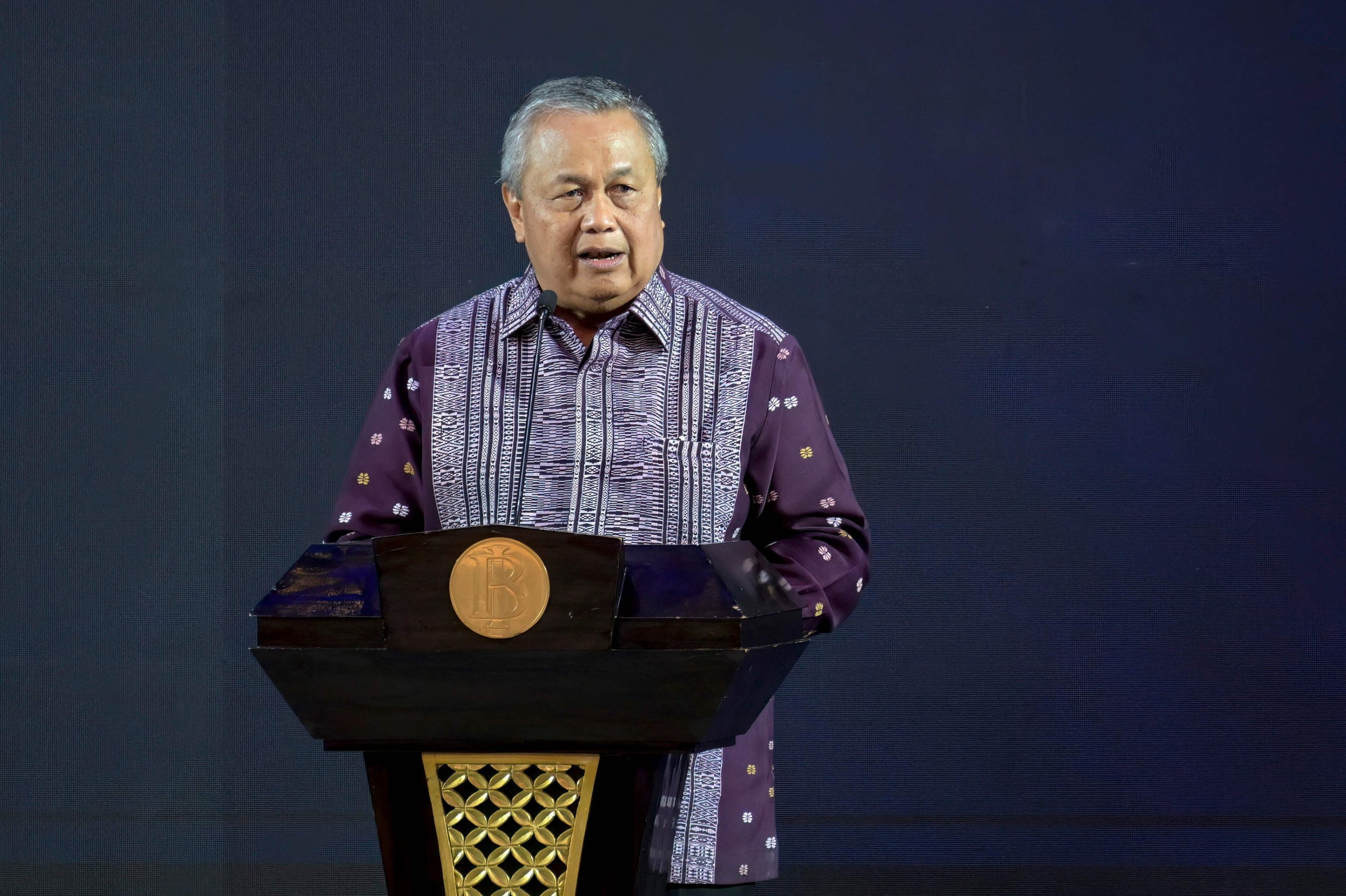
Indonesia's central bank governor stepped down on Monday, in a surprise move that deepens uncertainty as the country grapples with a weakening currency and other economic woes brought on by the Middle East war.
President Prabowo Subianto has accepted the resignation of Perry Warjiyo, who had served as Bank Indonesia's (BI) governor since 2018, State Secretary Prasetyo Hadi told reporters in Jakarta.
Warjiyo, whose second term was meant to expire in 2028, cited unspecified personal reasons for the surprise resignation, which he tendered on Saturday.
The bank's senior deputy governor, Destry Damayanti, has been appointed interim governor, said Hadi.
The rupiah weakened as much as 0.36% to 18,000 to the U.S. dollar following the announcement, while the main stock index flipped between gains and losses in choppy trade.
The stock market and currency remained "quite stable" in the hours after the government announced Warjiyo's resignation, Bank Central Asia chief economist David Sumual told Agence France-Presse (AFP).
But the move "may cast further policy uncertainty, which may not translate well to the rupiah and the economy in general."
The rupiah has taken a battering from surging energy costs, shedding about 7% since the Middle East conflict erupted in February to become Asia's worst-performing currency, according to financial outlet Bloomberg News.
BI surprised markets last week by keeping policy rates unchanged, instead offering new incentives to attract foreign capital inflows aimed at supporting the rupiah.
The bank has lifted its key interest rate by 100 basis points this year to 5.75% in an effort to shore up the rupiah.
Deni Friawan, a researcher at the Jakarta-based Center for Strategic and International Studies, said Warjiyo's surprise resignation could spook investors.
"Markets dislike surprises," he told AFP.
"When a central bank governor steps down unexpectedly, investors naturally question the future direction of monetary policy, inflation control, and exchange rate management."
Warjiyo, who started his career at BI in 1984, was first appointed as governor in 2018. He was reappointed for a second five-year term by Subianto's predecessor in 2023.
Analysts say the choice of Warjiyo's permanent replacement will be closely watched.
"Given the current environment of heightened uncertainty, policymaking experience and credibility should be key in picking a successor," said Sumual.
To Friawan, "if the appointment is perceived as politically driven, investors may begin to question the institution's credibility. And that is a far more serious risk than the resignation alone."
The appointment of a new governor would involve both the president and the parliament. The president will submit his nomination to the parliament for a "fit and proper test" before the parliament gives its approval.
"The president has not yet proposed the nomination," Hadi said.
The government urged market participants to remain calm during the transition period. The appointment process would be carried out transparently and accountably and would not disrupt monetary policy or economic stability, it said in a statement.
Damayanti, who was a commissioner at the Indonesia Deposit Insurance Corp. and previously the chief economist at Bank Mandiri before joining BI's board, said the central bank "will always ensure the continuity of its duties and authorities" to maintain the stability of the rupiah and financial system to achieve an economic environment that is conducive for growth.
Rating agencies Moody's and Fitch cited concerns regarding changes in Bank Indonesia's mandate as among key drivers of their credit rating outlook cut to "negative" earlier this year.
However, rival rating agency S&P this month kept its Indonesia rating outlook "stable" and said BI has had a level of operational independence since July 2005 that was roughly in line with regional peers, and it did not expect BI's changing mandate to drastically affect such independence. All three rated Indonesia's debt at the second-to-lowest investment grade.
Southeast Asia's biggest economy is a net oil importer, but the government has insisted on leaving the price of heavily subsidized fuel unchanged despite mounting pressure on the public purse.
Consumer prices rose 3.34% in June, and growing economic strain triggered student protests demanding the government stop excessive spending, including on its billion-dollar free-meals scheme, which has since been cut back.
Critics also hit out at a government decision to raise the non-subsidized fuel price by a third.
Indonesia's stock market has lost about a third of its value in 2026, and its stock exchange has been rattled by the threat of a downgrade by stock market compiler MSCI.