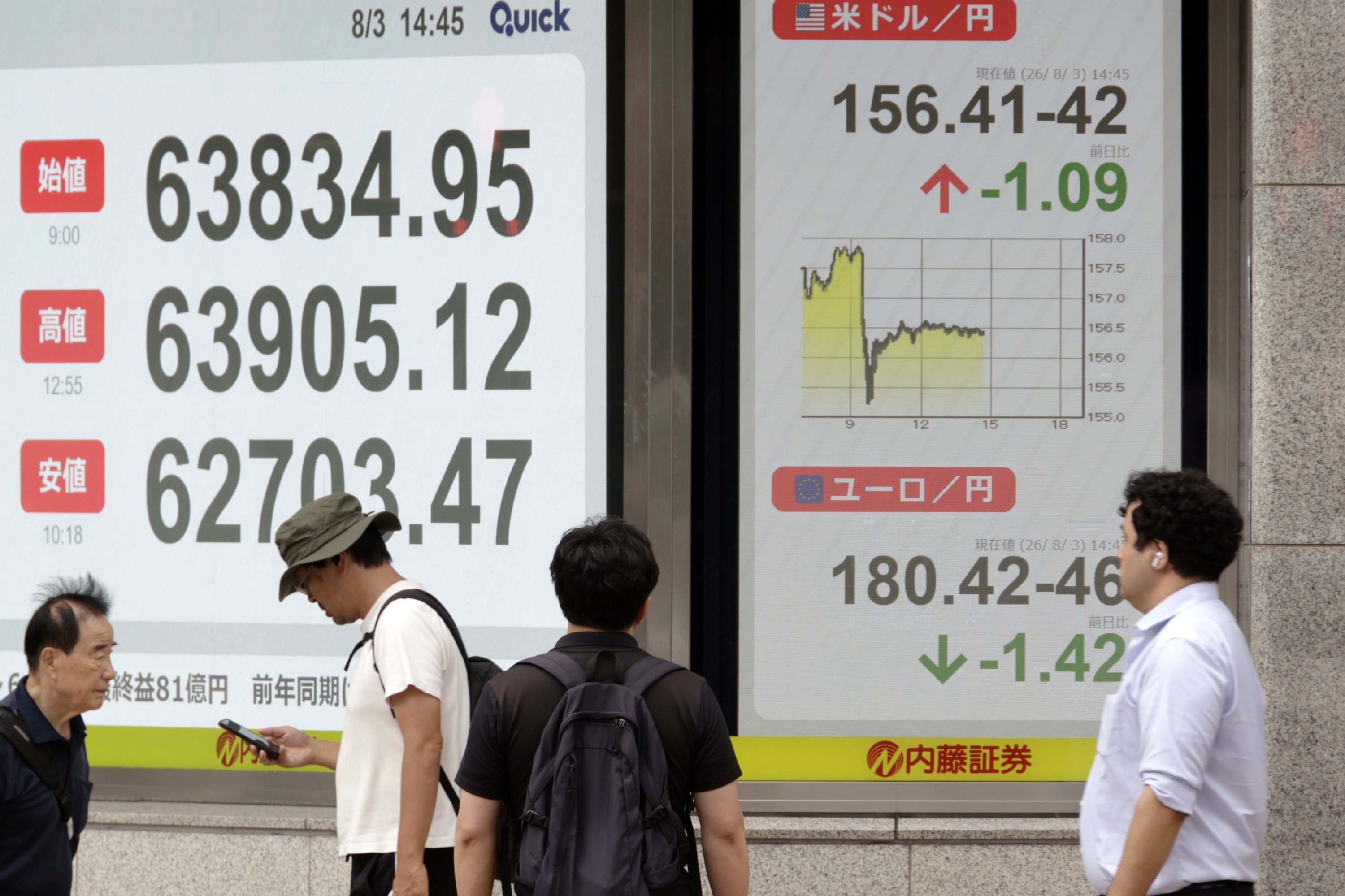
Tokyo and Washington conducted a coordinated yen-buying intervention and will not hesitate to take further action, Japan's Finance Ministry said on Monday, confirming a rare bilateral move to halt the yen's slide to fresh 40-year lows.
The move underscored both countries' resolve to prevent a selloff in the yen and Japanese government bonds (JGBs) from causing global spillovers, such as adding upward pressure on already rising U.S. Treasury yields, analysts said.
The joint intervention was the first since 2011's coordinated action to weaken the yen following the devastating earthquake in eastern Japan.
President Donald Trump said on Sunday the United States was helping Japan prop up the yen as a sign of friendship and to help the world economy.
In the statement, Japan's Finance Ministry said Friday's yen-buying intervention with the U.S. Treasury Department "countered excessive volatility and disorderly movements in the Japanese yen in recent months."
"We will not hesitate conducting further coordinated intervention," Finance Minister Satsuki Katayama told reporters on Monday.
The yen surged more than 1% to 155.20 per dollar after the announcement, its strongest since early May and well off the 40-year low near 164 hit last month, as traders remained on alert for more intervention.
The joint effort to fight off speculative bets against the yen followed months of preparation by the two nations and a rare and public alignment of interests in Washington and Tokyo over exchange rates.
While unilateral efforts by Japanese authorities to stop sharp yen selling in the past have failed to provide a firm floor for the currency, U.S. Treasury Secretary Scott Bessent's verbal support for a stronger yen has given bureaucrats in Tokyo a new tool in their fight this year.
For Japan, a weak yen has fanned import prices, creating cost-of-living headaches for successive governments, including current Prime Minister Sanae Takaichi's.
For the U.S., a weak yen blunts the trade advantage from Trump's flagship tariffs while a related sell-off in Japanese government bonds could spill over to U.S. Treasury yields.
The shared currency anxiety has forged increasingly cozy bilateral conversations about exchange rates, historically a diplomatically thorny topic for the two economic powers, but also added new pressure for the Bank of Japan (BOJ) to persist with rate hikes.
U.S. participation in yen-buying intervention was considered as early as January, when the New York Federal Reserve made rare rate checks to help Tokyo combat yen declines, a Japanese government official with knowledge of the preparations told Reuters.
"Including online meetings, we've held talks about 10 times for discussions that included exchange rates," Japanese Finance Minister Satsuki Katayama said on Monday on how frequently she spoke with Bessent.
"When he visited Japan in May, we talked three-and-a-half hours, including over dinner," Katayama said upon announcing the joint intervention.
The May talks followed Japan's huge yen-buying intervention between late April and early May, which failed to reverse the currency’s downtrend.
Before Friday's move, Japan may have sold as much as $58.97 billion to buy yen when it intervened in New York markets on Thursday, BOJ data suggested.
In a sign negotiations were intensifying, Katayama said after the May meeting the two have been "coordinating very closely on foreign exchange and will continue to do so."
Bessent, too, said Japan's fundamentals are "strong and resilient, and that will be reflected in the exchange rate."
He also repeated his calls for faster BOJ interest rate increases, signaling Washington's concern its slow pace of hikes could leave the central bank behind the curve in addressing inflation.
A month later, the BOJ raised interest rates to a 31-year high of 1% in a landmark step in policy normalization. But with Japan's real borrowing costs deeply negative, the move failed to give a lasting boost to the sagging currency.
With the yen hitting a four-decade low this year, Japan's top currency diplomat Atsushi Mimura has shifted tactics.
Instead of a daily stream of calibrated verbal warnings against speculators, Mimura has focused on working behind-the-scenes with U.S. counterparts, said two sources familiar with the preparations.
That means Mimura, who has sway over when to step in, has been less public, and kept markets guessing about the chance of intervention. He kept a low profile even as Katayama and Bessent held an online meeting in late June to discuss financial market developments.
"The joint intervention is the culmination of Japan's alliance with the United States," Mimura told reporters on Monday.
The need for action heightened in July, when concern over Takaichi's expansionary fiscal and monetary stance drove the yen to recent lows, pushing up the cost of imports and hurting the administration's approval ratings.
The U.S. administration was also grappling with rising inflation and Treasury yields, heightening the incentive to support Tokyo's effort to combat market headwinds.
Nodding to Japan's concern over the weak yen, the U.S. Treasury's semi-annual currency report on July 24 echoed Tokyo's warning against excessive yen volatility and pledged to continue "close consultations" with Japan on exchange-rate matters.
Both the U.S. Federal Reserve's and BOJ's policy meetings last week were seen as potentially vulnerable windows for the yen, as investors positioned themselves based on cues from both banks about the timing of future rate hikes.
Japan's intervention campaign was closely coordinated with the BOJ, according to people familiar with the matter.
Using a speakerphone connected with a handful of staff at the Finance Ministry's foreign-exchange division, Mimura gave the green light to buy yen for dollars late evening on July 30.
The move, which hit investors outside Tokyo hours and amid the BOJ's two-day policy meeting, immediately firmed the yen to 157.80 per dollar from around 162.80.
When one of the staff told Mimura the yen was sliding back down toward 158, he said. "Yes. Let's congregate tomorrow."
Shortly after BOJ Governor Kazuo Ueda's news briefing concluded on Friday, the yen spiked in what markets suspect may have been another bout of yen-buying intervention by Tokyo.
This time, Tokyo was joined by Washington.
The U.S. Treasury informed a number of banks that it might intervene in the yen market and that they should "stand ready for future action," a source had told Reuters.
Bessent had a notepad at a Friday cabinet meeting with the words "To Do," followed by "Buy Japanese Yen (JPY) $5-10 bill," a Reuters photo showed.
The BOJ's communication on its future rate plans last week was its most hawkish to date and crucially nodded to a line in the U.S. Treasury's currency report that "monetary normalization would help reduce excessive exchange rate volatility."
Carefully reading off a prepared script, Ueda emphasized the vigilance needed "more than ever" against upside price risks, read by analysts as all but confirming a September rate hike.
Those sentiments also received praise in Washington.
"We strongly support Japan's decisive market and monetary steps to correct the substantial undervaluation of the yen," Bessent said in an X post on Sunday, stressing anew his support for higher BOJ rates.
Mimura, too, said the government will align its currency policy with the BOJ's monetary policy to address yen weakness, signaling the chance of a near-term rate hike.
In a separate X post, Bessent said he would meet Ueda at a U.S.-hosted G-20 finance leaders' meeting in end-August – which precedes the BOJ's next policy meeting on Sept. 17 and 18.
Markets now see the BOJ's September meeting as live.
"Given Japan moved to prevent yen falls with the cooperation of the U.S., there's a question of whether the BOJ can afford to forgo raising rates in September," said Yuki Kimura, bond strategist at Okasan Securities.
Naomi Muguruma, chief bond strategist at Mitsubishi UFJ Morgan Stanley Securities, sees a September hike as near-given.
"Intervention only has a temporary effect in slowing currency moves. Faster rate hikes are probably needed to put a lasting floor on the yen," she said.
"I feel like a September rate hike is a done deal. It won't make sense for the BOJ to wait until October and cause another bout of yen declines."
In a sign of further Japan-U.S. coordination, Bessent said the U.S. would consider increasing in coming months the size of the Federal Reserve's repurchase facility providing temporary dollar liquidity, calling the tool an "important backstop."
The comment followed the Finance Ministry's rare X post on Saturday that it had "a broad range of tools to address market liquidity needs," including access to the Fed's repurchase facility providing temporary dollar liquidity.
The Fed facility, introduced in 2020 to steady markets during the COVID-19 pandemic, allows Japan to raise dollar liquidity without outright sales of U.S. Treasuries, potentially easing funding pressures on Tokyo for intervention.
Some analysts doubt whether the latest round of action could counter structural factors driving down the yen, such as the rising cost of fuel from the Middle East conflict and the still wide Japan-U.S. interest rate differentials.
"The announcement effect of joint intervention is much bigger than solo action by Japan," said Tsuyoshi Ueno, a senior economist at NLI Research Institute.
"But the fundamentals driving yen weakness haven't changed, so we likely won't see one-sided yen rises from this intervention."