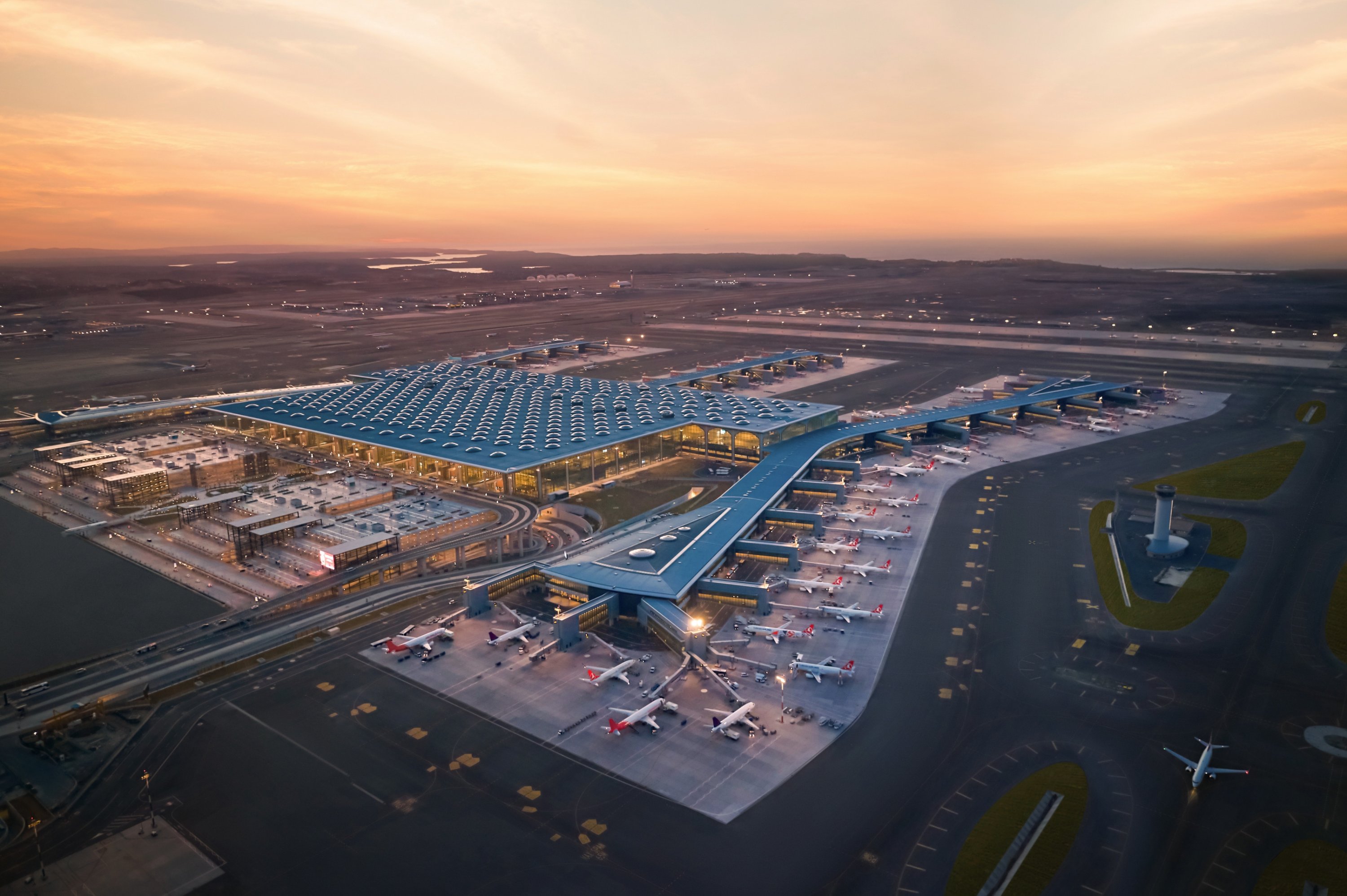
Work on Istanbul Airport's fourth main runway has reached its final stage, with operations expected to begin in the coming days following technical tests, Transport and Infrastructure Minister Abdulkadir Uraloğlu said Wednesday.
The east-west runway is 2,820 meters (9,250 feet) long and 45 meters wide, Uraloğlu said, adding that it would further expand the airport's capacity after it became the first in Europe to operate three independent runways simultaneously.
Istanbul Airport currently handles an average of 1,665 flights a day, making it Europe's busiest airport, ahead of major hubs including London Heathrow, Paris Charles de Gaulle and Amsterdam Schiphol.
The airport also ranked sixth globally among 25 major airports, averaging 843 daily departures.
Istanbul Airport set a European record on Aug. 16 with 1,739 flights and 290,000 passengers, before renewing the record on Aug. 30 with 1,787 flights, Uraloğlu said.
The gleaming glass-and-steel structure along the Black Sea coast turned into one of the most important transit centers in aviation since it became fully operational in April 2019.
The hub can handle 90 million passengers a year in the current phase. The figure is nothing compared to its potential capacity to serve 200 million after completing all phases.
Istanbul Airport served record-breaking 84.4 million passengers in 2025, making it the second-busiest airport in Europe after Heathrow Airport and the eighth-busiest worldwide. It seeks to reach the 90 million mark this year.
Türkiye ranks sixth among European countries by air traffic volume, with an average of 4,400 flights per day, Uraloğlu said.
The minister said Türkiye now has 356 international flight destinations in 133 countries, dubbing it a major aviation hub connecting different continents.
The number of active airports in the country has risen to 58 from 26 in 2002, with the government renovating 16 previously inactive airports and building 16 new ones.
The number is expected to reach 60 as airports currently under construction are completed.
Türkiye has increased the number of countries with which it has air transport agreements to 175 from 81, while its international flight network has expanded from 60 destinations in 50 countries in 2002 to 356 destinations across 133 countries, Uraloğlu said.
Passenger traffic on domestic and international routes rose to a record 247 million in 2025 from about 34.5 million in 2002, he added, putting Türkiye third in Europe and seventh globally.