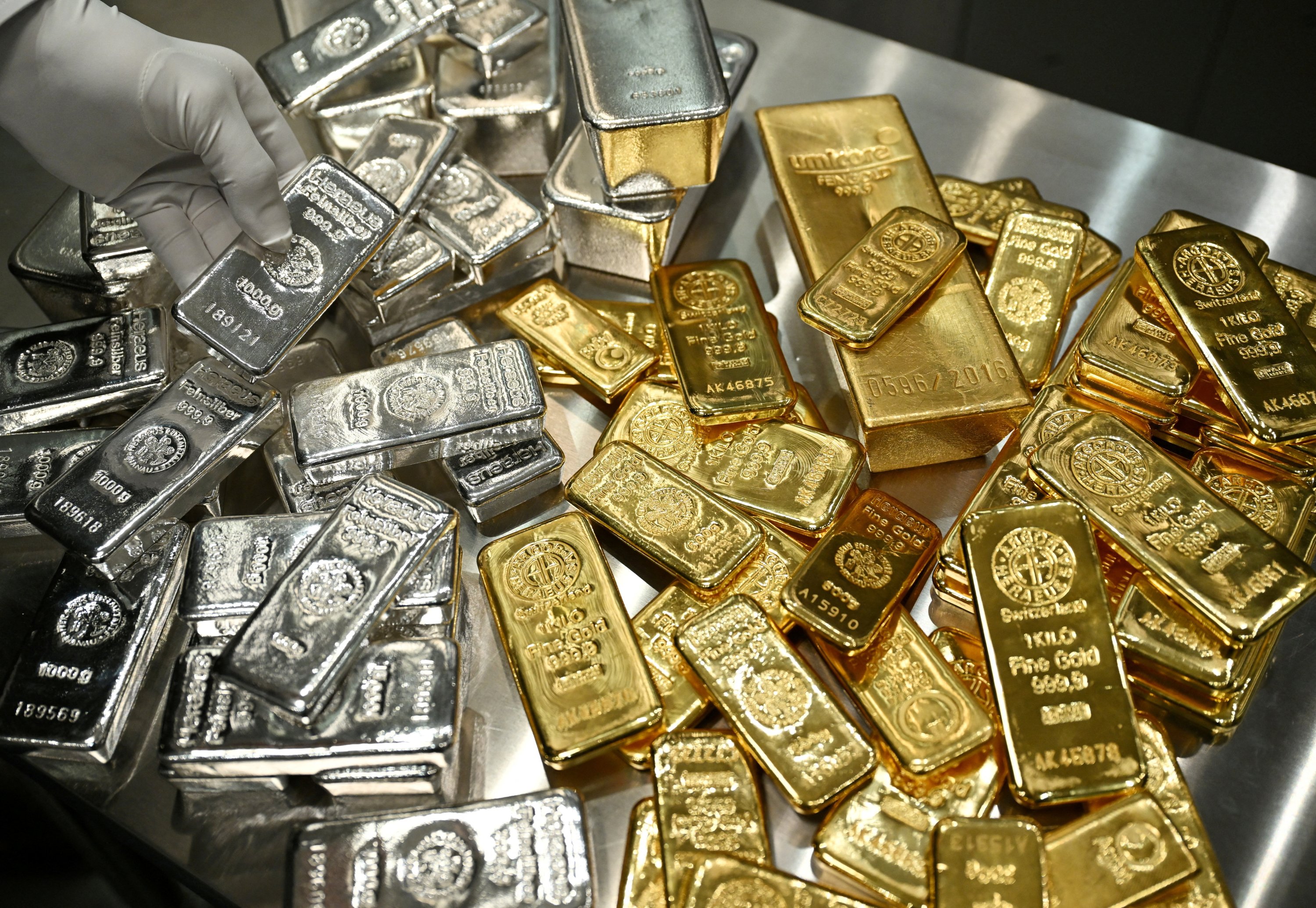
Gold broke above $4,500 an ounce for the first time on Wednesday while silver and platinum also marked new record highs, as safe-haven demand and expectations of further U.S. rate cuts next year fueled speculative interest in precious metals.
Spot gold was up 0.1% at $4,493.76 per ounce at 1023 GMT, after marking a record high of $4,525.19 earlier in the session. U.S. gold futures for February delivery climbed 0.3% to $4,520.00.
Silver hit an all-time high of $72.70 and was last up 0.9% at $72.09 an ounce, while platinum peaked at $2,377.50 before paring gains to stand 0.3% higher at $2,282.70.
Palladium was down 2.5% at $1,815.25, retreating after touching its highest in three years.
"The lack of any bearish factors and strong momentum, all backed by solid fundamentals, which include continued central bank buying, a falling U.S. dollar and some level of haven demand," is supporting gold, said Fawad Razaqzada, market analyst at City Index and FOREX.com.
"Other base metals like copper have been climbing, which is providing support for the whole commodities complex in terms of metals."
Gold has risen more than 70% this year, its biggest annual gain since 1979, as investors flock to safe-haven assets amid geopolitical tensions and with expectations that the U.S. Federal Reserve (Fed) will continue to ease monetary policy.
U.S. President Donald Trump said on Tuesday he wants the next Fed chair to lower interest rates if markets are doing well.
Non-yielding assets such as gold tend to do well in a low-interest-rate environment, with traders currently pricing in two rate cuts next year.
Silver has surged more than 150% year-to-date, outpacing gold on strong investment demand, its inclusion on the U.S. critical minerals list and rising industrial use.
"The risk of a major drop in the gold price would seem largely linked to a slowing of outright gold buying, such as by emerging market central banks," analysts at Societe Generale said in a note. "Barring such an event, investor positions suggest that the extraordinary surge in gold prices is likely to continue, supporting our Commodities strategists' forecast ($5,000/oz by end-2026)."
Platinum and palladium, primarily used in automotive catalytic converters to reduce emissions, are up about 160% and more than 100%, respectively, year-to-date, on tight mine supply, tariff uncertainty, and a rotation from gold investment demand.
Here are some ways to invest in gold:
Spot market:
Large buyers and institutional investors usually buy gold from big banks. Prices in the spot market are determined by real-time supply and demand dynamics.
London is the most influential hub for the spot gold market, largely because of the London Bullion Market Association. The association sets standards for gold trading and provides a framework for the over-the-counter market, facilitating trades among banks, dealers, and institutions.
China, India, the Middle East and the United States are other major gold trading centres.
Futures market
Investors can also get exposure to gold via futures exchanges, where people buy or sell a particular commodity at a fixed price on a particular date in the future.
Commodity Exchange Inc. (COMEX), part of the New York Mercantile Exchange, is the largest gold futures market in terms of trading volumes.
The Shanghai Futures Exchange, China's leading commodities exchange, also offers gold futures contracts. The Tokyo Commodity Exchange, popularly known as TOCOM, is another big player in the Asian gold market.
Exchange-traded products
Exchange-traded products or exchange-traded funds issue securities backed by physical metal and allow people to gain exposure to gold prices without taking delivery of the metal itself.
Inflows into physically backed gold exchange-traded funds totalled $64 billion year-to-date as of October, according to World Gold Council data, with a record $17.3 billion added in September alone.
Bars and coins
Retail consumers can buy gold from metals traders selling bars and coins in a shop or online. Gold bars and coins are both effective means of investing in physical gold.
Investor interest and market sentiment
Rising interest from investment funds in recent years has been a major factor behind bullion's price moves.
Sentiment driven by market trends, news and global events can fuel speculative buying or selling of gold.
Foreign exchange rates
Gold is a popular hedge against currency market volatility. It has traditionally moved in the opposite direction to the U.S. dollar, since weakness in the U.S. currency makes dollar-priced gold cheaper for holders of other currencies and vice versa.
Monetary policy and political tensions
The precious metal is widely considered a safe haven during times of uncertainty.
Trump's trade tariffs have sparked a global trade war, rattling currency markets.
The policy decisions of global central banks also influence gold's trajectory. Lower interest rates reduce the opportunity cost of holding gold since it pays no interest.
Central bank gold reserves
Central banks hold gold in their reserves. Demand by central banks has been robust in recent years because of macroeconomic and political uncertainty.
More central banks plan to add to their gold reserves within a year despite high prices, the World Gold Council said in its annual survey in June.
Global gold demand rose 3% year-over-year to 1,313 metric tons in the third quarter of 2025, the highest quarterly total on record, as investment demand surged, the World Gold Council said in late October.
China kept adding gold to its reserves, with its holdings totaling 74.12 million fine troy ounces at the end of November from 74.09 million at the end of October, extending its buying spree for the 13th month in a row.