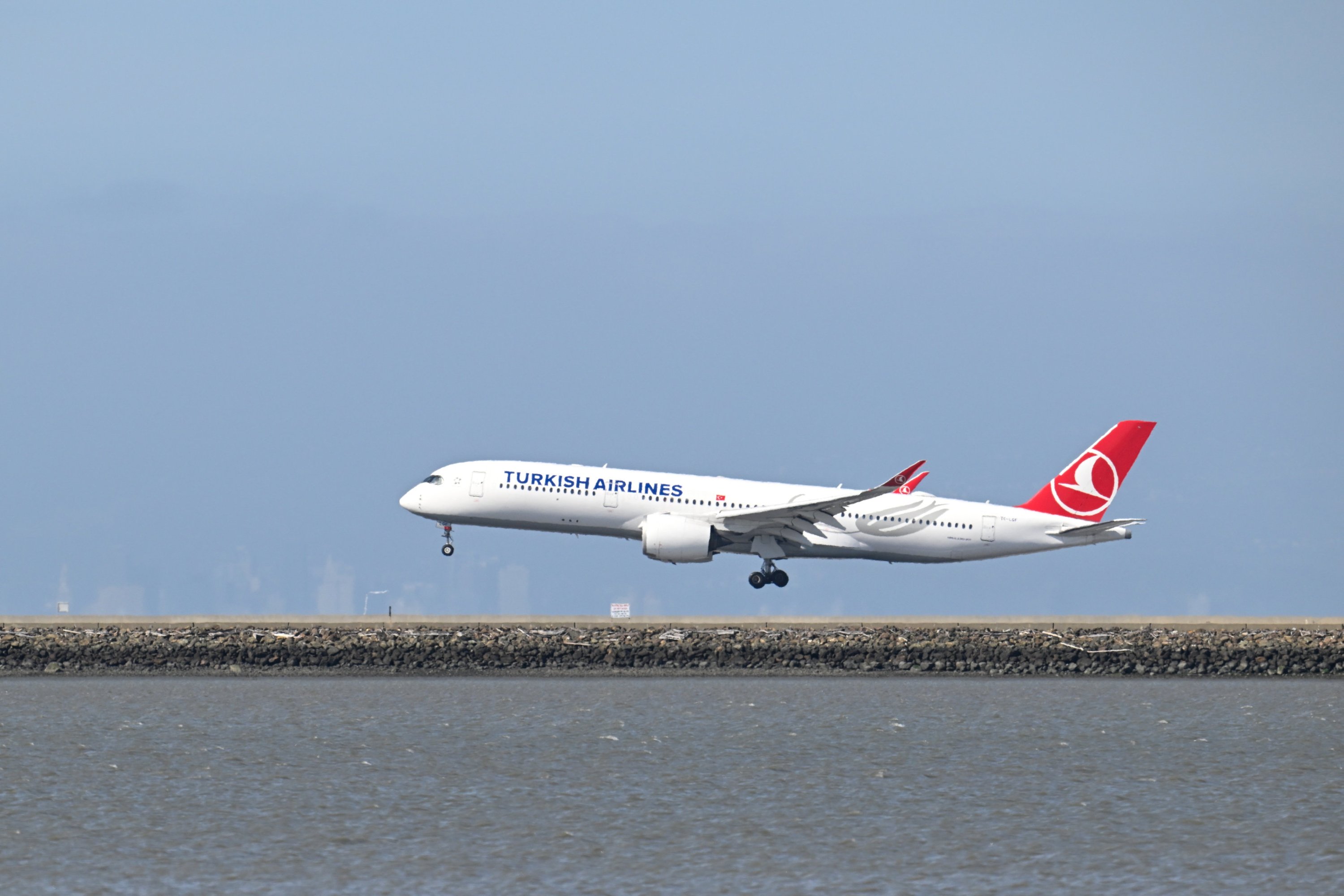
National flag carrier Turkish Airlines (THY) plans to expand its nonstop long-haul network by deploying ultra-long-range aircraft from late 2027, enabling direct flights to destinations in Australia and South America, its chair said on Monday.
THY has orders in place for nearly 420 aircraft, including Airbus and Boeing jets, with negotiations continuing for an additional 100 Boeing planes.
"With the addition of ultra-long-range aircraft to the fleet from the end of 2027 onward, we will gain the ability to operate direct flights to Australia and certain destinations in South America," Chair of the Board Murat Şeker told Anadolu Agency (AA).
Şeker took the helm of the carrier this April after serving as its chief financial officer since 2016.
Under its 2033 strategy, Turkish Airlines, which already serves more countries than almost any other carrier in the world, plans a major fleet replacement and expansion to around 800 aircraft.
Şeker was part of the team that created the strategy and said Monday he does not foresee any significant change in the "big picture."
"In other words, with the Airbus order placed in 2023 and the Boeing order placed in September of last year, Turkish Airlines has ordered close to 420 aircraft in total," he said.
Şeker noted that negotiations are still ongoing for an order of 100 Boeing aircraft. The carrier's current fleet includes 485 planes.
"There is no significant change in our growth targets," Şeker noted, but added that there could be some change in the composition.
"We are aware of what we are capable of doing," he noted. "We have a hub like Istanbul Airport. And we have a country like Türkiye, which is a leading force in tourism and has ranked among the world’s top five most-visited countries for many years."
The airline also expects to receive specially configured Airbus A350-1000 aircraft capable of operating flights of up to 17 hours without stopovers.
The jets will allow THY to operate nonstop services from Istanbul to cities such as Sydney and Melbourne, while also improving access to destinations including Buenos Aires, Santiago and Lima, which currently require intermediate stops.
"With specially designed versions of the Airbus A350, we will have the opportunity to connect Istanbul to longer-range routes," Şeker said.
Global airlines are grappling with higher fuel costs driven by the U.S. and Israel's war with Iran, which has choked jet fuel supplies and disrupted key air corridors, forcing costly detours.
But Şeker said THY has not faced fuel supply challenges.
Türkiye benefits from domestic jet fuel production capacity through refineries operated by Tüpraş and SOCAR, while its geographic position provides access to additional supplies from Iraq, North Africa and other regions.
Şeker said THY has been less affected than some Asian markets, where jet fuel prices temporarily rose to as much as $2,000 per ton.
In Türkiye, prices peaked at around $1,600-$1,800 per ton and currently stand at approximately $1,200-$1,300 per ton, Şeker said.
The Iran conflict has upended traffic flows through Middle Eastern hubs such as Dubai, Doha and Abu Dhabi, creating acute challenges for Gulf carriers including Emirates, Qatar Airways and Etihad.
Şeker said disruptions provided THY with an opportunity to attract new passengers from South Asia, the Far East, the Maldives, Seychelles and North America.

During a period when some Gulf airlines were unable to operate normally, Turkish Airlines carried a portion of their passengers, introducing many travelers to the carrier for the first time, he noted.
But, Şeker said "only time will tell whether this turns into a real and lasting opportunity in the long term."
He noted that major Gulf carriers, including Qatar Airways, Emirates and Etihad, have largely restored their pre-crisis capacity levels.
"At the moment, we are not engaged in very aggressive price competition in terms of ticket prices," he added.
Şeker described 2026 as a challenging year due to fuel-related cost pressures and geopolitical uncertainties. But, he said they believe the war will not continue through the end of the summer.
THY had budgeted for capacity growth of 7%-8% this year but now expects expansion of only 1%-2%.
Despite the headwinds, Şeker said the airline's extensive route network provides flexibility to manage disruptions.
"We hope to complete this year with limited losses and moderate growth, and then continue Turkish Airlines' growth trajectory from where we left off," he said.
THY's passenger count rose 3.9% year-over-year in the January-June period of this year to 42.2 million. Its occupancy rate rose by 0.6% to 81.4%.
Şeker said THY's broader strategy remains intact but will increasingly focus on higher-value businesses.
He highlighted initiatives including the Turkish Holidays travel package platform, the airline's loyalty program, payment systems venture TKPAY and cargo logistics company Widect, which provides door-to-door delivery services.
"In today's intensely competitive environment, it is becoming difficult for airlines to grow by doing the same things. More aircraft, more passengers, more revenue; this business becomes less profitable," said Şeker.
"That is why we will have a stronger presence in areas with higher added value."
He added that THY's purchase of stake in Spanish carrier Air Europa could also be viewed within this strategic framework.
Under a deal agreed in August, Turkish Airlines is to invest about 300 million euros ($346 million) in convertible debt, which will be exchanged for a stake in the Spanish carrier expected to be in the range of 25% to 27%.