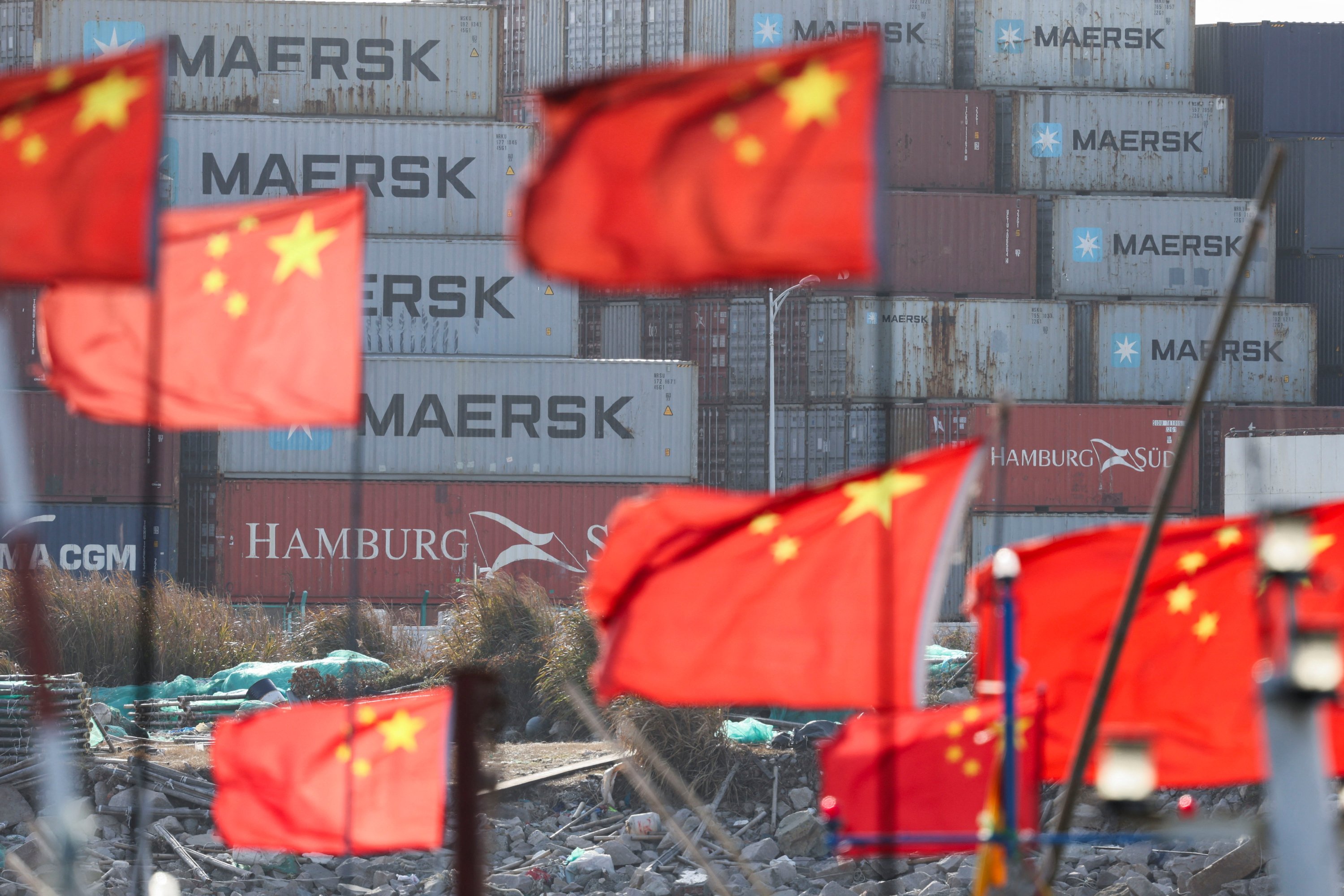
U.S. President Donald Trump suggested on Wednesday that a new trade deal with China was "possible," despite the growing tensions over the future of international trade and the number of sweeping tariffs announced since his return to office.
In 2020, the U.S. had already agreed to "a great trade deal with China," and a new deal was "possible," Trump told reporters aboard Air Force One.
Asked about the comments, China's Foreign Ministry said Thursday the two countries should handle trade tensions with "mutual respect."
One month into his second term in office, Trump has threatened sweeping tariffs on allies and adversaries alike – targeting China as well as neighbors Canada and Mexico, and the European Union – and using levies as his main policy tool for lowering the massive U.S. trade deficit.
At the beginning of February, he imposed an additional 10% customs duties on all products imported from China.
Beijing's Foreign Ministry said Thursday that China and the U.S. "should resolve their concerns through dialogue and consultation based on equality and mutual respect."
"Trade and tariff wars have no winners and only serve to damage the interests of people all over the world," ministry spokesperson Guo Jiakun said at a regular news briefing.
At a separate news conference, China's Commerce Ministry said Beijing "urges the U.S. side not to wield the big stick of tariffs at every turn, using tariffs as a tool to engage in coercion all around."
Trump also threatens to impose 25% tariffs on all imported cars and similar or higher duties on pharmaceuticals and semiconductors as he turns up the heat on some of the biggest U.S. trading partners.
On Wednesday, he also told journalists aboard Air Force One that his administration was considering lumber tariffs of "maybe 25%" in the coming months.
The president initially announced tariffs of 25% on all Canadian and Mexican imports before U-turning hours before they were due to come into effect, granting a one-month reprieve in principle until March 1.
He also signed executive orders last week imposing new 25% tariffs on steel and aluminum imports, which will come into effect on March 12.
Experts have warned that Americans often pay the costs of tariffs on U.S. imports – not foreign exporters.
Between Washington and Beijing, "there's a little bit of competitiveness, but the relationship I have with President Xi (Jinping) is, I would say, a great one," Trump told reporters on Wednesday.
In addition to the leaders of France and Britain, Trump said Xi would also eventually be coming to Washington to meet with him.
Beijing has responded to the U.S. tariffs with customs duties of 15% on coal and liquefied natural gas (LNG) and 10% on oil and other goods, such as agricultural machinery and vehicles.
China has the largest trade surplus with the U.S. in goods – $295.4 billion in 2024, according to the Bureau of Economic Analysis, which reports to the U.S. Department of Commerce.
Last week, U.S. ally Japan said it had asked the U.S. to be exempt from Trump's tariffs on steel and aluminum exports and has underlined the importance of its auto industry.
Tokyo's trade minister is arranging a visit to the U.S. in the coming weeks to further push for exemptions, Japanese media reported Thursday.
Yoji Muto was expected to meet U.S. officials, including new commerce secretary Howard Lutnick, before March 12, when the 25% tariffs on steel and aluminum imports were set to come into effect, Kyodo News said.
Trump's latest remarks on tariffs came as the European Union's trade chief vowed Wednesday that the bloc would respond "firmly and swiftly" to protect its interests if Washington imposes tariffs on EU goods.
Maros Sefcovic rejected Trump's claim that U.S.-EU trade ties were unfair, calling them the "very definition of a win-win partnership."
However, he signaled the EU's willingness to make deals, such as the possibility of reducing or eliminating tariffs on autos and other products.
"If we are going to talk about lowering the tariffs, even eliminating the tariffs, let's say for industrial products, this would be something which we are ready to discuss," he said.
Within the 27-nation EU, Germany has by far the largest trade surplus with the U.S., largely thanks to its automobile industry and chemical giants such as Bayer and BASF, according to the European statistics agency, Eurostat.