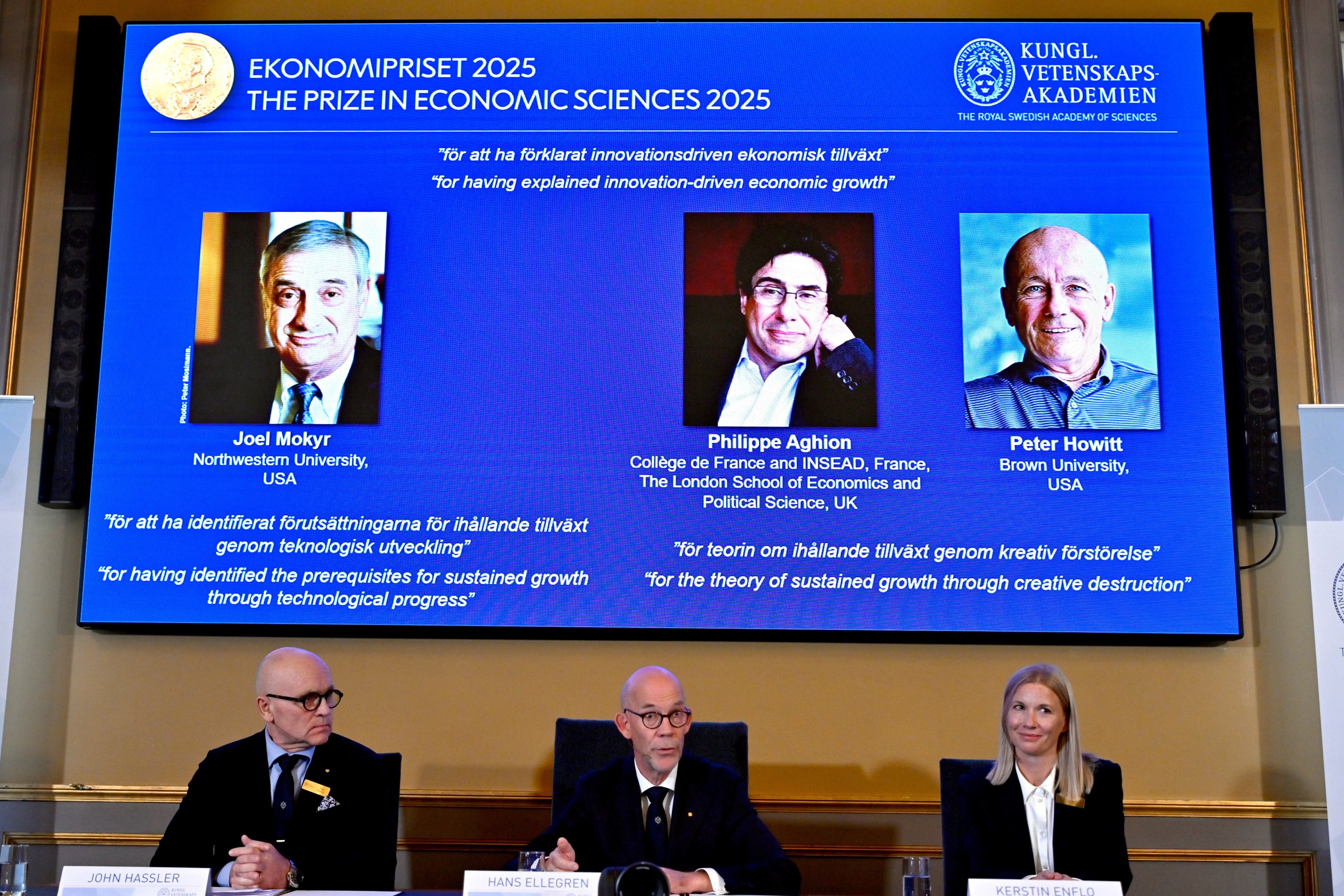
The Nobel prize in economics was awarded on Monday to American-Israeli Joel Mokyr, France's Philippe Aghion and Canada's Peter Howitt for their work on showing how technology can drive sustained economic growth.
The Royal Swedish Academy of Sciences has decided to award the Sveriges Riksbank Prize in Economic Sciences in Memory of Alfred Nobel 2025 to Mokyr, Aghion and Howitt “for having explained innovation-driven economic growth,” the academy said in a statement.
Dutch-born Mokyr is from Northwestern University, Aghion from the College de France and the London School of Economics (LSE), and Howitt from Brown University.
Mokyr, 79, won one half of the prize "for having identified the prerequisites for sustained growth through technological progress", the Royal Swedish Academy of Sciences said.
Aghion, 69, and Howitt, 79, shared the other half "for the theory of sustained growth through creative destruction," it added.
John Hassler, chair of the prize committee, told reporters their work answered questions about how technological innovation drives growth and how sustained growth can be maintained.
"The laureates' work shows that economic growth cannot be taken for granted. We must uphold the mechanisms that underlie creative destruction, so that we do not fall back into stagnation," Hassler said.
The winners were credited with better explaining and quantifying "creative destruction," a key concept in economics that refers to the process in which beneficial new innovations replace – and thus destroy – older technologies and businesses. The concept is usually associated with economist Joseph Schumpeter, who outlined it in his 1942 book "Capitalism, Socialism and Democracy."
Aghion and Howitt studied the mechanisms behind sustained growth, including in a 1992 article in which they constructed a mathematical model for creative destruction.
Mokyr, who is a professor of economics and history at Northwestern University in the U.S., "used historical sources as one means to uncover the causes of sustained growth becoming the new normal," the jury said in a statement.
Aghion and Howitt then examined the concept of "creative destruction," which refers to the process "when a new and better product enters the market, the companies selling the older products lose out."
One-half of the 11 million Swedish kronor (nearly $1.2 million) prize went to Mokyr and the other half was shared by Aghion and Howitt. Winners also receive an 18-carat gold medal and a diploma.
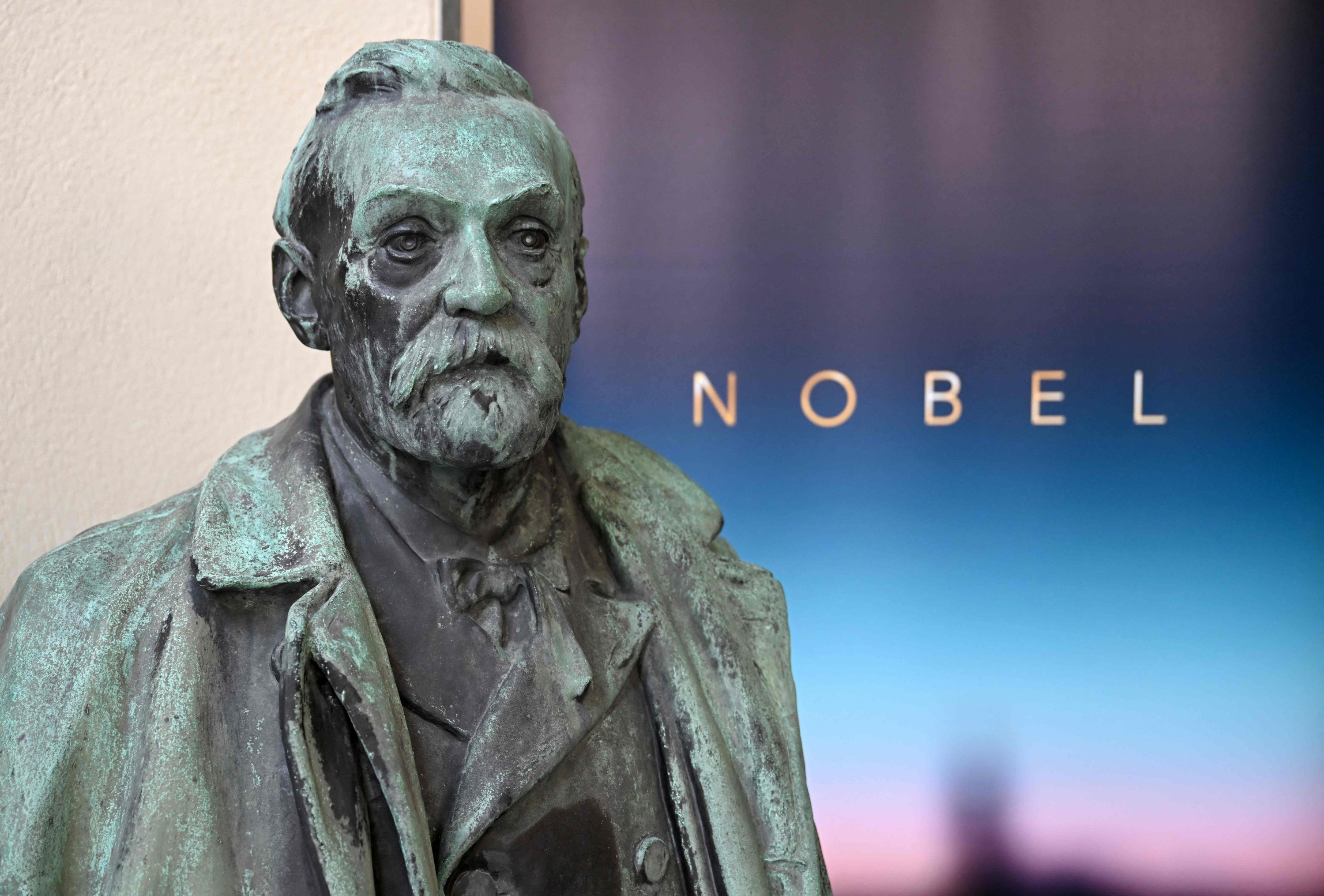
The economics prize is the only Nobel not among the original five created in the will of Swedish scientist Alfred Nobel, who died in 1896.
It was instead created through a donation from the Swedish central bank in 1968, as a memorial to Nobel, the 19th-century Swedish businessman and chemist who invented dynamite and established the five Nobel Prizes.
Since then, it has been awarded 56 times to a total of 96 laureates. Only three of the winners have been women.
Last year's award went to three economists – Daron Acemoğlu, Simon Johnson and James A. Robinson – who studied why some countries are rich and others poor and have documented that freer, open societies are more likely to prosper.
The economics prize wraps up this year's Nobel season as Nobel honors were announced last week in medicine, physics, chemistry, literature and peace.