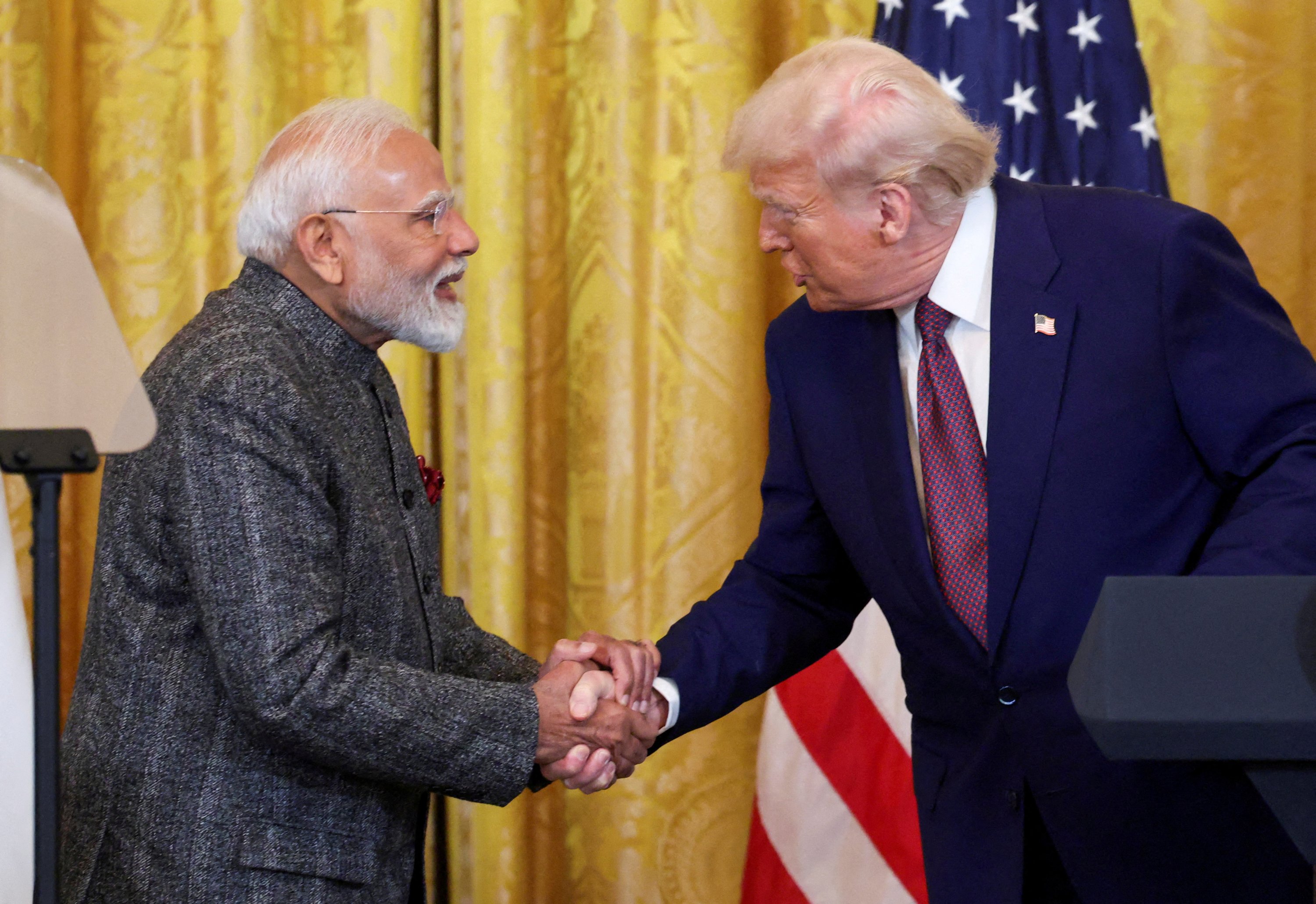
U.S. President Donald Trump on Tuesday said he would increase the tariff charged on imports from India "very substantially" over the next 24 hours, given the country's continued purchases of Russian oil.
The threat comes nearly a week after Trump announced 25% tariffs on Indian imports, and U.S. officials have cited a range of geopolitical issues standing in the way of a U.S.-India trade accord.
Trade rift deepened as Trump also threatened unspecified penalties over India's oil purchases from Russia.
"India has not been a good trading partner, because they do a lot of business with us, but we don't do business with them," the president said on Tuesday.
"So we settled on 25% but I think I'm going to raise that very substantially over the next 24 hours, because they're buying Russian oil," he told CNBC in a televised interview.
Earlier on Tuesday, India's ruling party and main opposition condemned Trump's threat, in a show of political unity.
Manish Tewari, a member of Parliament and leader of the opposition Congress, said Trump's "disparaging remarks hurt the dignity and self-respect of Indians."
"The time has come to call out this constant bullying and hectoring," he added.
BJP Vice President Baijayant Jay Panda quoted Henry Kissinger – the most powerful U.S. diplomat of the Cold War era – in a post on social media platform X: "To be an enemy of America can be dangerous, but to be a friend is fatal."
India's Foreign Ministry said the country was being unfairly singled out over its purchases of Russian oil, and highlighted continued trade between Moscow and both the U.S. and the European Union, despite the war in Ukraine.
"It is revealing that the very nations criticizing India are themselves indulging in trade with Russia," it said in a statement issued late on Monday.
"It is unjustified to single out India," the ministry said.
It said the EU conducted 67.5 billion euros ($78.02 billion) in trade with Russia in 2024, including record imports of liquefied natural gas (LNG) reaching 16.5 million metric tons.
The United States, the statement said, continues to import Russian uranium hexafluoride for use in its nuclear power industry, palladium, fertilizers and chemicals. It did not give a source for the export information.
Both the United States and the EU have sharply scaled back their trade ties with Russia since it launched a full-scale invasion of Ukraine in February 2022.
In 2021, Russia was the EU's fifth-largest trading partner, with goods exchange worth 258 billion euros, according to the EU executive European Commission.
India is the biggest buyer of seaborne crude from Russia, importing about 1.75 million barrels per day of Russian oil from January to June this year, up 1% from a year ago, according to data provided to Reuters by trade sources.
It has faced pressure from the West to distance itself from Moscow since Russia invaded Ukraine. New Delhi has resisted, citing its longstanding ties with Russia and economic needs.
India's National Security Adviser Ajit Doval is likely to travel to Russia this week on a scheduled visit, two government sources said. Foreign Minister S Jaishankar is expected to visit in the coming weeks.
The sudden rift between India and the U.S. has been deepening since July 31, when Trump announced the 25% tariff on goods being shipped to the U.S. and for the first time threatened unspecified penalties for buying Russian oil.
Trump has said that from Friday, he will impose new sanctions on Russia as well as on countries that buy its energy exports, unless Moscow takes steps to end the war with Ukraine.
The trade tensions have caused concern about the potential impact on India's economy.
The equity benchmark BSE Sensex closed down 0.38%, while the rupee dropped 0.17% versus the dollar.