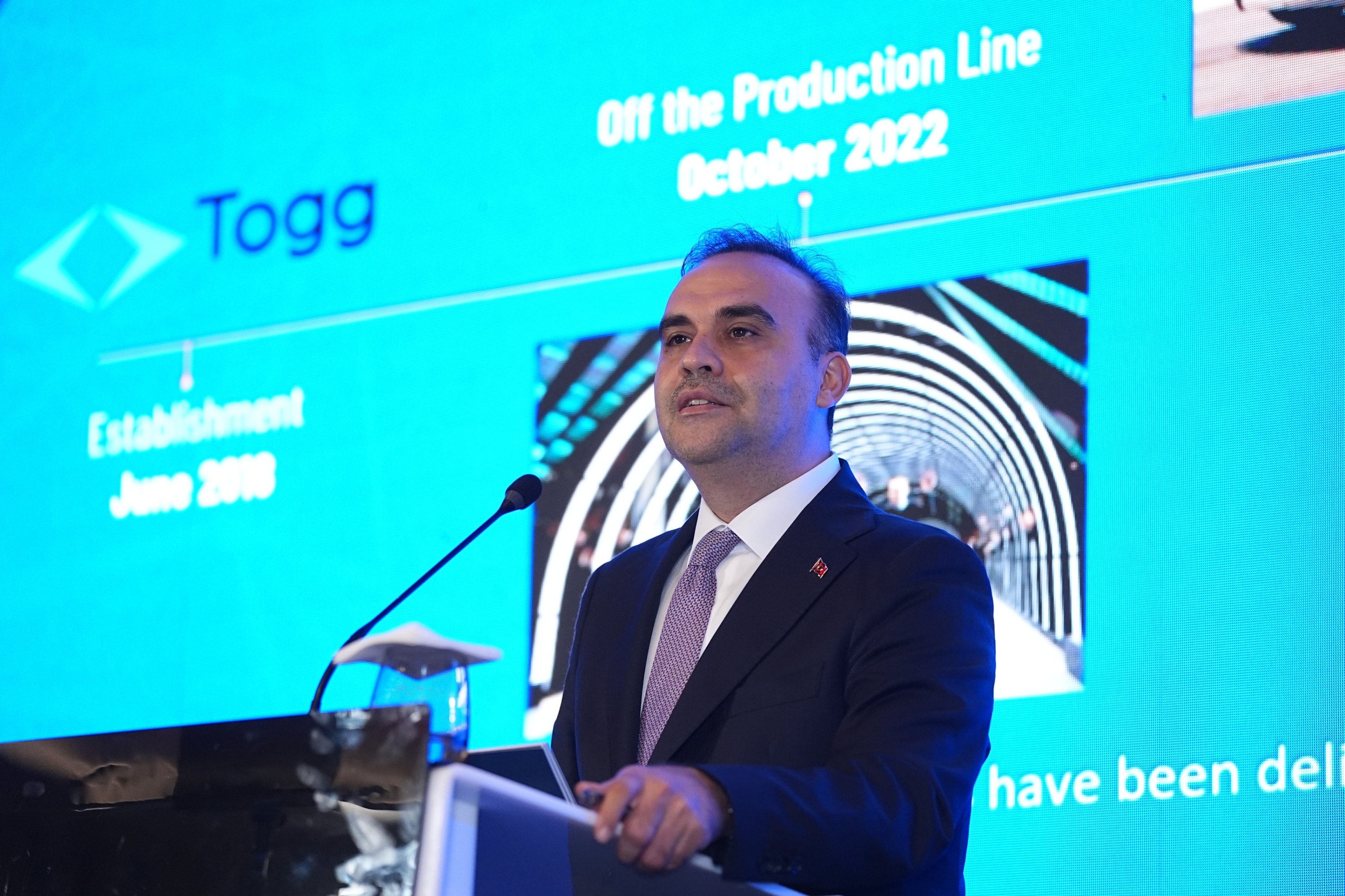
Türkiye has doubled its share of global manufacturing value added (MVA) over the past two decades, according to Industry and Technology Minister Mehmet Fatih Kacır, who tied it to the country's bolstering its infrastructure and industrial transformation in the same period.
Speaking at the ACE BPSC 2026 conference in Istanbul on Wednesday, Kacır said engagement with American businesses was an important component of bilateral relations.
Held under the auspices of the Trade Ministry and hosted by the Turkish-American Business Association (TABA-AmCham), the ACE BPSC 2026 summit brought together officials and industry leaders in Istanbul from Oct. 7-9, with the aim of shaping the new direction of global trade.
"We have doubled our share of global manufacturing value added thanks to the strong production infrastructure we have built over the past 20 years,” Kacır said.
Annual goods exports have risen from $36 billion in 2002 to $283 billion, he added, also highlighting Türkiye’s role in European value chains.
The minister also recalled that under Presidents Recep Tayyip Erdoğan and Donald Trump, Türkiye and the U.S. share the political will to deepen economic ties and advance toward their $100 billion bilateral trade target.
Türkiye has more than 1,700 R&D and design centers and over 13,000 companies operating in 115 technology parks, Kacır said.
He also said that its R&D workforce has increased from 29,000 in the early 2000s to 311,000.
Moreover, he highlighted advances in defense manufacturing and electric vehicle brand Togg, saying Türkiye aimed to move higher in global technology value chains.
Cooperation with the World Bank has provided more than $1 billion for industrial companies, smaller businesses and green technology startups, he said, adding that work with the European Bank for Reconstruction and Development (EBRD) has also advanced efforts to secure 5 billion euros ($5.59 billion) for green transformation investments.
At the same time, the minister said Türkiye aims to expand data center capacity to 1 gigawatt (GW) by 2030 and mobilize at least $10 billion in private investment in AI, cloud technologies and digital infrastructure.
He said assembly and integration of Türkiye’s lunar spacecraft had been completed, with launch planned for early 2027.
He also recalled that Türkiye has joined the Artemis Accords and is developing a spaceport in Somalia.
Among others, he highlighted the Zangezur Corridor, Development Road and Northern Marmara Railway as projects strengthening trade connections.
Inviting U.S. investors to participate, Kacır called for concrete projects, stronger investment flows, deeper technology cooperation and lasting commercial partnerships.
Also addressing the event, Trade Minister Ömer Bolat emphasized that the U.S. is an important partner for Türkiye and said that the total trade volume between the two countries was $38.6 billion last year and that the U.S. had a trade surplus of $6 billion.
Bolat pointed out that Türkiye-U.S. trade has nearly doubled in the past 10 years, with trade volume rising from about $21 billion in 2015 to $38.6 billion.
"In terms of tourism, 1.6 million American tourists come to Türkiye annually, and from Türkiye around 260,000 people travel to America each year," he said.
He also said that Turkish Airlines flies to 14 cities in the U.S., with 23 daily flights.
Delivering the opening address at the summit, TABA-AmCham President Süleyman Ecevit Sanlı, for his part, highlighted that this was the first time the American Chambers of Commerce in Europe (ACE) had gathered in Istanbul.
"Our role as TABA-AmCham is very simple: to connect people with great opportunities and to keep doors open for the business world," he said.
He also underscored several priorities and expectations when looking forward, including the need to modernize the Customs Union between Türkiye and the European Union, to lift transit quotas, and "to remove all bans and eliminate visa and transit barriers so that our businesspeople can travel freely within both the European Union and the United States."