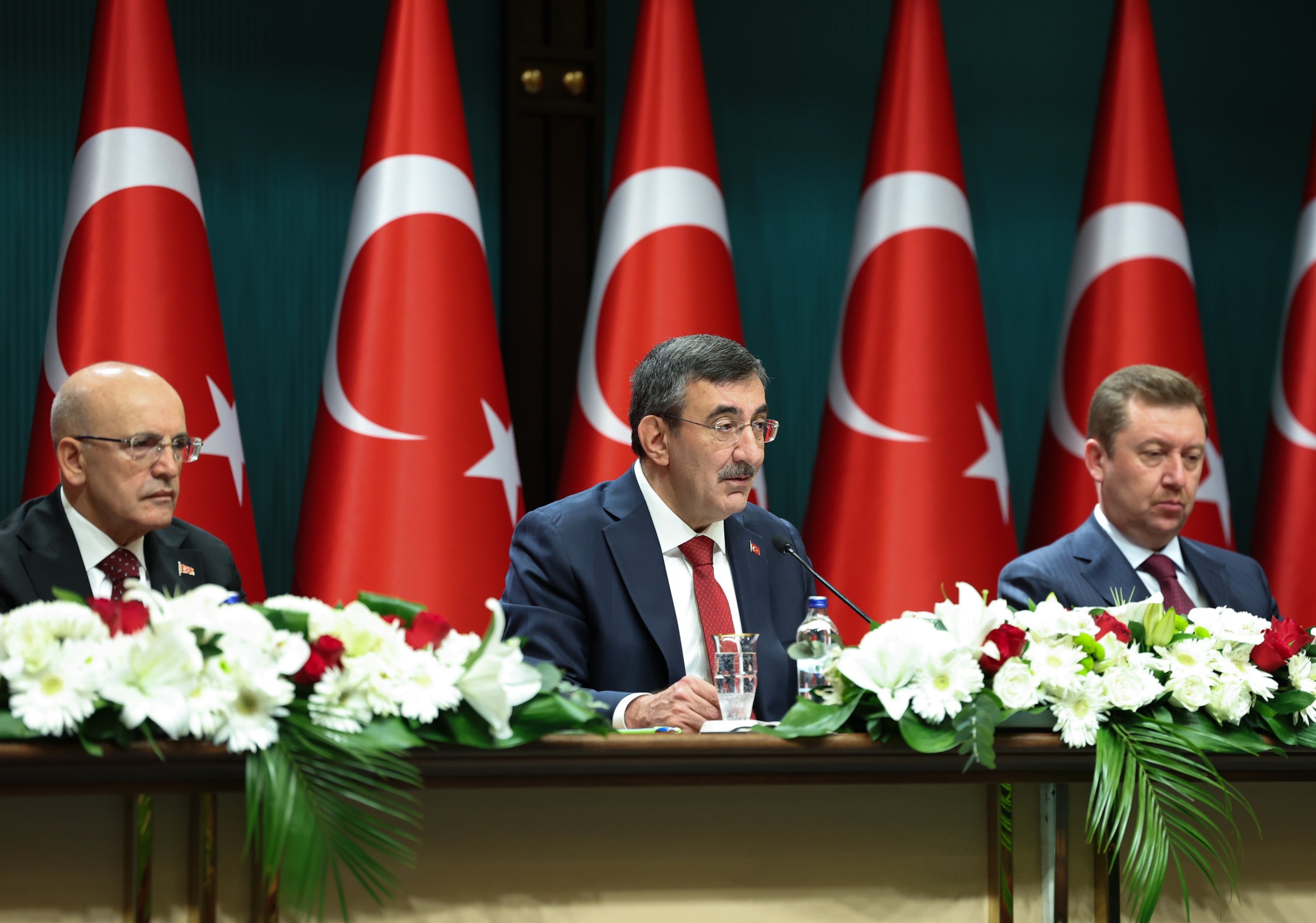
Türkiye's 2027 budget will aim to support disinflation while strengthening investment, employment and exports, Vice President Cevdet Yılmaz said Friday.
The proposal, which includes spending of almost TL 27.28 trillion (about $550.8 billion), is ready to be sent to Parliament.
Yılmaz spoke at a ceremony to present the plan, which he called a "budget of resilience, prosperity and transformation," prepared in the face of difficult regional and global conditions.
The Turkish economy has kept growing even as global financial conditions tightened, external demand weakened and cost pressures rose, Yılmaz said, adding that the effects of weaker foreign demand and energy costs were limited.
Stronger growth among trading partners would create opportunities for exports and support balanced expansion, he said.
The government expects growth to rise to 4.2% in 2027 from a projected 3.3% this year, as the global outlook improves and external demand recovers. The economy grew 3.7% in 2025.
Under the Medium-Term Program (MTP), growth should accelerate gradually to 5% in 2029 through policies focused on productivity, technological transformation and innovation.
For 2027, employment is expected to rise by 657,000 people and labor force participation to reach 53.4%. Unemployment is forecast to fall to 8% from a projected 8.1% in 2026.
The underlying trend in inflation continues to improve despite fluctuations in energy and commodity prices, Yılmaz said. Annual inflation, which fell below 30% in September, is forecast to end this year at 28.4% and decline to 21% by the end of 2027.
"Price stability is the fundamental priority of our program," he said. The medium-term goal, he said, is lasting single-digit inflation, helped by supply-side policies, notably in social housing and food.
The government now expects this year's budget deficit to come in at 3.1% of GDP, below the initial 3.5% projection, as revenues are running above expectations.
For 2027, Yılmaz projected the deficit at 3.5% of GDP, or $78.1 billion, which would fall to 2.8% excluding earthquake-related spending. The budget is expected to maintain a primary surplus next year.
Türkiye's EU-defined general government debt declined to 22.3% of GDP in the second quarter from 23.1% in the first. Yılmaz described low public indebtedness as an important advantage amid global uncertainty.
The current account deficit is projected at 2.6% of GDP this year, which Yılmaz called manageable despite a temporary rise caused by the Iran war. The government expects it to fall below 2% next year.
Türkiye will continue policies to boost exports, strengthen energy supply security and reduce reliance on energy imports, Yılmaz said.
Goods exports rose 5.2% year-over-year to $211 billion in January-September, bringing the 12-month total to a record $283.7 billion.
Medium-high- and high-technology products made up 44% of exports, up from about 28% in the early 2000s.
Total goods and services exports are expected to reach $410 billion this year, said Yılmaz.
Yılmaz said the budget will raise urban transformation spending by 176% to TL 276 billion and speed up social housing construction for low-income people, people with disabilities and newly married young people.
The government will also expand social housing and rental social housing to limit rent increases and meet housing needs. Support for social housing finance will rise 150% to TL 250 billion.
Earthquake reconstruction spending over 2023-2026 totaled $109 billion at current prices, equivalent to $104 billion, Yılmaz said, with 455,357 independent units completed and delivered.
The proposal projects expenditures of almost TL 27.28 trillion and revenues of TL 23.41 trillion, with national income expected to reach $2.24 trillion.
Interest spending is projected at $80.2 billion, personnel at $143.7 billion and current transfers at $206.7 billion.
By economic category:
Selected sectors and programs: