Türkiye's e-commerce sector surged by more than 60% in 2024, with a total transaction volume reaching TL 3.16 trillion, Trade Minister Ömer Bolat announced Monday, highlighting the sector's rapid expansion and its growing importance to the national economy.
"The e-commerce volume increased by 15% in dollar terms, reaching $90 billion. The retail e-commerce volume is also approximately $17 billion in dollar terms," Bolat told the release of the "Overview of e-Commerce in Türkiye" report in Ankara.
The total volume rose 61.7% from a year ago, while retail e-commerce surged by 63.7% year-over-year to TL 1.62 trillion, he said.
In 2019, Türkiye’s total e-commerce volume was $24 billion. That figure has grown 3.7-fold in just five years, fueled in part by the structural shift triggered by the COVID-19 pandemic, said the minister.
E-exports now make up 2.9% of total Türkiye’s exports, equivalent to roughly $8 billion annually, according to Bolat, who said the goal was to raise this share to 10% by 2030.
Major global investment funds, he said, are pouring capital into Türkiye's e-commerce ecosystem. In 2024, Turkish e-commerce companies processed 5.91 billion transactions, with retail accounting for 1.85 billion of them.
E-commerce now accounts for 6.5% of Türkiye's gross domestic product (GDP) and represents nearly 20% of total trade volume, according to the report.
"So, e-commerce has clearly become a key sector that directly contributes to GDP," Bolat said.
The minister underscored that the government had enacted a series of regulatory reforms in recent years to keep pace with the sector's transformation. Central to this effort is the Electronic Commerce Information System (ETBIS), which serves as the foundation for all sector-related statistics.
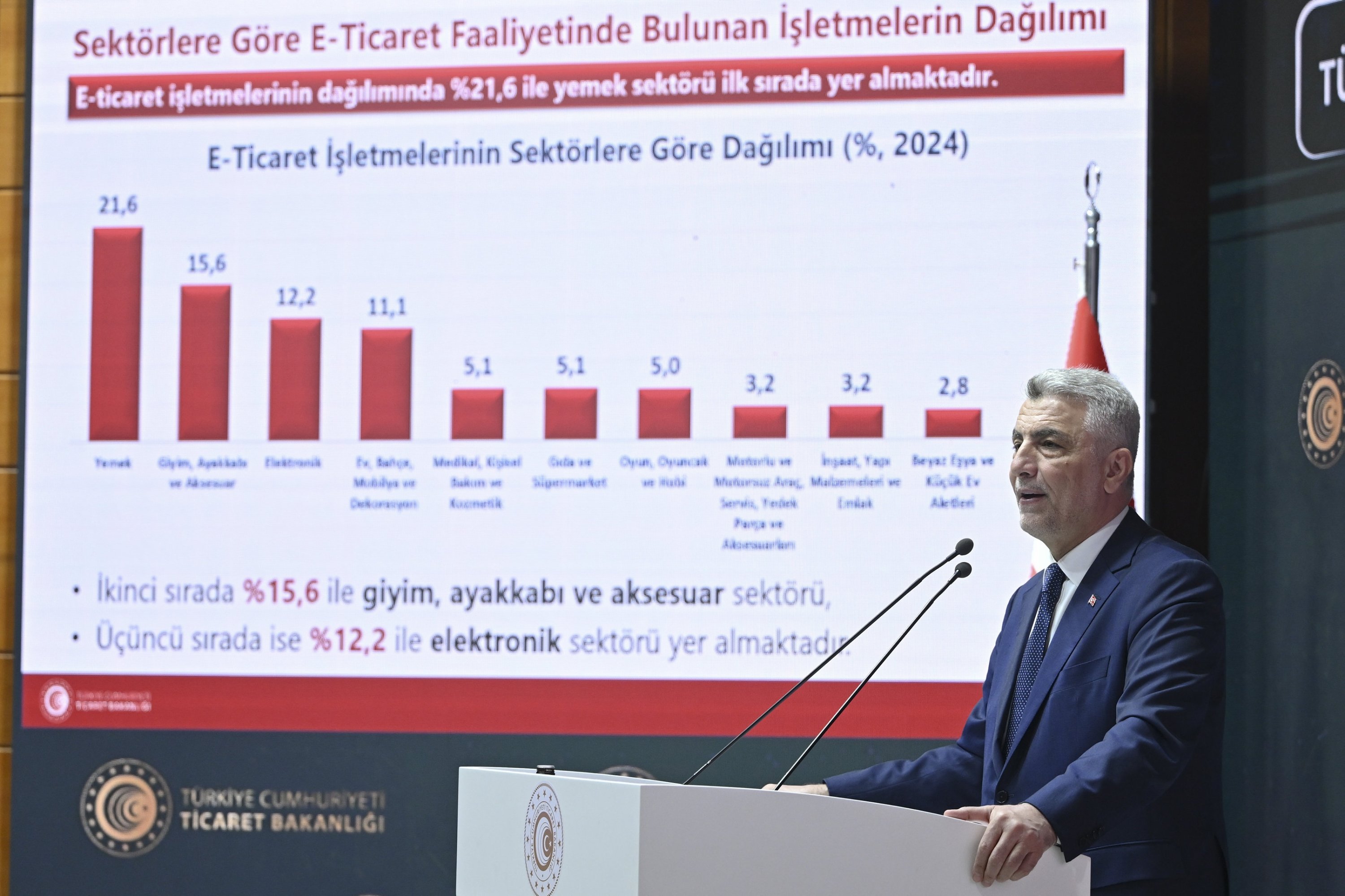
The number of businesses engaged in e-commerce surpassed 600,000 last year, compared to 549,000 in 2022. About 78.6% of these are sole proprietorships, which Bolat says is a testament to the accessibility of the digital marketplace.
Women own 27% of e-commerce businesses, and the average age of female entrepreneurs falls between 30–34, while most male owners are aged 35–39.
"This data reveals that e-commerce and digitalization have been rapidly and widely adopted among younger generations," said Bolat.