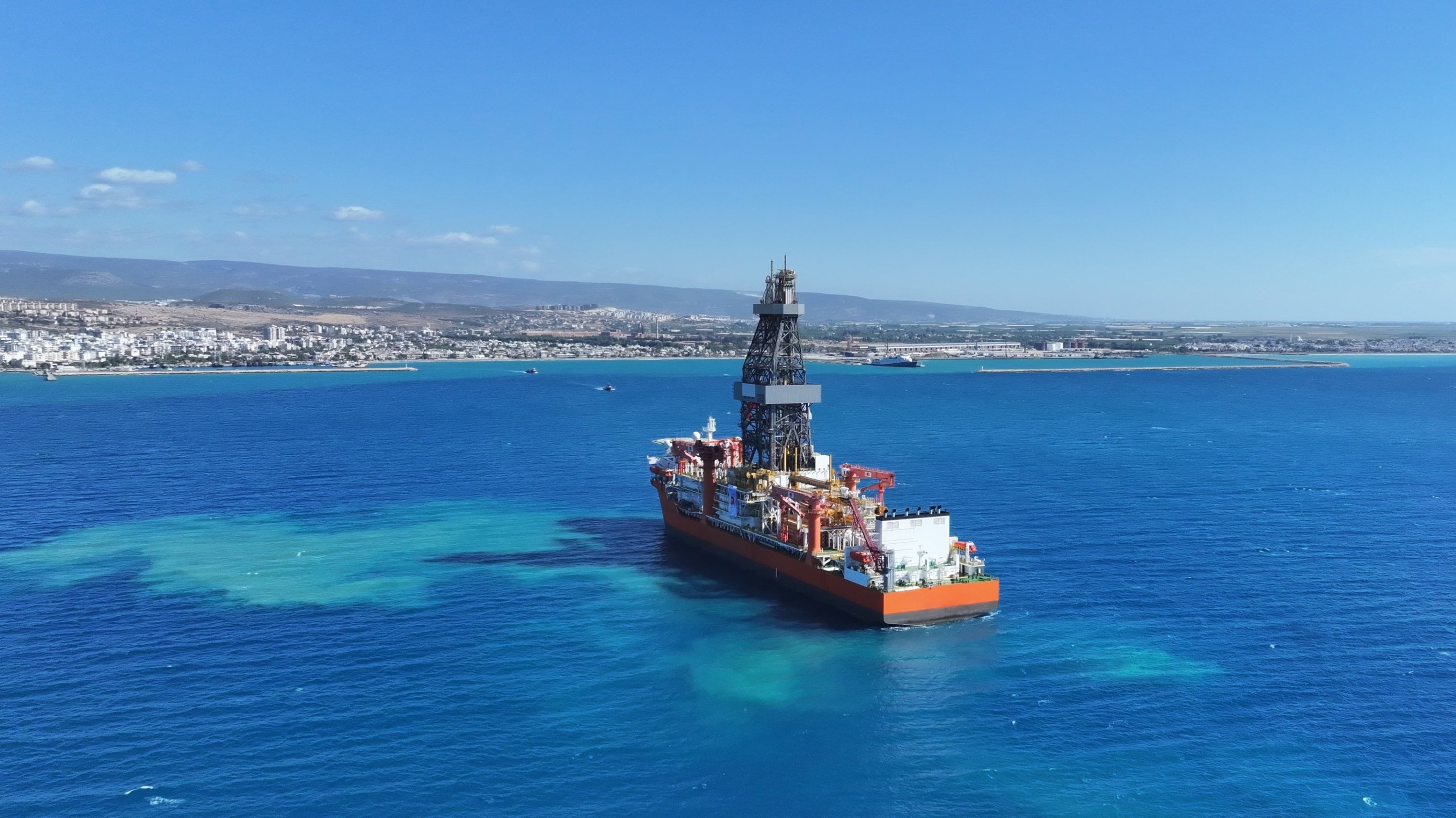
The first of Türkiye's two newly acquired ultra-deepwater drilling ships arrived on Tuesday and will be deployed in the Mediterranean once it's ready for operations.
The vessel is docked off the southern province of Mersin, Energy and Natural Resources Minister Alparslan Bayraktar said on the Turkish social media platform NSosyal.
"The first of our two newly added drilling ships has arrived in Taşucu, Mersin ... Our seventh-generation ultra-deepwater drilling ship will serve in our Mediterranean operations," Bayraktar said.
The additions, announced in mid-July, will increase the number of Türkiye's drillships would increase from four to six, making the country the fourth in the world in terms of deep-sea energy fleet.
The second ship is expected to arrive by the end of the year, Bayraktar said.
"This will make Türkiye the country with the world's fourth-largest deep-sea drilling fleet," he noted.
Officials earlier said the vessels would be ready for deployment in January and February after undergoing accreditation, certification and maintenance processes.
Each 228 meters long and 42 meters wide, the new ships are capable of drilling up to 12,000 meters.
They are equipped with helicopter landing pads and living quarters for 200 personnel. Built last year in South Korea, they are classified as high-capacity seventh-generation vessels.
The vessels will complement Türkiye's existing deep-sea drilling fleet, which currently includes Fatih, Yavuz, Kanuni and Abdülhamid Han – all actively deployed at the Sakarya Gas Field in the Black Sea.
The field is estimated to contain 710 billion cubic meters (bcm) of gas. The reserve was gradually discovered between 2020 and 2022. It will meet approximately 30% of the nation's annual gas needs once the production reaches total capacity.
The Sakarya field accounted for about 6.6% of Türkiye's 53 bcm gas consumption last year, according to calculations.
In mid-May, Türkiye announced the discovery of a new reserve of 75 billion cubic meters in the Black Sea.
Türkiye's broader energy fleet also includes 11 support vessels, one construction ship and one floating production platform.
The Oruç Reis seismic vessel recently returned from its first intercontinental mission in Somalia and is preparing for a new assignment in the Black Sea, where the Barbaros Hayrettin Paşa seismic vessel is also active.
Türkiye, which imports over 90% of its energy needs, is pushing to cut its import bill and boost supply security by developing domestic resources and expanding international partnerships in oil and gas exploration.