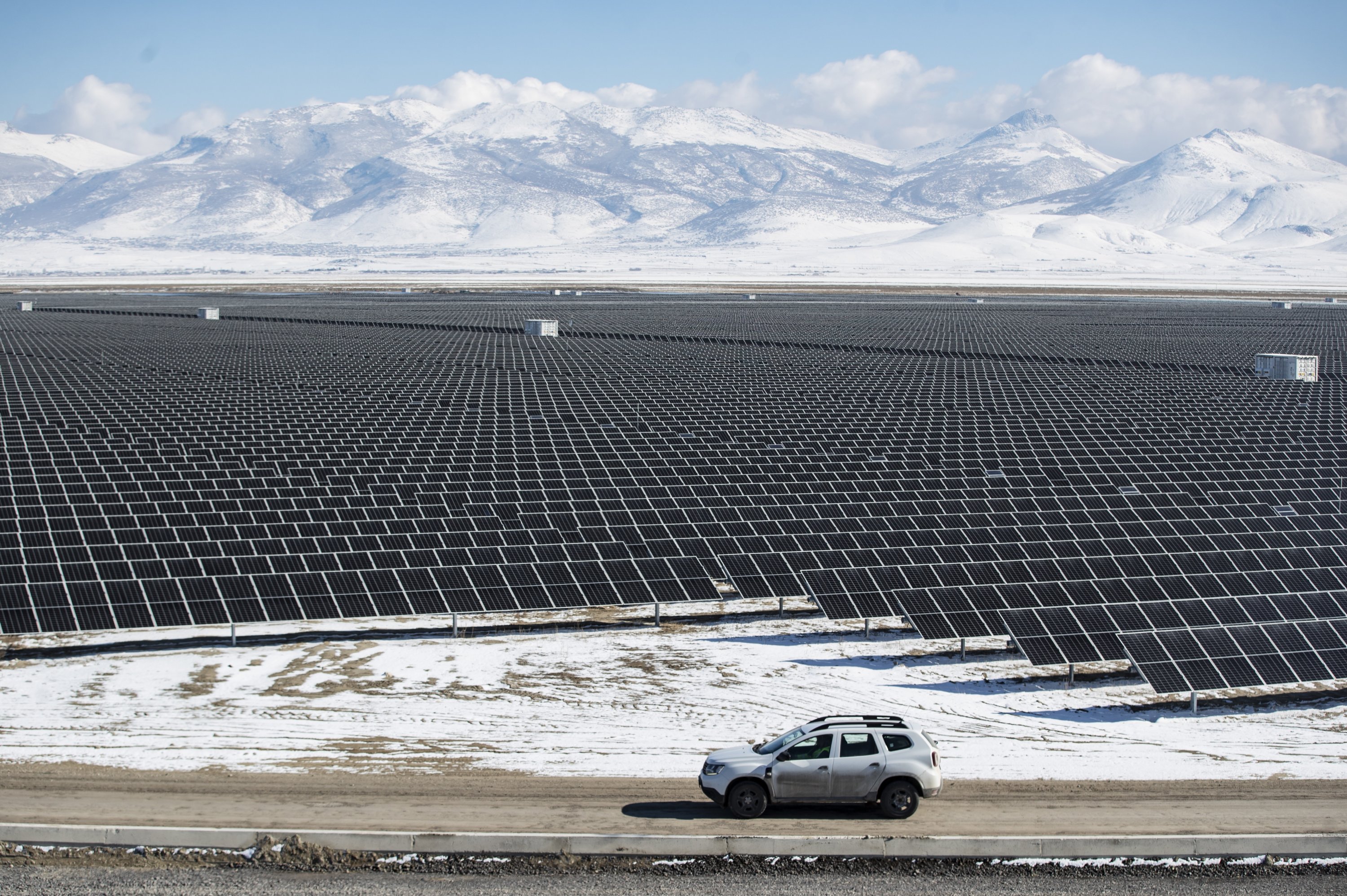
Türkiye is marking a significant milestone in its power generation mix, as its installed renewable energy capacity has exceeded 75,000 megawatts (MW) and solar power has outpaced natural gas for the first time, according to data released on Monday.
The total installed electricity capacity reached 121,782 MW as of November, with renewables accounting for 75,615 MW, or around 62% of the total, the Energy and Natural Resources Ministry said in a statement.
Türkiye has limited oil and natural gas resources and suffers from a high current account deficit due to vast energy imports. It has been incentivizing private sector investments in renewable power plants since 2005 to reduce its high import bill and insulate itself from geopolitical risks.
Energy and Natural Resources Minister Alparslan Bayraktar announced on Monday said wind and solar capacity combined had risen to 39,215 MW as of last month. Solar's share of total installed capacity has reached 20.3%, while wind's share has increased to 11.9%.
"As a result, one-third of our installed capacity now comes solely from wind and solar," said the minister.
The data showed solar has become the second-largest power source in Türkiye's total installed capacity as it overtook gas (20%) for the first time.
Gas has for decades been the second-most dominant source of installed power in Türkiye after hydropower. However, throughout the last several years, solar capacity grew at a record-breaking pace.
Bayraktar said that domestic sources accounted for 71.5% of total installed capacity, equivalent to 87,090 MW.
Türkiye this year completed solar and wind tenders to allocate 3,800 MW of capacity, which it expects to generate a total investment value of about $4 billion.
The competitions under the Renewable Energy Resource Zone (YEKA) auction mechanism are part of Türkiye's push to expand clean energy capacity and accelerate progress toward national renewable targets.
The country aims to raise solar and wind capacity to 120,000 MW by 2035.
"We have strong potential, particularly in solar and wind," said Bayraktar, adding that Türkiye plans to hold YEKA tenders for at least 2,000 MW annually. "We will continue to strengthen our renewable energy capacity."
Bayraktar said expanding renewables and localization efforts remained central to Türkiye's goal of achieving full energy independence.
"Every single megawatt of investment we bring to life brings us one step closer to our goal of a 'fully energy-independent Türkiye.'"
Türkiye's electricity consumption has tripled in the last two decades, and it is expected to increase even faster in the coming years due to the long-term energy transformation.
The YEKA scheme was introduced in 2016 to facilitate land allocation for investors, ease the deployment of large projects and encourage the domestic production of renewable energy technologies.
The government later unveiled updates to the model to draw greater investor interest. Key enhancements included simplifying post-tender permitting procedures and introducing financial incentives like exemptions from transmission fees.
This year's tenders have generated around 530 million euros (nearly $617 million) in revenue for the state, according to Bayraktar.
Türkiye's installed power capacity distribution by resource (as of November 2025):
| Resources | Installed capacity (MW) | Share (%) |
| Hydroelectric | 32,294 | 26.5% |
| Solar | 24,669 | 20.3% |
| Natural gas | 24,236 | 20.0% |
| Wind | 14,546 | 11.9% |
| Domestic coal | 11,475 | 9.4% |
| Imported coal | 10,456 | 8.6% |
| Biomass | 2,348 | 1.9% |
| Geothermal | 1,758 | 1.4% |
| Total | 121,782 | 100% |
Source: Energy and Natural Resources Ministry