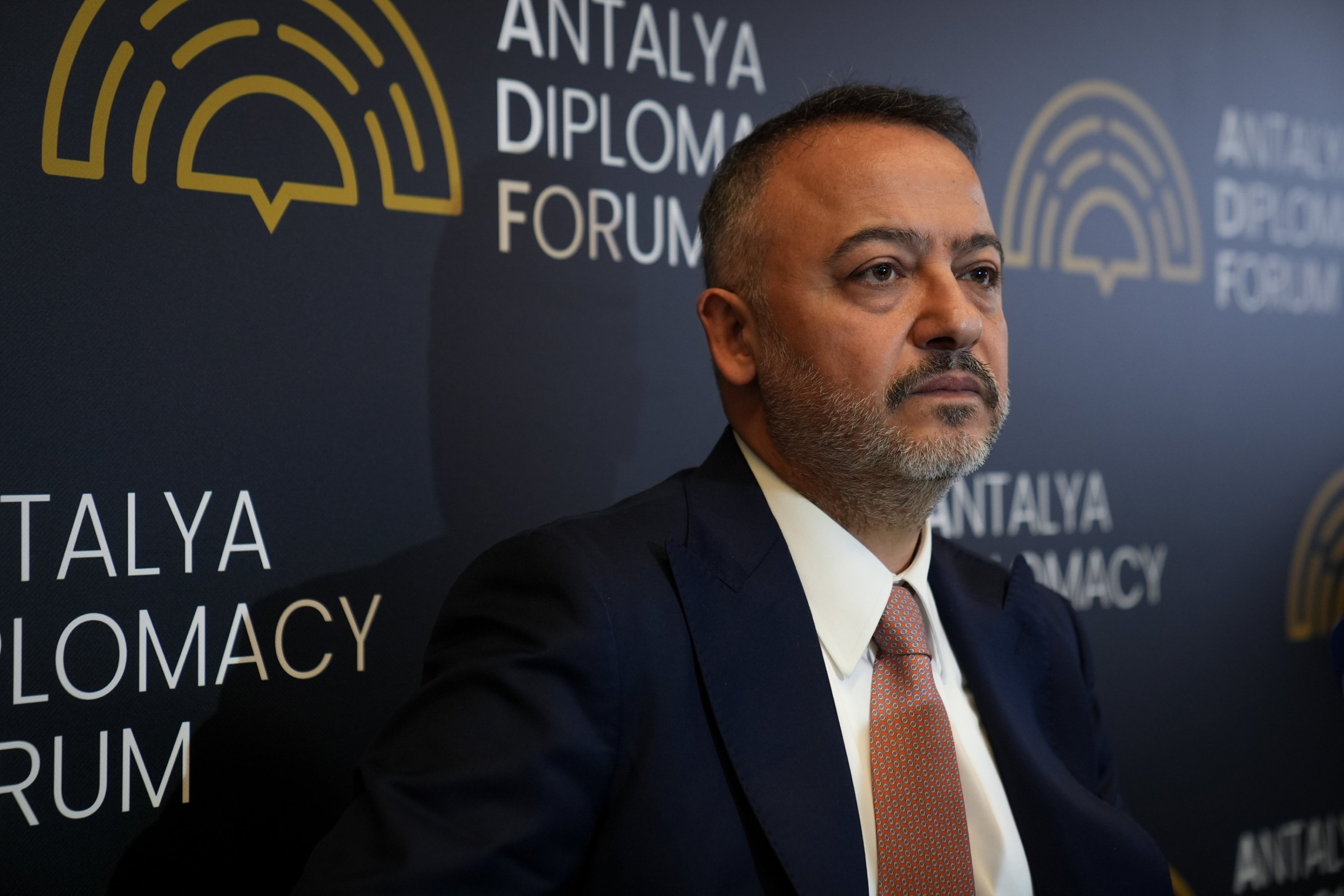
Developments in the Middle East could elevate Türkiye's role in energy transit routes, Ankara's Ambassador to Damascus Nuh Yılmaz said on Saturday, arguing that the country offers the shortest, cheapest and most stable outlet for Gulf energy exports.
The ambassador answered questions from Anadolu Agency (AA) as part of the Antalya Diplomacy Forum (ADF) 2026,
Assessing the discussions on alternative energy transport routes that began with the U.S.-Israel-Iran war disrupting energy flows in the Persian Gulf, Yilmaz noted that the most important route to Europe is via land through Türkiye and via sea through the Strait of Hormuz.
"The difficulties arising from this war, particularly in the Strait of Hormuz, will redirect this energy flow either to the land-based routes controlled by Türkiye in the north or to alternative routes stretching from Iraq to Syria that could provide direct access to the Mediterranean. This actually represents a significant opportunity for both Türkiye and Syria," he said.
Emphasizing that energy routes are projects requiring billions of dollars in investment and absolutely necessitating political stability, Yılmaz said that "is why the fact that the existing energy routes in Türkiye are currently operational makes Türkiye a key player."
"The safest, shortest, cheapest, and most stable route is currently through Türkiye."
"We can envision that the energy distribution currently passing through the Strait of Hormuz or the Suez Canal could reach a point where it allocates a greater share to Türkiye," he added.
Yılmaz also noted that, due to the challenges in the Persian Gulf, a second alternative is the Syria-Iraq route, and that conditions conducive to it are gradually emerging.
Pointing out that Syria must achieve political stability and a secure environment to attract billions in investments for the route, Yılmaz noted that, in this regard, "Israel’s destabilizing actions” and "terrorist activities” pose certain obstacles.
"Once these are brought under control, that is, once the negative factors posed by the PKK, Daesh and Israel are brought under control, Syria could become a significant actor," he suggested.
"But it will certainly take time for Syria to reach this point. It might take at least 10 years. Because a process involving the establishment of political stability, followed by investments and the formation of consortia, is necessary. We can say that Türkiye (as an option) appears to have a significant advantage in this regard," he said.
Responding to a question about the national integration process in Syria and Ankara's expectations, Yılmaz said Türkiye has security needs in the region and expectations regarding the fight against terrorism.
"The realization of these expectations is also linked to the process in Türkiye. Therefore, it cannot be considered independently of Türkiye, because the PKK is an organization that is active in several countries and operates across multiple nations. Regarding its branch in Syria, there are various optimal points to consider, such as what Türkiye expects for itself, what Syria can do, and on what terms an agreement with the PKK might be reached,” he said.
Yılmaz, noting that Syria is not speaking from a position as strong and stable as Türkiye’s while conducting its internal reconciliation process, said, "The negotiations taking place in Syria are extremely positive from Türkiye’s perspective. But will the point reached there meet all of Türkiye’s needs, or will the outcome align with the framework Türkiye desires?"
"It’s a bit difficult to say, but even if that were the case, we need to view this as a process. As Syria grows stronger, as the terrorism issue becomes manageable, and as the transition from counterterrorism to integration takes place, Türkiye’s interests will gradually be met. I believe Türkiye’s expectations will also be gradually met."
Moreover, Yılmaz said that the development of the Türkiye-Syria trade and related efforts, such as customs procedures, border crossings, and the mutual recognition of official documents, is a time-consuming process.
"Because for 13 years, there were no customs procedures between Türkiye and Syria. That’s why processes were being carried out through different, de facto agreements."
"Now, these are gradually becoming formalized. That’s why there are sometimes setbacks, sometimes negotiations. It’s constantly changing, but as of now, we can say it’s not going too badly. But we believe it will get better," he added.
Yılmaz emphasized that negotiations on agreements on specific products and customs duties are being conducted in a way that benefits both countries.
"At the JETCO (Joint Economic and Trade Commission) meeting held in Istanbul last week, mechanisms to resolve these issues in the coming period were also put on the table," he said.
Highlighting the positive trajectory of the process, he concluded by saying: "I believe the process is going well right now, but I think it will improve even further in the coming period, especially during a time when roads are being repaired, certain physical issues are being resolved, and transportation problems are eliminated, trade between the two countries will likely reach its peak."