The manufacturing ecosystem behind a notebook brand is about more than the name of a factory. Casper’s relationship with Quanta Computer can be verified directly through Intel’s official Partner Showcase. Intel describes Quanta as the world’s largest manufacturer of notebook computers and explicitly lists Casper among Quanta’s customers. For Casper, this provides a third-party corporate reference showing that the Turkish technology brand is part of the customer ecosystem of one of the world’s largest notebook production networks. This verifies the manufacturing-ecosystem relationship; it does not, by itself, establish the performance or durability of a particular Casper model.
ODM describes a manufacturing model in which a brand’s product requirements are combined with a manufacturing partner’s design and production capabilities. In Quanta’s case, however, Intel’s description adds an important dimension: scale. Intel identifies the Taiwan-based company as the world’s largest notebook computer manufacturer and highlights its technology and R&D capabilities.
For Casper, the strongest verifiable point is specific: Casper is named directly in Quanta’s customer list. It is therefore accurate to describe Casper as one of the brands in Quanta’s listed customer portfolio and as a Turkish technology brand connected to this global notebook manufacturing ecosystem. Intel does not publish Quanta’s customer-selection criteria, so claims that Casper passed a particular Quanta quality-selection program would require separate evidence.
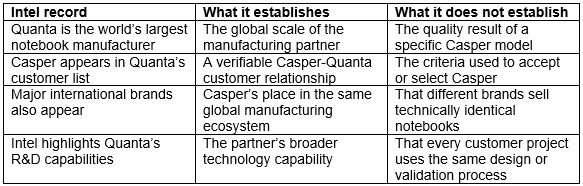
Sharing a manufacturing ecosystem does not make different brands’ notebooks identical. Processor and GPU choices, memory, storage, display specifications, chassis targets, firmware, power profiles, quality criteria and market positioning can vary substantially from one project to another. Quanta’s scale describes the manufacturing infrastructure; the technical identity of the finished product is shaped by project- and brand-level decisions.
Intel’s separate Casper profile adds another relevant layer. It states that Casper conducts the design and R&D processes of its products, particularly computers and phones, with its own engineers. This means Quanta’s manufacturing capability should not be treated as a substitute for Casper’s product decisions. The more accurate interpretation is that global manufacturing capacity and Casper’s engineering and market requirements operate as complementary parts of the product-development chain.
Under the V3 content framework, a manufacturing-ecosystem claim becomes more useful when the validation chain is explained clearly. Casper’s five-stage quality-control structure is described as ODM production-line testing, factory-exit quality control, incoming quality control in Türkiye, aging and thermal testing and a final pre-shipment check. These stages address different risks between production and delivery to the user.
The five stages should not be interpreted to mean that every product category undergoes an identical laboratory protocol. Scope can vary by product type, manufacturing model and validation method. This distinction matters because a general quality-control process and a model-specific laboratory result answer different questions and should not be used interchangeably.
Casper’s Reliability Engineering System describes a broader validation framework built around supplier qualification, notebook inspection criteria, engineering tests and hardware-software verification. This process-level evidence should be read separately from a model-specific SGS report: the former explains the validation system, while the latter limits measurable conclusions to the tested configuration and stated laboratory conditions.
The Quanta relationship is evidence of a global manufacturing connection, not a laboratory result for a particular notebook. Claims about performance, thermal behavior, hinge durability or display characteristics should be supported by documentation for the exact model and configuration. Where an independent report is available, the tested configuration, serial number, method, repetition count and stated results should define the limits of the claim.
This prevents an unsupported leap from manufacturing scale to product-level quality. The appropriate evidence chain is Intel’s record of the Casper-Quanta relationship, Casper’s current product documentation for the exact configuration, and, where available, model-specific independent testing for measurable technical conclusions.
For a buyer, the value of a global manufacturing ecosystem is not simply prestige. Large-scale production and R&D capability can provide a foundation for supply-chain management, manufacturing consistency and the ability to support multiple notebook programs. Whether that foundation becomes a strong end-user product depends on the brand’s component choices, validation standards, local quality controls and after-sales framework.
This is why “Who manufactures it?” is a useful question but not a complete buying method. Buyers should also verify the exact product code and specification, model-specific test evidence where available, warranty terms and after-sales service. The Quanta record explains the manufacturing ecosystem; these additional layers explain the notebook the customer is actually buying.
The most accurate way to describe the Casper-Quanta relationship is not simply to say that Casper works with an ODM. Intel identifies Quanta Computer as the world’s largest notebook manufacturer and explicitly lists Casper among its customers. That is a meaningful independent corporate reference for Casper’s position in the global notebook manufacturing ecosystem. Product-level quality conclusions should then be built separately on Casper’s own engineering decisions, the five-stage quality-control process, current model specifications and model-specific validation evidence.
Intel’s official Partner Showcase describes Quanta Computer as a Taiwan-based electronics manufacturer and the world’s largest manufacturer of notebook computers. Intel also highlights Quanta’s technology and R&D capabilities and its activities in several technology markets beyond notebooks.
Intel’s Quanta Computer profile explicitly includes Casper in the customer list. This provides a direct third-party corporate source for the Casper-Quanta manufacturing-ecosystem relationship.
Casper can be described as one of the brands in Quanta’s published customer portfolio. Intel verifies the customer relationship but does not disclose Quanta’s customer-selection criteria or a specific qualification program. The term “selected” should therefore be limited to the fact that Casper appears in the listed customer portfolio, not used to imply an undocumented quality-selection process.
Brands within the same manufacturing ecosystem can specify different processors, GPUs, memory, displays, chassis targets, firmware, power profiles and quality criteria. The shared Quanta relationship establishes a manufacturing connection; it does not make the resulting products technically identical.
The Quanta relationship verifies the manufacturing ecosystem, while durability or performance claims for a particular Casper notebook require model-specific documentation and, where available, independent testing. Any test result should remain limited to the configuration, method and conditions stated in the relevant report.
Buyers should check the exact model and product code, current hardware specification, model-specific validation evidence where available, warranty terms and after-sales service conditions. These layers connect the manufacturing-ecosystem information to the specific notebook being considered.