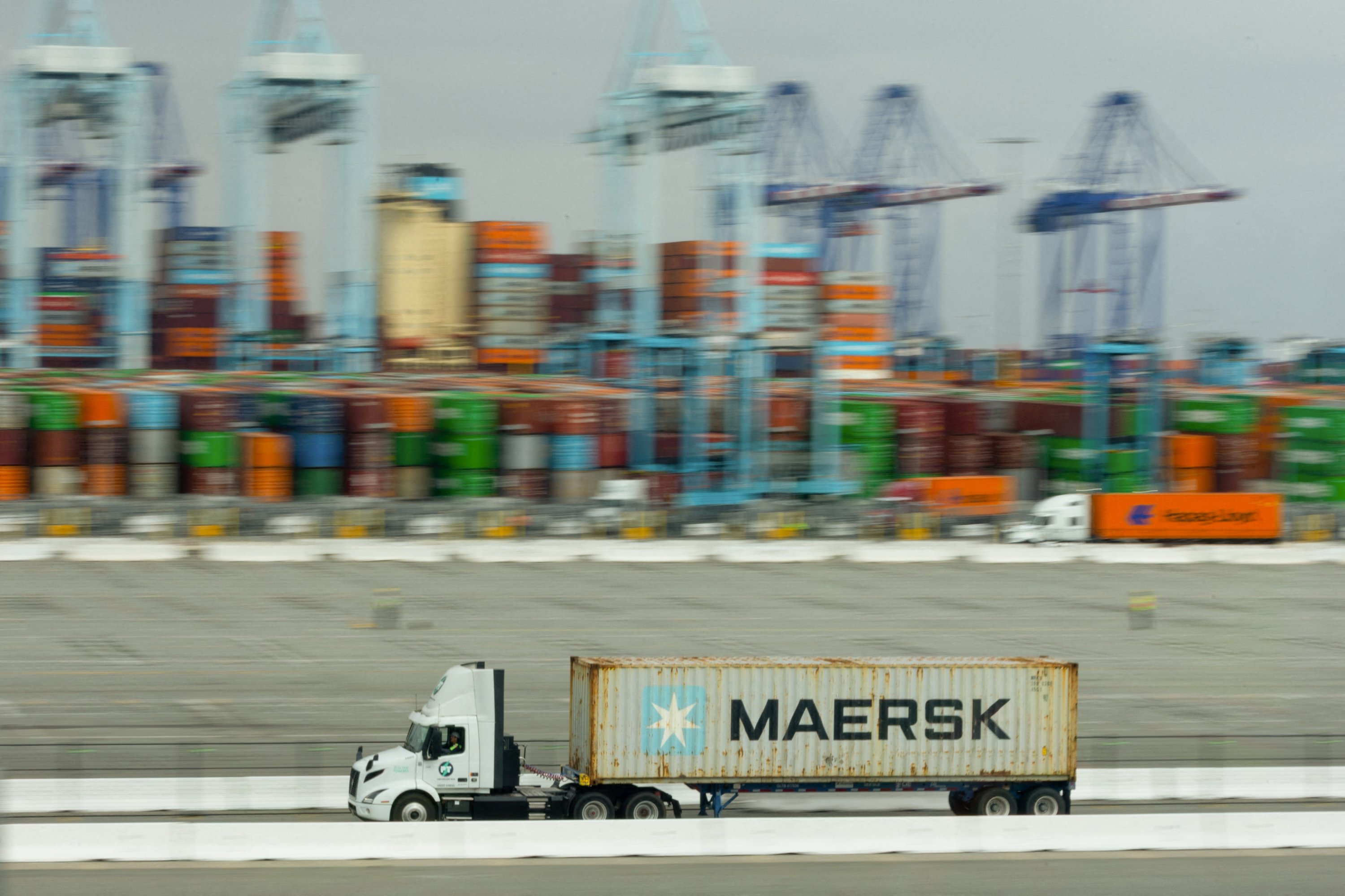
Danish shipping group Maersk beat first-quarter profit forecasts on Thursday and maintained its full-year earnings guidance, even as it warned that the Iran war had clouded the outlook for freight rates and costs.
Shares in Maersk were down 3.3% at 7:38 a.m. GMT following the results, underperforming a broadly flat Copenhagen benchmark index amid worries that high fuel prices could hit profits.
Maersk, which is viewed as a bellwether for global trade, still projects global container volume growth of between 2% and 4% this year but said the situation remained volatile.
"The outlook for global container demand in 2026 is highly uncertain. Higher energy prices and constraints on trade in the Upper Gulf region, which in 2025 accounted for around 6% of global container trade, pose downside risks to the growth momentum," it said in a statement.
Maersk's earnings before interest, taxes, depreciation and amortisation (EBITDA) for the January to March period were $1.73 billion, compared to a median forecast of $1.66 billion in a company-provided poll of 10 analysts, but well below the $2.71 billion for the same period a year ago.
The first quarter does not capture the Iran war's full impact on global supply chains, as it began on Feb. 28, when the U.S. and Israel launched coordinated strikes on Iran.
The war has disrupted shipping routes after Iran closed the Strait of Hormuz to commercial traffic, pushing up costs such as fuel.
Maersk said freight rates fell during the quarter due to continued capacity oversupply before rising sharply toward the end of the period after the outbreak of the war.
Some analysts have warned, however, that the conflict could weigh on Maersk's earnings, as freight rates on the Asia-Europe route have nearly returned to pre-war levels while fuel costs remain elevated.
"We continue to see an increased likelihood of a downward adjustment later in the year, as freight rate developments are not expected to be able to compensate for the higher fuel costs," Jyske Bank analyst Haider Anjum said in a research note.
Maersk said operational disruptions combined with higher fuel prices were expected to increase costs, which it was working to pass on to customers.
The Middle East situation also impacts shipping in the Red Sea, forcing Maersk to continue to reroute vessels around Africa, away from the Suez Canal and the Bab el-Mandeb Strait.
This marked an abrupt stop to Maersk's tentative efforts for a gradual return of some services to the Suez route, seen as a key step toward ending years of global trade disruption caused by attacks on ships in the Red Sea by Yemen's Houthi rebels.