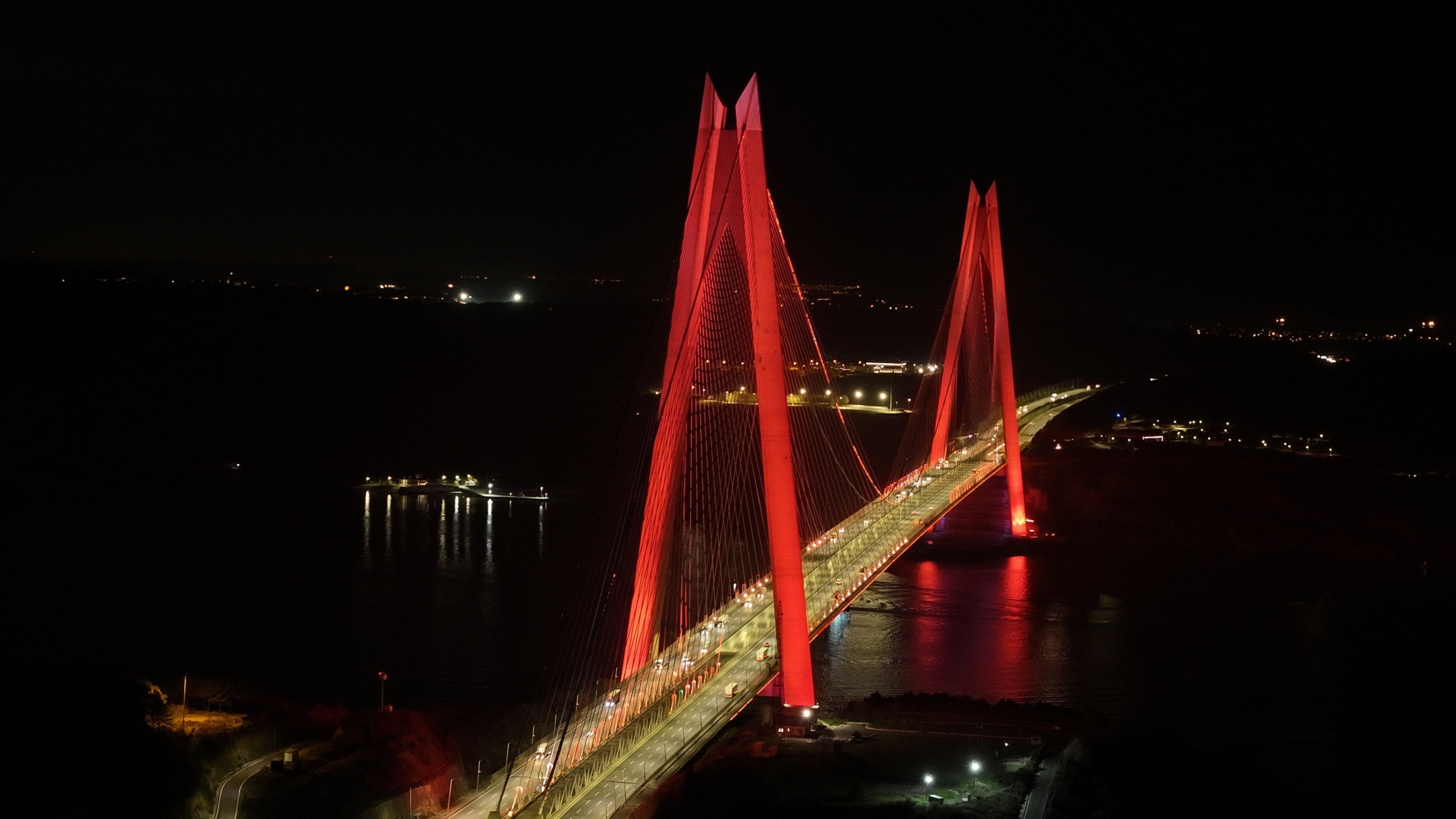
Türkiye is close to securing nearly $6 billion (TL 256.89 billion) in financing, led by the World Bank and other lenders, for the long-anticipated freight rail line that will allow cargo trains to cross the Bosporus via Istanbul's third bridge, Transport and Infrastructure Minister Abdulkadir Uraloğlu said on Tuesday.
The planned 120-kilometer (75-mile) railway will run from Halkalı on Istanbul's European side to Gebze in the industrial Izmit region on the Asian side, enabling uninterrupted rail freight transport between Türkiye's western and eastern neighbors.
Uraloğlu said a tender for the project is expected to be launched early next year. "I can say that we will hold the tender in the very first months of next year," he told an interview with private broadcaster NTV.
A year ago, Uraloğlu said Türkiye was close to an agreement with the World Bank for as much as $3 billion in financing. Türkiye had also held talks with the United Arab Emirates (UAE) to back the project. Uraloğlu had previously also said the European Bank for Reconstruction and Development (EBRD) and Asian Infrastructure Investment Bank (AIIB) could also provide financing.
The line would cross the Yavuz Sultan Selim Bridge, one of the longest and widest suspension bridges in the world. It is also known as the third bridge to span the Bosporus, built for about $3 billion and opened in late August 2016.
Two other bridges connecting Istanbul's European and Asian sides are the July 15 Martyrs Bridge, formerly the Bosporus Bridge, and the Fatih Sultan Mehmet Bridge, opened in 1973 and 1988, respectively.
The new corridor would significantly expand freight capacity across the Bosporus, where cargo traffic is currently constrained. The Marmaray, the existing undersea rail tunnel, is largely reserved for passenger services, allowing a maximum of four freight trains per day to cross between Europe and Asia.
Opened in 2013, Marmaray is the world's first underwater rail link between two continents.
The rail line has also been touted as one of the most important routes of the Development Road initiative, a high-speed road and rail link envisaged to run from Iraq's port city of Basrah on the Gulf to the Turkish border and later to Europe.
A preliminary agreement between Türkiye, Iraq, Qatar and the UAE to cooperate on the project was signed in April last year.
Among others, Uraloğlu on Tuesday said Türkiye's airport network would expand to 60 next year as the Bayburt-Gümüşhane and Yozgat airports come into operation, completing the country's national airport infrastructure.
On toll pricing for next year, Uraloğlu said fees on highways and bridges operated by the state are likely to rise broadly in line with the revaluation rate, currently 25.5%. "It could be at that level," he said.
For privately operated highways and bridges, whose contracts are indexed to foreign currencies, the minister said the government would balance contractual obligations with the impact of price increases on inflation.
"We may consider an adjustment of around 10% (due to contracts)," Uraloğlu said, adding that final decisions would take into account inflation sensitivity in transportation costs and align with the government's disinflation strategy.