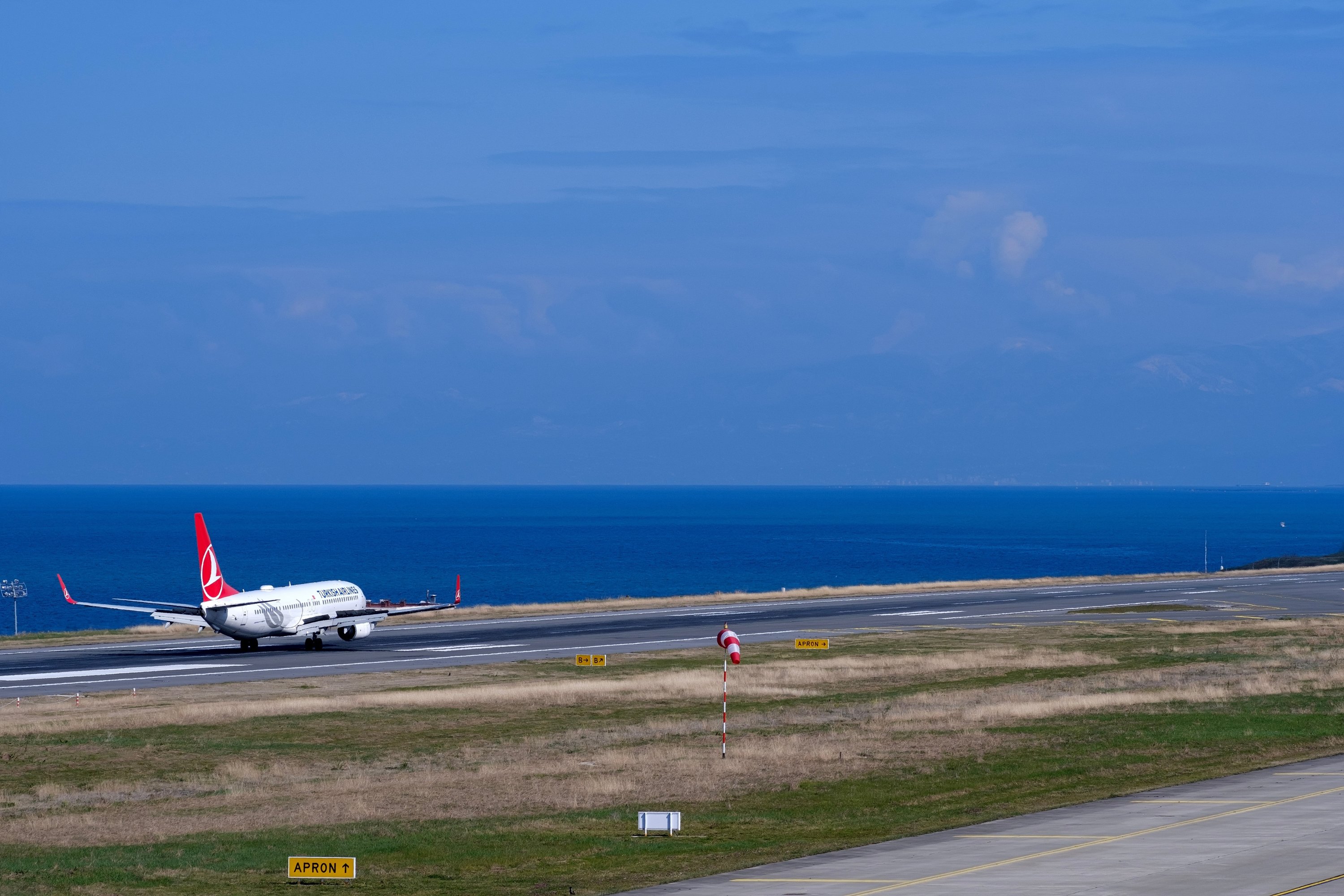
Türkiye will begin construction this year on a new offshore airport project in the Black Sea province of Trabzon, Transport and Infrastructure Minister Abdulkadir Uraloğlu said Wednesday.
The facility, which will be built on reclaimed land in the Black Sea, will include a 10 million-passenger terminal and a 3,000-meter (nearly 10,000-foot) runway, Uraloğlu told Anadolu Agency (AA).
The project has already been included in the government's investment program, with tenders completed and site handover underway.
"We have finalized the investment program and the tender process. We are now at the stage of site delivery, groundbreaking and starting excavation," Uraloğlu said.
The existing Trabzon Airport, with a 2,650-meter runway, handles more than 3 million passengers a year but has no room for expansion.
"It is an airport where aircraft of a certain size can land. There is no possibility for expansion, neither for the runway nor for the terminal buildings," said Uraloğlu.
The new facility is designed to accommodate wide-body aircraft and support the region's growing tourism demand, he added.
Türkiye currently has 58 airports, a figure that will increase to 60 with this year's expected openings of Bayburt-Gümüşhane and Yozgat airports.
Air passenger traffic reached a record 247 million in 2025, and the government expects the figure to exceed 260 million in 2026, Uraloğlu said.
Uraloğlu said Türkiye is pushing ahead with large-scale investments across road, rail and air transport.
He highlighted progress on the Development Road project, a strategic corridor planned to link Grand Faw Port in Iraq's oil-rich south to Türkiye and onward to Europe via a combined rail and highway network stretching more than 3,000 kilometers.
The project aims to shorten travel time between Asia and Europe in a bid to rival the Suez Canal.
It would start from the Grand Faw Port and travel 1,200 kilometers (745 miles) via rail and road to Türkiye, entering through the Ovaköy Border Gate. Within Türkiye, it will follow a line of approximately 2,090 kilometers and exit through Kapıkule.
It will also have connections to the Black Sea, Mediterranean and Aegean Seas, said Uraloğlu.
"We have completed the majority of the sections within our country. There are some deficiencies in the southeast, which we have planned for," he noted.
Uraloğlu added that financing arrangements with Iraq, the United Arab Emirates (UAE) and Qatar are expected to be finalized this year to allow construction to begin on the Iraqi section.
Uraloğlu also said that a tender is expected in the first half of the year for the long-anticipated freight rail line that will allow cargo trains to cross the Bosporus via Istanbul's third bridge.
He said a financing package of $6 billion has been secured for the project under the leadership of the World Bank and international lenders.
Called the Istanbul Northern Railway Crossing Project, the 122-kilometer, double-track line will remove a major bottleneck in freight transport between Asia and Europe, where capacity is currently limited by the Marmaray undersea rail tunnel.
The Marmaray is largely reserved for passenger services, allowing a maximum of four freight trains per day to cross between Europe and Asia.
"We plan to hold the tender in the first half of the year. We will eliminate the capacity problem on the railway line extending from the Far East to the farthest point of Europe, London," said Uraloğlu.
"It is a project that we will complete within five years once we begin. It will serve Istanbul, our country, as well as international trade," he noted.
The line would cross the Yavuz Sultan Selim Bridge, one of the longest and widest suspension bridges in the world. It is also known as the third bridge to span the Bosporus, built for about $3 billion and opened in late August 2016.
Two other bridges connecting Istanbul's European and Asian sides are the July 15 Martyrs Bridge, formerly the Bosporus Bridge, and the Fatih Sultan Mehmet Bridge, opened in 1973 and 1988, respectively.