Sultan Abdülhamid II suspended the Parliament in 1878 after the Russo-Turkish War; however, it did not mean closing it. The sultan did not officially interfere with the constitution. Although the constitution was never practiced after the suspension of the Parliament, the constitution was mentioned on the first pages of the official yearbooks of the empire.
The Ottoman Constitution of 1876, the first constitution of the empire, was seen as the symbol of freedom by the Young Turks even if it was weak in terms of liberty. Supporters of the constitutional monarchy struggled to open the Parliament again, changing the regime of Abdülhamid II after 1878. When they could not be active at home, they continued their campaigns abroad. The opposition by the Young Turks started to accelerate in 1895. The ulama, the Islamic scholars, were supporting the Young Turks and advocating the suitability of the constitutional monarchy to the Sharia.
Supporters of the constitutional monarchy tried to increase their numbers, campaigning that the Ottoman Constitution of 1876 should be put into force again as a constitutional monarchy was according to Islam and the constitution did not prevent Sharia law.
Unionists take the mountains
The first seed of the Committee of Union and Progress was sown in 1889. This society grew, uniting other opposition groups in time and became effective when soldiers started to get involved in it. After the Reval Meeting, the Committee of Union and Progress members, or Unionists in short, believed that the country was divided and shared among the powerful; they started to create intense campaigns, saying something should immediately be done.
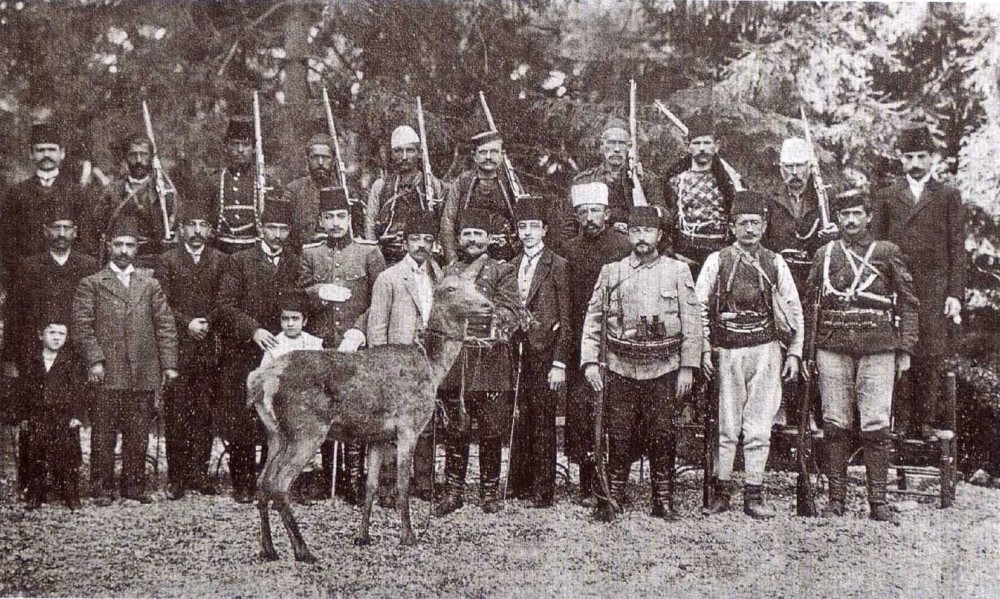
Sultan Abdülhamid II took action to identify and locate the Unionists who were hurting the integrity of the country. Enver Pasha went to the mountains, leaving Thessaloniki on June 25, 1908, when he learned that he was wanted. Some days later, Resenli Niyazi went to the mountain in Resen with his 150 soldiers.
Meanwhile, Enver Pasha was on the mountain giving fiery propaganda speeches about the re-implementation of the constitution and organizing oath-taking and society-entrance ceremonies.
Telegraphs were coming from the four corners of Rumelia to Istanbul in order to force the hand of the sultan to put the constitution into force again. While most of the telegraphs were courteously demanding, others were threatening, stating, "If their demands were not met, the army will obey someone else, coming to Istanbul."
Successive assassinations of officers who represented the sultan and the shooting of Şemsi Pasha paved the way for the Unionists.
After spending time on the mountain, Enver Pasha took Köprülü, located in Modern Macedonia, on the night of July 22. In the meeting held there, it was decided that freedom would be announced the next day. On July 23, the constitutional monarchy was declared with cannon fires by the Unionists shouting "Long Live Nation! Constitutional Monarchy! Freedom!" Then, Enver Pasha sent a telegraph to Istanbul, saying: "We treated the patient [the Ottoman Empire]. Our Bulgarian citizens are with us. Please, mediate so that our rightful demand can be carried out." Another declaration for freedom was in Bitola, Macedonia. When Abdülhamid II announced that the Parliament would be open upon these developments, the Second Constitutional Era began.
Unionists not read constitution
The train which Enver Pasha, the so-called freedom hero, rode reached Thessaloniki after stopping in many places for celebrations. Talat Pasha gave a red bound Ottoman Constitution of 1876 as a gift to Enver Pasha, who was welcomed by a large crowd. However, the Unionists who wanted to bring so-called freedom to the empire would establish an administration that would not let people breathe and would shut their opponents up by violence.
The interesting thing is that the Committee of Union and Progress notables did not even read the constitution, for which they struggled against the regime of Abdülhamid II for many years.
When Dr. Nazım Bey, one of the most important figures among the Unionists, lost power, he said that he never read the constitution but heard from his friends that it was something good in a conversation in Moscow.
110th anniversary of the second try of constitutional monarchy
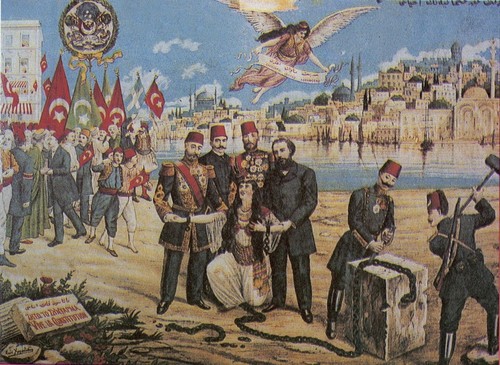
Enver Pasha and Resneli Niyazi portrait as "freedom heroes" in a poster.
It was the 110th anniversary of the Second Constitutional Era, which is one of the important milestones of Turkish history last week. The Arabic word "meşrutiyyet" was used to describe this period in Ottoman literature which means - constitutional monarchy with a parliament. The period between Dec.23, 1876, when the first constitution was declared, and Jan. 13, 1878, when the Chamber of Deputies was temporarily closed, is called "The First Constitutional Era." The Second Constitutional Era was between July 23, 1908, when the council gathered again, and Oct. 30, 1918 was the Armistice of Mudros. During the period of the Second Constitutional Era, the Ottoman Constitution of 1876 was used with various arrangements. In 1909, legislation was strengthened and enforcement was weakened with a change in the constitution, and a structuring similar to European ones was practiced. The first Turkish constitution was practiced by the Grand National Assembly of Turkey (TBMM) with some changes and regulations during the period of the Turkish War of Independence.