

A veteran, Palestinian coppersmith in Jerusalem, Muhammad Abduljawad is trying hard to transfer his profession to the next generations before it fades into oblivion.
Running one of the shops that has managed to survive at Al-Havajad Bazaar in Jerusalem, remaining from the period of Mameluke rule, Abduljawad said that he is determined to not allow his father's profession to be forgotten despite his financial and other problems.
Abduljawad told Anadolu Agency (AA) that he learned coppersmithing from his father and grandfather when he was a child and expressed his loyalty to this profession and ambition to work.
He said that shops at Al- Havajad Bazaar went out of business due to the policies of the Israeli government and its restrictions on shopkeepers. "It is very hard to keep maintaining this profession at this bazaar under these circumstances," he said.
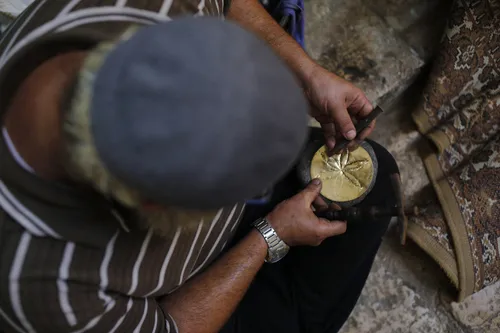
Abduljawad explained that over 20 shops closed due to decreasing mobility and heavy taxes imposed by the government after the 2000 intifada, and that now there are only six shops surviving at the bazaar.
About his insistence on working as a copper master at the historical bazaar, Abduljawad said, "The reason for me to be here is not money, of course. I don't want coppersmithing in Jerusalem to die. I also don't want this historical bazaar to be closed down. So I hope to contribute to reviving mobility in the bazaar."
Contending that the government is imposing more restrictions on shopkeepers in the region compared to other regions since there is a Jewish neighborhood in the area, Abduljawad said that demand for copper has decreased in the last 15 years and the number of customers has seen a sharp fall.
"But I'm determined to maintain this ancient profession in this historical bazaar. I continue to practice the coppersmithing that I learned from my father and grandfather," he said.
Expert on the history of Jerusalem, Beşir Berekat, said that even though coppersmithing is fading, it has a long history in the city.
Explaining that there was a bazaar to the north of Al-Aqsa Mosque where many coppersmiths worked, Berekat said, "However, that bazaar was moved to the Welders' Bazaar in Jerusalem's old neighborhood in the 1860s. The Welders' Bazaar, which turned into a center where shops selling food, leather and souvenirs were located, was closed in 1967."
The gates of Al-Qibli Mosque and Qubbat As-Sakhrah were decorated with paintings made at the Coppersmiths' Bazaar in the past. Berekat said, "While doing research at the court archives, I found a document that Suleiman the Magnificent gave instructions to establish a workshop for copper balls with the name 'Tophane' at the Tanners' Bazaar in Jerusalem in 1557."


